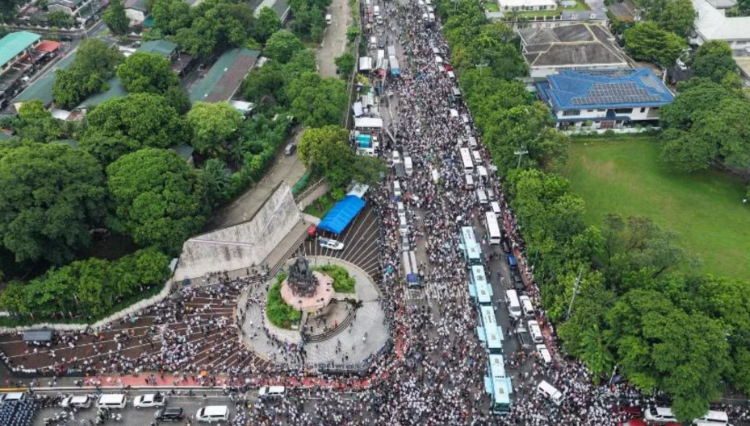
The Iglesia Ni Cristo, one of the Philippines' most influential religious organizations, demonstrated its considerable political reach on Tuesday when thousands of its members converged on Manila's EDSA thoroughfare to protest imminent criminal charges against Senator Rodante Marcoleta. The show of force came at a politically sensitive moment, with the church member and avowed Duterte loyalist facing graft accusations tied to his election campaign finances, whilst Vice President Sara Duterte's Senate impeachment trial is set to commence within days.
Authorities documented at least 8,000 protestors during the morning commute, with police expecting the crowd to swell as the day progressed. The demonstration transformed one of Manila's busiest arteries into a paralyzed corridor, with only dedicated bus lanes remaining passable whilst thousands of workers and students struggled to navigate to their destinations. The scale of disruption underscored the church's capacity to mobilize its substantial membership base on short notice, a capability that has made it a sought-after political ally throughout the Philippines' recent history.
The Ombudsman's office announced on Monday that Marcoleta would face charges stemming from his failure to disclose 75 million pesos—roughly USD 1.2 million—in unused funds from his election campaign. Prosecutors allege that the senator either deliberately concealed the money or maintained inadequate financial records, violations that carry serious implications under Philippine electoral law. The timing of the charge announcement, mere hours before the massive INC rally, suggested the church had been closely monitoring developments and moved swiftly to galvanize its membership in response to what it characterized as an injustice.
INC spokesman Edwil Zabala framed the protest through the lens of systemic inequality, arguing that the charges represented selective prosecution rather than impartial justice. In a video statement posted to the church's social media channels, Zabala declared that the organization would not acquiesce to what it perceived as discriminatory enforcement, emphasizing that the church would continue demanding accountability for those it believed to be unfairly targeted. The rhetorical strategy reflected a broader narrative the Iglesia Ni Cristo has deployed in recent years, positioning itself as a defender of its members against what it portrays as politically motivated persecution.
Marcoleta's predicament must be understood within the wider context of deteriorating relationships among the Philippines' political elite. Vice President Duterte, once a close ally of President Ferdinand Marcos, has undergone a dramatic and public falling out with the sitting president, precipitating her impeachment by the House of Representatives last month. The INC's decision to mobilize on Marcoleta's behalf carries implications extending well beyond one senator's legal troubles, effectively signaling the church's continued alignment with the Duterte faction even as that faction faces mounting institutional pressure.
The Duterte camp has experienced a cascade of legal challenges and political setbacks in recent months. Senator Jose Estrada, another Duterte loyalist, faced charges last month connected to an sprawling corruption scheme involving bogus flood control projects that have become a symbol of institutional decay in Philippine governance. Meanwhile, Senator Ronald Dela Rosa, a prominent architect of the former president's controversial drug war, has effectively disappeared from public view to evade arrest on an International Criminal Court warrant. These cumulative pressures on Duterte's political network have increased the significance of maintaining reliable Senate votes during what amounts to a crucial political moment.
Duterte's impeachment trial commences on July 6, requiring a two-thirds supermajority—16 votes from the 24-seat Senate—to result in her removal as vice president and permanent disqualification from elected office. Marcoleta is widely regarded as a near-certain vote against conviction, making his continued presence in the chamber potentially decisive for the Vice President's fate. The INC rally thus operated simultaneously on two registers: a direct appeal against what the church views as the wrongful prosecution of one of its members, and a broader show of force designed to reinforce the political cost of moving against Duterte's remaining supporters in the legislative chamber.
The INC's political mobilization has expanded beyond defending individual members. In November, the church organized a rally drawing hundreds of thousands of participants to protest the flood control scandal, effectively channeling popular anger over corruption into a demonstration that many observers noted benefited the Duterte narrative by emphasizing failures attributed to the current Marcos administration. That January's massive INC rally opposed Duterte's initial impeachment before it was reversed by the Supreme Court further illustrated the church's willingness to deploy its membership in defense of the Duterte political project.
President Marcos responded to the Manila traffic crisis by canceling a planned luncheon with foreign press, a decision that reflected both the immediate disruption caused by the rally and the broader anxieties surrounding the upcoming impeachment trial. The canceled engagement suggested the administration's concerns about the political coordination being demonstrated by the Duterte faction and its organizational allies, even as the government maintains its formal commitment to prosecuting what it characterizes as legitimate criminal investigations.
The convergence of these developments reveals fundamental tensions within Philippine governance regarding the balance between accountability and political loyalty. The INC's mobilization raises questions about whether criminal investigations can proceed without regard to a defendant's political connections and organizational affiliations, whilst also demonstrating how religious institutions with significant membership can function as political actors with the capacity to disrupt normal civic functioning. For Southeast Asian observers, the episode illustrates how religious organizations in the region can transcend their spiritual missions to become integral components of political power struggles, with implications for institutional independence and the rule of law.

