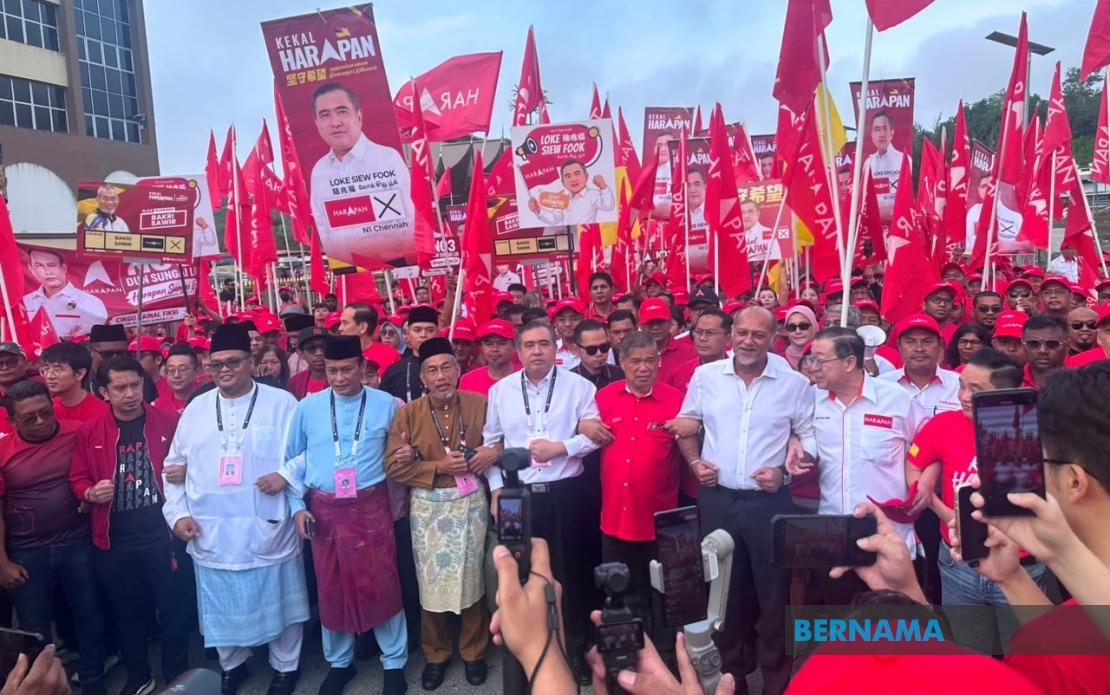
The upper echelons of Pakatan Harapan made a coordinated show of strength across Negeri Sembilan on July 18, mobilising to support the coalition's slate of candidates as they registered for the 16th state election. The deliberate deployment of ministerial firepower across multiple nomination centres signalled both confidence and determination to maintain PH's position in a state where the coalition currently holds 17 of 36 legislative seats. This strategic visibility on nomination day reflects a broader pattern among Malaysian political coalitions of signalling internal cohesion and organisational readiness to voters at the earliest stages of an electoral campaign.
In Jelebu, Transport Minister Anthony Loke, who doubles as DAP secretary-general, filed nomination papers for the Chennah state seat under the watchful presence of fellow DAP luminaries including party chairman Gobind Singh Deo and adviser Lim Guan Eng, alongside Amanah president Datuk Seri Mohamad Sabu. The convergence of three component parties' senior figures at a single nomination venue represented more than ceremonial theatre. For DAP and Amanah, their combined appearance functioned as a visual reaffirmation of the partnership's durability, particularly significant given historical tensions between these parties during previous state and federal configurations. Loke's participation as a national minister elevated the local contest into a federal-state nexus, suggesting that Pakatan Harapan's central leadership views the Negeri Sembilan outcome as consequential beyond merely maintaining state-level representation.
Parallel mobilisation occurred across the Jempol district, where Deputy Communications Minister and Wanita DAP chief Teo Nie Ching accompanied fellow candidate Teo Kok Seong in filing for the Bahau seat. The presence of Communications Minister Datuk Seri Fahmi Fadzil at the same nomination centre, who supervised four PH candidates across Serting, Palong, Jeram Padang and Bahau, illustrated how PH distributed its ministerial resources strategically. Teo Kok Seong brings incumbency credentials from the 14th General Election, providing continuity, whilst the three other nominees—Yaacob Mahmood, Muhammad Zahin Zinal Abidin and Manivanan Gowin—represent PH's effort to field fresh faces in constituencies without entrenched local representation. This generational mixing within candidate selection reflects a deliberate approach to simultaneously preserve institutional memory whilst signalling renewal to voters fatigued by prolonged political cycles.
The Port Dickson district witnessed the arrival of Menteri Besar Datuk Seri Aminuddin Harun, accompanied by DAP deputy secretary-general Hannah Yeoh, PKR secretary-general Datuk Dr Fuziah Salleh and the Prime Minister's political secretary Datuk Farhan Fauzi. Aminuddin's nomination for the Linggi seat carried particular weight given his position as both state executive leader and PH's de facto campaign figurehead in Negeri Sembilan. The attendance of the Prime Minister's political secretary underscored the federal government's investment in the state result, suggesting that while state contests operate under their own electoral logic, the Putrajaya leadership recognises successful performances in regional polls as validations of federal coalition management. Incumbents including Yew Boon Lye (Chuah), Choo Ken Hwa (Lukut) and Dr G Rajassekaran (Sri Tanjung) receiving support signalled PH's intention to defend existing strongholds rather than pursue aggressive territorial expansion.
Entrepreneur and Cooperatives Development Minister Steven Sim's presence at the Seremban nominations, accompanying six PH candidates with support from Selangor State Legislative Assembly Speaker Lau Weng San, Bukit Gelugor MP Ramkarpal Singh and PKR vice-president Datuk Seri R. Ramanan, illustrated the all-hands-on-deck recruitment of federal and state-level allies. This cross-territorial mobilisation carries particular significance for Malaysian politics, where state elections increasingly function as barometers of federal coalition health. By deploying figures rooted in Selangor governance structures, PH arguably sought to project an image of a coalition capable of synchronising resources and personnel across regional boundaries—a competency that voters increasingly value.
The Election Commission's scheduling of the poll for August 1, with early voting on July 28, compresses the formal campaign window. This compact timeline makes the nomination day mobilisation tactically significant; by flooding nomination centres with recognisable national figures, PH maximised media coverage and public awareness during a period when voters may otherwise regard state elections as peripheral to national political currents. For a coalition governing at federal level, such nomination day theatrics serve dual purposes: reassuring the party's grassroots that central leadership remains invested whilst broadcasting to state-level voters that a federal government stakes its reputation on Negeri Sembilan outcomes.
Context surrounding the election involves Negeri Sembilan's dissolution on June 5 following Yang Dipertuan Besar Tuanku Muhriz Tuanku Munawir's consent, triggered by political dynamics within the state legislative assembly. The 2023 state election result—where PH captured 17 seats, Barisan Nasional fourteen and Perikatan Nasional five—established a fragile mathematical foundation for the coalition's governance. While PH holds a nominal majority, the relatively narrow margin necessitates disciplined coalition management and persuasive campaign performance to ward off erosion toward opposition rivals. The composition of BN's fourteen seats suggests that whilst the federal coalition's state partner retains substantial presence, the narrowed margin compared to historical Barisan dominance in Negeri Sembilan reflects broader structural shifts in Malaysian electoral competition.
For Malaysian political analysts observing these dynamics, the 2024 Negeri Sembilan exercise illuminates several evolving patterns in coalition governance. First, parties within dominant federal coalitions increasingly treat state contests as proving grounds for national narrative-building rather than merely localised competitions. Second, the deliberate cross-party presence of senior figures—DAP, PKR and Amanah leaders appearing together—functions as coalition cement at moments when tensions could otherwise fray partnerships. Third, the ceremonial aspects of nomination day mobilisation reflect how Malaysian electoral culture, influenced by Westminster traditions but adapted to coalition dynamics, transforms administrative procedures into political theatre. For Malaysian voters and regional observers, these nomination day appearances telegraph whether federal-level political leadership genuinely invests in state governance or treats such contests as secondary to national agendas.

