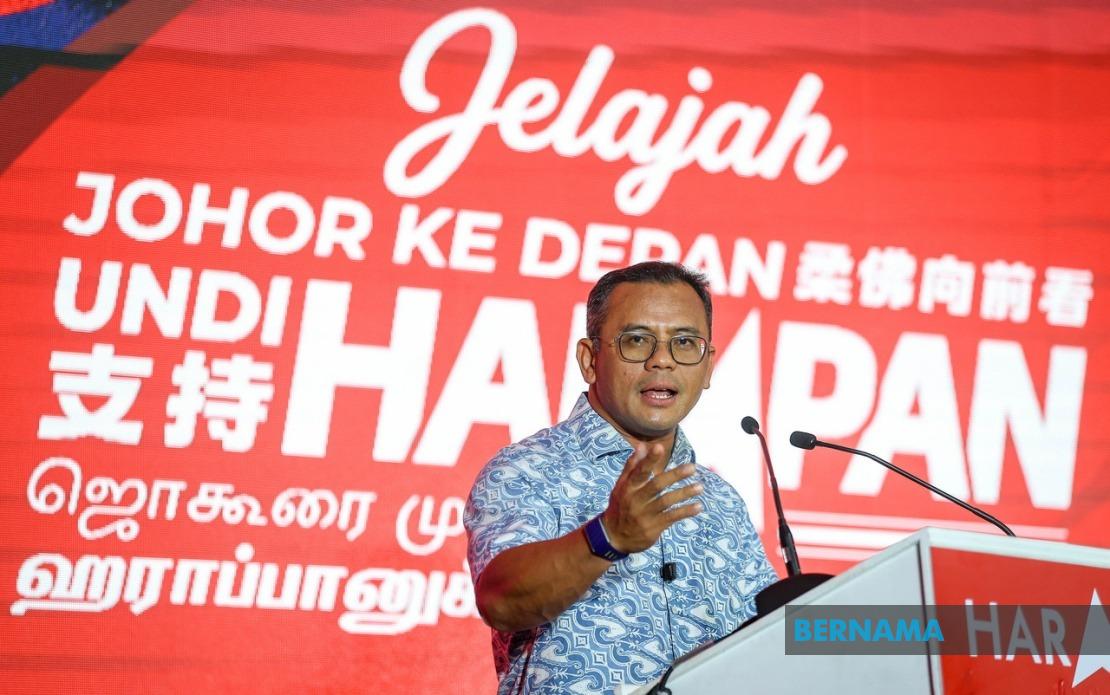
Pakatan Harapan is framing its participation in the Johor state election as a campaign for more balanced and sustainable development across the southern state, rather than a disruptive political intervention. PKR vice-president Datuk Seri Amirudin Shari made this case during campaigning in Batu Pahat on July 1, emphasising that PH's vision centres on unlocking potential beyond the conventional economic powerhouses that currently dominate regional growth.
Amirudin, who also serves as Selangor Menteri Besar and PKR's election director, identified a critical structural problem in Johor's development trajectory: prosperity remains geographically concentrated in specific districts while other regions lag significantly behind. He pointed to Johor Bahru as the dominant economic hub, with northern, eastern and western districts experiencing limited spillover benefits. The income disparity between Johor Bahru and Segamat exemplifies this regional imbalance, a gap PH argues requires deliberate policy intervention to address.
The coalition's critique gains numerical weight when examining investment versus employment outcomes. Johor attracted RM101 billion in investments during the previous year, yet this capital inflow failed to generate robust job creation commensurate with the investment scale. According to Amirudin, fewer than 40,000 new employment opportunities emerged from this investment activity. By comparison, Selangor drew RM83 billion in investments but created 60,000 new jobs, suggesting more efficient capital deployment and labour market integration in the neighbouring state.
This employment gap carries particular significance for Johor's younger workforce and families dependent on cross-border income. Amirudin highlighted the daily reality of Johor residents commuting to Singapore for employment, a pattern reflecting insufficient high-wage job opportunities within the state economy. The reliance on external employment sources indicates that despite substantial inbound investment, Johor has not achieved the productive capacity needed to retain and adequately compensate its labour force.
PH's proposed remedy involves strategically channelling investments toward high-impact sectors with explicit support from federal policy frameworks. The Johor-Singapore Special Economic Zone (JS-SEZ) represents a flagship initiative in this vision, offering potential for collaborative regional development that could generate premium employment opportunities while leveraging Singapore's proximity. By aligning state-level investment strategy with federal support mechanisms, PH argues it can create the structural conditions for quality job creation rather than merely welcoming investment capital.
The coalition's approach reflects a broader governance philosophy emphasizing transparent, inclusive leadership. PH has committed to adopting what Amirudin termed an open leadership approach, positioning this as essential for transforming Johor into what he described as the "Jewel of the South"—a destination of pride and prosperity for both Malaysia and its citizens. This framing suggests that sustainable development requires not only capital investment but also institutional reform and community-centred decision-making processes.
PH is contesting all 56 seats available in the Johor state legislature, signalling comprehensive ambitions rather than a coalition-building strategy dependent on post-election negotiations. With polling scheduled for July 11 and early voting commencing July 7, the coalition has positioned this election as a choice between incremental adjustments to existing governance models and substantive restructuring of development priorities. The campaign emphasises that PH's mandate would represent a mandate for systemic change rather than continuity.
Amanah, PH's Islamic-oriented coalition partner, participated in the campaign event through deputy president Datuk Seri Dr Mujahid Yusof, reinforcing the multi-party character of PH's challenge to the incumbent administration. This coalition composition signals an attempt to appeal across diverse demographic and ideological constituencies, though the specific policy contributions from each coalition partner remain to be elaborated as campaigning intensifies.
For Malaysian observers and regional analysts, this election reflects broader patterns of political contestation across peninsular states. The emphasis on development equity and employment generation resonates with concerns voiced in other jurisdictions where investment growth has not automatically translated into broad-based prosperity. Johor's electoral contest thus carries implications beyond the state itself, potentially influencing how competing coalitions frame development priorities in upcoming elections elsewhere in Malaysia and signalling evolving voter expectations regarding the relationship between investment attraction and employment security.
The campaign narrative also reveals strategic positioning around federal-state coordination. By highlighting how federal initiatives like the JS-SEZ could amplify state-level development when properly integrated, PH implicitly argues that incumbent state administrations have underutilised available federal resources. This emphasis on administrative efficiency and policy coordination offers a technocratic counter-narrative to any arguments framed purely in terms of partisan identity or communal representation, potentially broadening PH's appeal among voters prioritising tangible economic outcomes.

