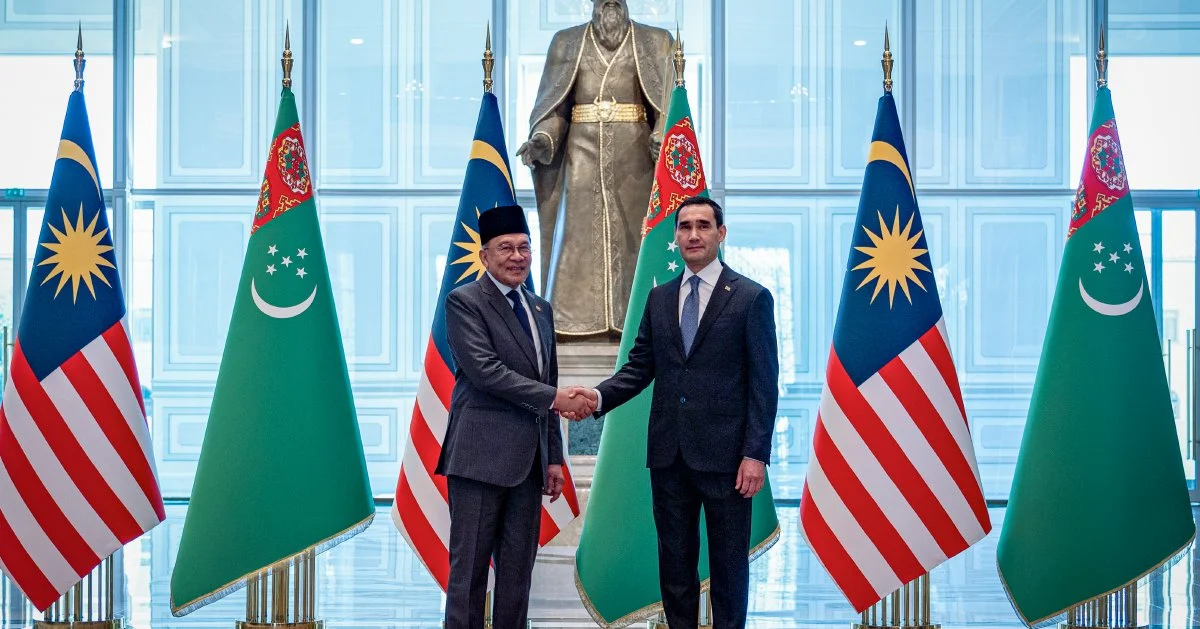
Petronas has positioned itself as a cornerstone of Malaysia's renewed engagement with Turkmenistan, capitalising on deepened diplomatic relations following Prime Minister Datuk Seri Anwar Ibrahim's official visit to the Central Asian nation. The national oil and gas company's expanding operations in Turkmenistan represent more than commercial advancement—they signal a strategic pivot toward stronger bilateral ties that extend well beyond the energy sector into broader economic and geopolitical spheres.
The timing of Petronas's expansion into Turkmenistan reflects a calculated approach to Southeast Asian energy security and Malaysia's broader foreign policy objectives. With global energy markets remaining volatile and regional demand for reliable hydrocarbon supplies intensifying, the company's presence in one of the world's most resource-rich nations offers long-term stability for Malaysian energy interests. Turkmenistan holds among the world's largest proven natural gas reserves, making it an invaluable partner for a nation increasingly dependent on energy imports as domestic reserves mature.
Petronas's longstanding operational footprint in Turkmenistan extends across multiple decades, during which the Malaysian company has developed deep institutional knowledge of the Central Asian operating environment, regulatory frameworks, and geological complexities. This accumulated expertise distinguishes Petronas from newer entrants and provides Malaysian interests with a competitive advantage in negotiating partnerships and securing access to commercially viable projects. The company's historical experience in the country has built trust with Turkmen authorities and created pathways for expanding cooperation.
The national oil company's role transcends conventional energy transactions. By maintaining a substantial presence in Turkmenistan, Petronas effectively serves as a commercial ambassador for Malaysian interests, creating opportunities for downstream industries, service providers, and technology companies to access Central Asian markets. This multiplier effect generates economic benefits across Malaysia's value chain, from petrochemical manufacturers to engineering consultancies and logistics providers.
Prime Minister Anwar's visit to Turkmenistan underscores Malaysia's strategic interest in diversifying its international partnerships beyond traditional spheres. Central Asia represents an underexplored frontier for Malaysian business engagement, where energy cooperation can catalyse broader economic integration. The regional bloc's geographic position between Europe, Asia, and the Middle East positions it as a critical junction for future trade corridors and investment flows. Petronas's operations serve as anchors for Malaysian influence in these emerging strategic networks.
Government-to-government energy collaboration through Petronas creates diplomatic channels that extend into other sectors—telecommunications, infrastructure development, technology transfer, and education. Successful commercial partnerships often generate political goodwill that facilitates cooperation on regional security matters, trade facilitation, and cultural exchanges. Turkmenistan's strategic location and resource wealth make it a valuable partner for Malaysia's Vision 2050 objectives and its positioning within evolving Asian geopolitical configurations.
The expansion of Malaysia-Turkmenistan ties carries implications for Southeast Asian energy security architecture. As ASEAN nations grapple with mounting import dependency and price volatility, bilateral partnerships with resource-rich nations outside the region offer hedging mechanisms against supply disruptions. Petronas's involvement in Turkmenistan demonstrates how national champions can advance both commercial objectives and national strategic interests simultaneously, a model increasingly relevant as regional energy competition intensifies.
Turkmenistan's energy sector operates within a unique governance framework where state entities exercise dominant control over resource extraction and commercialisation. International companies operating in the country must navigate complex political dynamics and centralised decision-making structures. Petronas's experience navigating these conditions positions Malaysia advantageously for future opportunities, whether in new field developments, infrastructure projects, or downstream ventures. The company's institutional relationships with Turkmen government bodies represent valuable assets that accumulate over time.
Looking forward, the Malaysia-Turkmenistan partnership through Petronas offers multiple expansion vectors. Liquefied natural gas marketing opportunities, joint ventures in downstream processing, technology cooperation in reservoir management, and collaborative development of marginal fields all represent plausible extensions of current engagement. As global energy markets transition toward lower-carbon solutions, bilateral cooperation could encompass renewable energy integration, carbon capture technologies, and methane reduction initiatives—positioning both nations as forward-thinking energy partners.
The strategic coherence between Petronas's commercial operations and Malaysian foreign policy objectives illustrates how state-owned enterprises can serve as instruments of broader national interest. Energy security, geopolitical influence, and economic development intertwine in ways that make Petronas's Turkmenistan operations far more significant than their revenue contribution alone might suggest. This integrated approach reflects Malaysia's recognition that in an increasingly interconnected global economy, competitive advantage derives from strategic coordination across governmental, commercial, and diplomatic domains.

