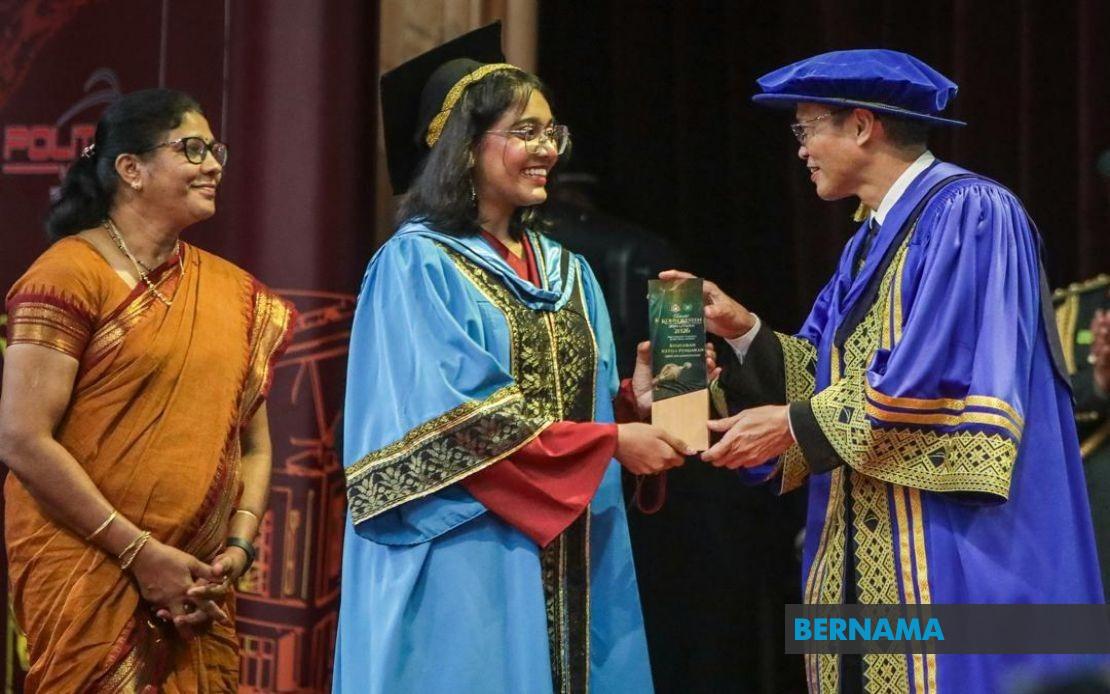
Teerti Ganapathi Rao's journey through higher education stands as a testament to the power of familial encouragement and personal determination. The 22-year-old Diploma in Digital Technology graduate from Politeknik Tuanku Syed Sirajuddin (PTSS) in Arau, Perlis, has claimed both the Director-General's Award and the Academic and Co-Curricular Excellence Award at the Northern Zone Polytechnic and Community College Convocation Ceremony, an achievement rendered all the more remarkable by the fact that she pursued her studies whilst navigating profound personal loss.
When her father passed away during her Semester Two examinations in 2023, Teerti faced what many would have considered an insurmountable obstacle. Yet rather than abandon her studies or allow her academic performance to collapse, she maintained her focus and ultimately graduated with a cumulative grade point average of 3.61—a result that placed her squarely in the upper echelon of academic achievers. Speaking to reporters after the convocation ceremony at Dewan Harumanis on August 3, Teerti reflected on the unexpected nature of her recognition. "I thought I would not be fortunate enough to receive this award, so when I was informed that I had been selected, I was truly surprised and grateful," she explained, her words capturing the humility that has evidently characterised her approach throughout her three years at the institution.
Central to Teerti's ability to persevere through grief was the legacy of encouragement left by her father. As the youngest of four siblings, she had initially harboured doubts about her academic trajectory, harbouring plans to pursue a foundation programme rather than committing to the full diploma. Yet her father's persistent counsel—that she complete her diploma studies—became her guiding light during the darkest period of her university experience. This familial influence represents a theme that resonates deeply within Malaysian educational contexts, where parental guidance often serves as the emotional and moral foundation upon which students build resilience.
Beyond her headline awards, Teerti's academic record demonstrates consistent excellence across her studies. She received the Head of Department's Award for three consecutive semesters—the first, third, and fourth—indicating that her strong performance was neither a fleeting achievement nor confined to a single field of study. This consistency suggests a methodical, disciplined approach to learning that extended across her coursework and practical components alike. Her engagement with her institution extended beyond the classroom walls, as she served actively as a member of the Student Representative Council, a role that evidently sharpened her leadership, communication, and collaborative capabilities.
Teerti's contributions to her institution's intellectual community also include meaningful participation in collaborative research and academic dissemination. She represented PTSS at a collaborative programme and seminar paper presentation hosted by Universiti Putra Indonesia, gaining valuable exposure to international academic standards and networking opportunities. For her culminating final-year project, Teerti developed the Koop Printing System, a technological solution specifically engineered to enhance operational efficiency within cooperative printing service management. This practical application of her digital technology skills to a real-world business challenge exemplifies the kind of problem-solving orientation that Malaysian polytechnic education aims to cultivate.
Language acquisition represents another dimension of Teerti's intellectual development. Beyond fluency in Bahasa Melayu and English—the lingua francas of Malaysian professional environments—she has achieved proficiency in Mandarin, Tamil, and Telugu, reflecting both her family background and her commitment to multilingual competency. Additionally, she possesses foundational knowledge of French, Japanese, and Korean. In an increasingly interconnected Southeast Asian region where cross-cultural communication has become a competitive advantage, Teerti's linguistic portfolio positions her favourably for roles in technology sectors requiring international collaboration or engagement with diverse user bases.
Looking forward, Teerti's aspirations extend well beyond her polytechnic credentials. She is currently awaiting outcomes from her application to pursue a Bachelor's degree in Information Technology, with Universiti Malaya listed as her primary choice. Her ultimate ambition reaches further still—she envisions pursuing doctoral studies at PhD level, a trajectory that would position her among Malaysia's technology researchers and innovators. This long-term vision suggests that her polytechnic award represents not a pinnacle but rather a waypoint on a considerably more ambitious academic and professional pathway.
Teerti's entry into the technology field emerged from an unconventional origin point. At sixteen years old, she was introduced to computers and coding through friendships formed within gaming communities—a reminder that technological talent often surfaces through informal channels and peer networks rather than formal institutional structures alone. "The field is indeed challenging, but if you learn step by step and truly understand the concept, everything becomes easier," she reflected, offering insight into her pedagogical philosophy. This measured, concept-focused approach to technical learning—prioritising deep understanding over rote memorisation—aligns well with contemporary best practices in computer science education.
The convocation ceremony itself, graced by Tuanku Syed Sirajuddin Jamalullail, the Raja of Perlis, underscored the significance of these academic achievements within the broader Malaysian educational ecosystem. The ceremony, spanning from August 3 to August 9, honoured 6,104 graduates from polytechnics and community colleges across three northern states: Perlis, Kedah, and Penang. This scale reflects the substantial pipeline of skilled intermediate-level talent that Malaysia's polytechnic system continues to produce annually.
Teerti's story carries particular resonance for Malaysian students navigating personal challenges whilst pursuing educational advancement. In a nation where academic competition remains fierce and family expectations often weigh heavily, her ability to channel grief into greater determination offers an implicit message: adversity need not derail ambition. Her achievement also reflects positively on PTSS's institutional culture and support systems, suggesting that the polytechnic has created an environment where students facing personal crises can still access the academic and pastoral support necessary to excel.
The recognition accorded to Teerti through the Director-General's Award signals official validation of an educational journey characterised by intellectual rigour, institutional engagement, and personal resilience. For other Malaysian students contemplating their own futures—particularly those from modest backgrounds or those confronting unexpected hardships—Teerti's trajectory demonstrates that excellence remains attainable despite formidable personal obstacles. Her progression toward a bachelor's degree and potential doctorate further illustrates the critical role that Malaysia's polytechnic institutions play in identifying and nurturing talent that subsequently contributes to the nation's knowledge economy and technological advancement.

