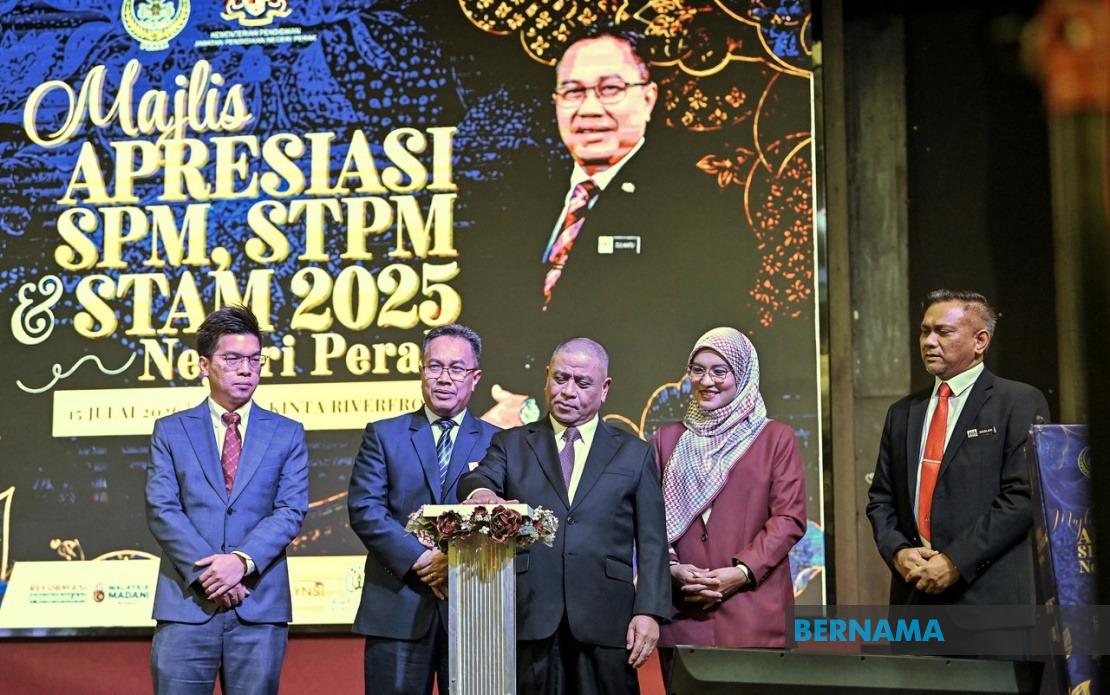
The Perak state government's Menteri Besar Scholarship programme continues to demonstrate tangible benefits for students and families across the state, serving as both a financial safety net and an incentive for academic excellence. Launched to reduce the educational burden on households, the initiative has resonated particularly strongly with middle and lower-income families, according to recent recipients who shared their experiences at a state-level appreciation ceremony held in Ipoh on July 15.
Yoong Lam, a 20-year-old graduate of Sekolah Menengah Kebangsaan Sultan Yussuff, exemplifies the scholarship's impact on student achievement. Having secured a perfect Overall Grade Point Average of 4.00 in her Sijil Tinggi Persekolahan Malaysia examination, she received RM1,200 per semester through the scheme. She deployed this assistance strategically, allocating funds to cover her examination fees, purchasing essential academic reference materials, and accessing additional tuition support—expenditures that would otherwise have strained her household finances significantly. As the elder of two siblings in a family where her father operates as a self-employed worker and primary income earner, Yoong Lam credited the scholarship with meaningfully reducing pressure on her parents while enabling her to pursue the additional academic support necessary for top-tier examination performance.
The scholarship's reach extends across diverse educational pathways within the state's secondary system. Muhammad Haziq Hafit, a 19-year-old student from Al-Ulum Al-Syar'Iyyah Religious Secondary School in Bagan Datuk, received RM1,000 assistance following his excellent performance in the Sijil Tinggi Agama Malaysia examination. He plans to channel these funds toward preparation for university entry and ultimately pursue educational studies at the University of Malaya. Similarly, Muhammad Taufiq Ikwan Mohammad Asri, also 19 and from the same institution, intends to utilise his scholarship allocation to arrange logistics and purchase necessities before undertaking advanced studies in Egypt. Both students acknowledged that while the quantum of assistance may appear modest compared to other scholarship schemes, its significance for families navigating middle-income circumstances proved substantial.
Peeling back to examine the broader educational context in which this scholarship operates reveals an increasingly sophisticated state approach to student support. Menteri Besar Datuk Seri Saarani Mohamad announced that Perak achieved a state average grade point of 4.49 in the 2025 Sijil Pelajaran Malaysia results, marking the strongest performance in thirteen years. The achievement arrived after three consecutive years of improvement, suggesting the implementation of multiple complementary strategies beyond scholarship allocation. Notably, the performance gap between candidates sitting examinations in urban centres versus rural localities narrowed to merely 0.04 points, indicating that educational quality and opportunity for academic distinction have become more equitably distributed across Perak's geographic regions.
Underlying these headline results lies the Tuisyen Cikgu Saarani programme, administered through Yayasan Perak in collaboration with the Perak State Education Department. This initiative has focussed particularly on distributing supplementary reference materials developed specifically for Perak students, crafted by experienced educators based on systematic analysis of pedagogical gaps and examination requirements within the state. The additional reference books emphasise conceptual mastery and examination technique development, moving beyond generic study aids toward tailored, evidence-based resources. During the current year, 63,567 copies of these supplementary materials have been circulated among daily school students throughout the state, with concentrated distribution to candidates assessed as having strong potential for examination success but requiring structured additional guidance.
The programme has expanded significantly in scope to encompass religious educational pathways previously outside its original remit. First-time inclusion of students from Sekolah Menengah Tahfiz Darul Ridzuan and Sekolah Menengah Agama Rakyat institutions means that nearly 25,000 SPM candidates anticipated for the 2026 examination cycle across all school categories in Perak stand to benefit from these curated reference materials. This expansion reflects official recognition that high-performing students within Islamic religious schools face identical examination pressures and conceptual challenges as their counterparts in secular institutions, yet previously lacked access to the same targeted support infrastructure. The Perak Islamic Religious Department has been enlisted to oversee distribution and implementation within these schools, ensuring cultural and pedagogical appropriateness.
For Malaysian policymakers examining educational equity and student support mechanisms, Perak's integrated approach merits attention. Rather than viewing scholarships and supplementary resources as isolated interventions, the state has constructed a layered support architecture encompassing direct financial assistance, academically-targeted reference materials, and expanded institutional coverage. The narrowing rural-urban performance gap particularly demonstrates how deliberate investment in educational infrastructure can address longstanding regional disparities. These findings gain relevance across Southeast Asia, where comparable challenges of uneven educational opportunity persist, and where similar scholarship and resource-distribution models might be adapted to local contexts.
The human testimonies embedded within the programme's results offer insight into how state educational investment translates into individual and family circumstances. Recipients consistently framed the assistance not as generous windfall but as meaningful relief that enabled rather than replaced parental investment and student effort. This framing suggests the scholarship's psychological and practical benefit extends beyond its numerical value; students recognise their selection as validation of academic capability whilst experiencing tangible material support for continued educational pursuit. For families already investing emotionally and financially in their children's examination success, such assistance represents acknowledgment of shared sacrifice rather than substitution for it.
Looking forward, the sustainability and scalability of Perak's model depend on continued political commitment and resource allocation, particularly as the state seeks to maintain its upward trajectory. The integration of religious schools into existing programmes demonstrates flexibility and inclusive thinking, yet also hints at capacity constraints requiring calibrated expansion. Whether the state can maintain per-student scholarship levels while extending coverage to additional cohorts remains an open question. Nevertheless, the documented results—improved state examination outcomes, reduced geographic performance variation, and demonstrable family impact—establish the framework as empirically grounded rather than merely aspirational, offering a replicable model for other Malaysian states reconsidering their educational support architecture.

