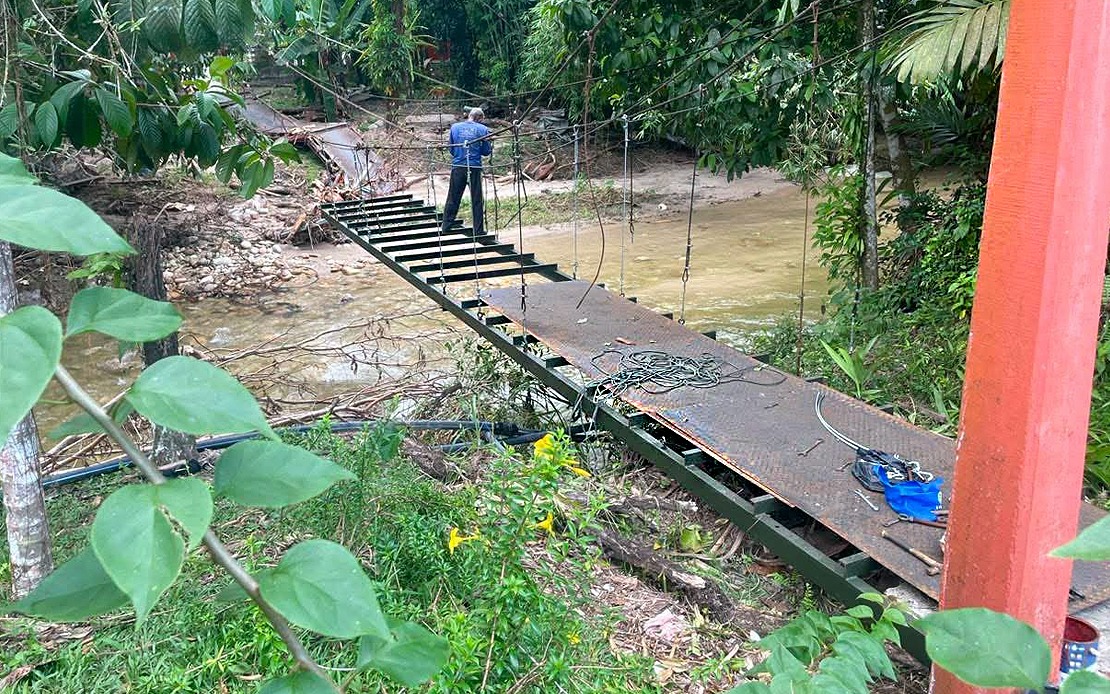
The Perak state government has committed RM500,000 towards constructing a permanent concrete bridge in Kampung Ulu Geruntum, Gopeng, to restore connectivity to the village after catastrophic flooding damaged its critical infrastructure. The allocation comes in response to the June 19 incident when a powerful water surge overwhelmed and destroyed the settlement's main bridge, leaving residents isolated and prompting the evacuation of more than 50 people to temporary shelter at Gopeng Town Hall.
State Housing and Local Government Committee chairman Sandrea Ng Shy Ching confirmed the funding decision and outlined the multi-phase approach the state government is taking to address both immediate and long-term infrastructure needs. In her statement, Ng emphasised the urgency of restoring normal life to the affected community and acknowledged the collective efforts of government agencies and personnel deployed to manage the crisis. The concrete bridge project, she indicated, would commence once ongoing remedial work at the site is finalised, though no specific completion timeline was provided for the permanent structure.
Beyond the major bridge reconstruction, the state government is pursuing a parallel strategy to minimise disruption to residents during the construction phase. An emergency allocation of RM150,000 has been approved for a temporary suspension bridge, which was already under construction at the time of Ng's announcement and was expected to be operational by mid-July. This interim solution reflects pragmatic crisis management, allowing villagers to maintain essential access to markets, healthcare facilities, schools, and employment opportunities in Gopeng town while the permanent bridge is being built.
Ng, who represents the Teja state assembly seat, also mobilised her own constituency allocation to address immediate humanitarian concerns arising from the disaster. She approved RM45,000 from her personal allocation to fund the repair of damaged water pipes and restoration of the water supply network that was disrupted by the surge. This dual-level funding approach—combining state-level capital expenditure with constituency-level operational support—demonstrates coordinated governance at multiple administrative levels to tackle both emergency response and recovery needs.
The June 19 water surge that triggered this crisis represented a significant natural disaster for the rural community. The collapse of the main bridge severed the sole vehicular access route linking Kampung Ulu Geruntum to surrounding areas, leaving residents completely cut off. The incident forced the emergency evacuation of residents to temporary relief facilities, disrupting livelihoods, schooling, and access to essential services. The loss of water supply compounded the difficulties, creating a multi-dimensional humanitarian challenge that required coordinated intervention across various government departments.
For Perak state, the incident highlights the vulnerability of rural communities to extreme weather events and water-related disasters, a concern increasingly relevant across Southeast Asia as climate patterns shift and rainfall intensity increases. The flooding and bridge collapse in Kampung Ulu Geruntum exemplify the infrastructure risks that remote settlements face, where a single point of access failure can result in complete isolation. This has implications for how state and federal authorities approach infrastructure resilience planning in rural areas, particularly in regions prone to seasonal flooding and water surges.
The three-tier funding approach—the RM500,000 permanent bridge, the RM150,000 temporary suspension bridge, and the RM45,000 for utility repairs—reflects a comprehensive understanding of disaster recovery that extends beyond physical reconstruction. The suspension bridge serves as a critical bridge solution that keeps the community functioning during the months-long construction phase for the permanent structure. This prevents the secondary social and economic impacts of prolonged isolation that would otherwise compound the initial disaster's effects on residents' livelihoods and wellbeing.
The timeframe for bridge reconstruction remains a key factor in community recovery. While the temporary suspension bridge was targeted for mid-July completion, the permanent concrete bridge's schedule was contingent on completing site remediation first. For residents of Kampung Ulu Geruntum, this phased approach means that normalcy would return gradually rather than immediately, requiring sustained patience and government follow-through on timelines. The adequacy of these allocations will become apparent only once construction contracts are let and detailed cost assessments are completed.
The disaster and subsequent government response carry broader lessons for regional infrastructure planning. As Malaysia and its neighbouring countries experience more frequent extreme weather events, the case of Kampung Ulu Geruntum underscores the importance of building redundancy into rural infrastructure systems. Single-bridge access routes, while economical, create single points of failure that can isolate communities entirely. Future infrastructure investments in rural areas may need to consider alternative access routes, elevated design standards to withstand surge events, or rapid-deployment temporary crossing systems that can be activated during emergencies.
For Perak specifically, this incident marks one of several recent examples of flooding and water-related infrastructure damage affecting both urban and rural areas. The state government's response—combining emergency allocations with medium-term reconstruction—represents standard disaster management practice, yet the underlying question of whether current infrastructure standards adequately account for climate-driven weather extremes remains unresolved. As Kampung Ulu Geruntum's residents await restoration of full connectivity, the broader conversation about infrastructure resilience and rural development priorities will likely continue within Perak's planning and development corridors.

