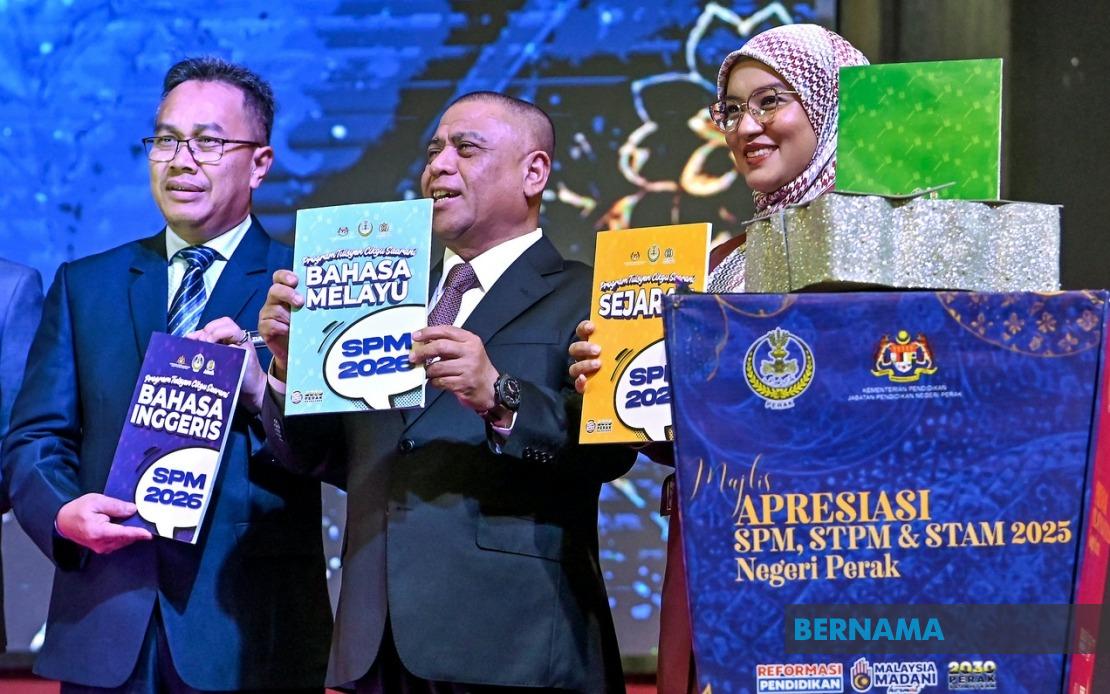
Perak's education system has marked a significant milestone by recording its best Sijil Pelajaran Malaysia (SPM) performance in 13 years, with students achieving a State Average Grade (GPN) of 4.49 in the 2025 examination cycle. The accomplishment signals sustained momentum in the state's push to elevate educational standards, building on improvements recorded over the preceding three years that demonstrate a consistent upward trajectory.
Menteri Besar Datuk Seri Saarani Mohamad attributed the success to coordinated efforts across multiple stakeholders working to fortify educational quality in Perak. Speaking at the 2025 Appreciation Ceremony for SPM, STPM and STAM achievers in Ipoh, Saarani emphasized that the convergence of initiatives undertaken by educators, administrators, and community partners had produced measurable results. The recognition ceremony drew together State Education Department director Zulkafli Mohamed Mokhtar and Yayasan Perak general manager Dr Nasreen Khanum Nawab Zadah Khan, underscoring the institutional commitment to celebrating and consolidating educational gains.
One of the most striking features of Perak's results is the narrowing of the traditional performance disparity between urban and rural candidates. The achievement gap between these two demographics stands at merely 0.04 points—a figure that carries profound implications for equity in Malaysian education. This near-parity suggests that Perak's efforts to distribute educational resources and opportunity more evenly across geographical boundaries are bearing fruit, challenging the narrative that rural students face insurmountable disadvantages in national examinations. For Southeast Asian educators wrestling with similar urban-rural divides, Perak's experience offers a cautionary but encouraging case study in how targeted policy and investment can help level the playing field.
Perak's strong performance extended beyond SPM to encompass pre-university qualifications. The state recorded a Cumulative Grade Point Average (CGPA) of 2.91 in the Sijil Tinggi Persekolahan Malaysia (STPM) examination, surpassing the national average of 2.88. This distinction is particularly noteworthy as STPM remains the conventional pathway for Malaysian students seeking entry to local universities. Among the 1,336 candidates nationwide who achieved the maximum CGPA of 4.00, Perak accounted for 116—a proportion that underscores the state's capacity to nurture top-tier academic talent alongside broader improvement across the student population.
Religious education also flourished under Perak's expanded educational mandate. The Sijil Tinggi Agama Malaysia (STAM) examination saw Perak students achieve a GPN of 3.03, with 36 candidates attaining the coveted Mumtaz distinction. This performance reflects both the integration of Islamic education into Perak's broader pedagogical framework and the state's commitment to fostering moral and spiritual development alongside academic achievement. The presence of strong STAM results alongside conventional academic qualifications demonstrates that Perak's education system operates on a pluralistic model catering to diverse learning pathways and student aspirations.
Menteri Besar Saarani's remarks during the ceremony extended beyond raw statistics to articulate a philosophical understanding of educational success that resonates with modern thinking on student development. He cautioned against reducing achievement solely to examination scores, instead positioning academic recognition as one component of a holistic success narrative encompassing effort, resilience, and community contribution. This perspective aligns with growing international acknowledgement that standardized test performance, while important, incompletely captures the competencies required for meaningful participation in contemporary society. The emphasis on effort and support systems acknowledges that individual student achievement is fundamentally relational—embedded within networks of familial encouragement, pedagogical guidance, and institutional infrastructure.
The recognition accorded to 266 recipients—encompassing high-performing students, exemplary educators, schools, and District Education Offices—established a formal mechanism for celebrating distributed success. This inclusive approach to recognition proves significant because it institutionalizes the notion that educational excellence emerges from collective endeavor rather than isolated talent. By honoring teachers and school communities alongside students, Perak's acknowledgement framework sends a structural message about the interdependence of educational outcomes. Teachers, often working within resource constraints, receive validation that their contributions matter and are observed. Schools gain institutional recognition that incentivizes continued investment in quality. This architecture of appreciation potentially creates virtuous cycles of motivation and institutional commitment.
For Malaysian policymakers and educators elsewhere in Southeast Asia, Perak's results carry several transferable lessons. The state demonstrates that closing achievement gaps between urban and rural populations, while formidably challenging, is not insurmountable when approached with systematic intent and adequate resourcing. The three-year upward trend suggests that improvements in educational outcomes are neither accidental nor ephemeral but rather the consequence of deliberate strategy and sustained implementation. Furthermore, the concurrent excellence across multiple examination streams—SPM, STPM, and STAM—indicates that quality education need not be narrowly conceived but can encompass diverse pathways reflecting varied student interests and vocational orientations.
The broader context of Perak's achievement warrants consideration within Malaysia's ongoing national education discourse. As the country grapples with persistent questions about educational equity, quality, and relevance to contemporary labor market demands, Perak's performance offers empirical evidence that incremental but consistent improvement is achievable within Malaysia's federal education system. The state's success does not resolve systemic challenges of curriculum rigidity, assessment-driven pedagogy, or the persistent urban-rural resource gap, but it does suggest that within existing constraints, creative deployment of available resources and coordinated stakeholder engagement can generate measurable progress.
Looking forward, the challenge confronting Perak's education authorities lies in sustaining this momentum while deepening the quality of learning outcomes beyond examination performance. The state must ensure that its three-year upward trajectory represents genuine enhancement of student learning and capability rather than optimization for testing alone. Furthermore, while the narrowing of the urban-rural gap is commendable, the persistence of even a 0.04-point disparity invites continued scrutiny of whether structural inequalities in resource allocation, teacher expertise distribution, or learning environment quality remain addressable. The next phase of Perak's educational development will involve translating examination room success into real-world competency development, workforce readiness, and sustainable competitive advantage for graduates entering an increasingly complex regional and global economy.

