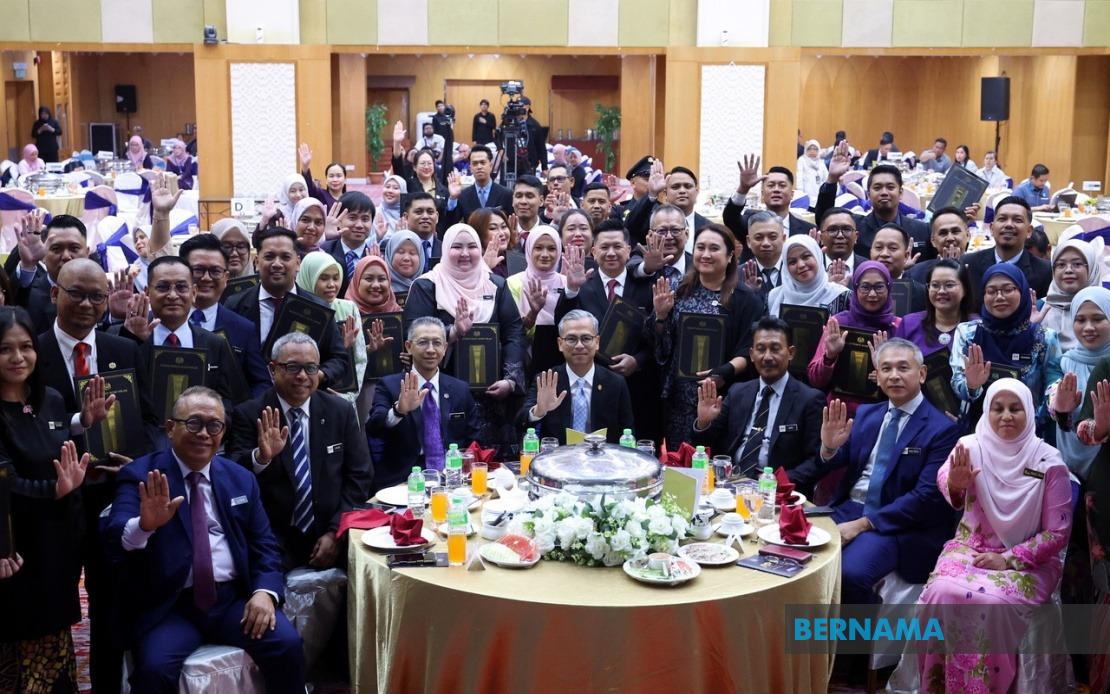
The MADANI Government views economic performance through the lens of everyday impact rather than headline-grabbing statistics alone, Communications Minister Datuk Seri Fahmi Fadzil declared during an official ceremony in Kota Kinabalu this week. While Malaysia's macroeconomic indicators—spanning investment inflows, government revenue, foreign reserves, GDP expansion, and international trade volumes—are indeed registering positive momentum at both national and state levels, Fahmi emphasised that these figures remain hollow unless they meaningfully improve the financial circumstances of ordinary citizens.
This philosophical approach represents a deliberate pivot in how the current administration frames success. Rather than celebrating abstract numerical growth, the government seeks to measure its effectiveness through concrete improvements in household wallets and purchasing power. Fahmi articulated this shift by describing the "people's economy" as the living, breathing reality experienced by individuals navigating their daily routines, rather than the sanitised versions presented in government economic reports and central bank statements.
A particularly instructive example underpinning this narrative is the government's implementation of targeted diesel subsidy retargeting, known as BUDI MADANI. This programme represents precisely the type of policy intervention that the Communications Minister believes exemplifies the bridge between macro-level prosperity and micro-level household relief. The subsidy framework attempts to channel government support towards those segments of society where fuel costs constitute a meaningful portion of disposable income, rather than applying blanket assistance that spreads benefits thinly across all income brackets.
The geographical complexity of Malaysia's eastern regions makes this discussion particularly pertinent for Sabah and Sarawak. These states present unique logistical challenges absent from more densely populated peninsular territories. Citizens frequently traverse considerable distances between district centres to access services, conduct business, or pursue economic opportunities. Consequently, fuel expenses represent a proportionally larger burden for residents compared to their counterparts in more compact urban environments. Prime Minister Datuk Seri Anwar Ibrahim and his cabinet have reportedly elevated these spatial realities to central importance in their policy deliberations, signalling recognition that economic interventions cannot employ one-size-fits-all approaches across such geographically disparate territories.
Fahmi's remarks, delivered while officiating the Communications Ministry's Sabah and Labuan Zone Excellent Service Awards ceremony, suggest a broader institutional commitment to ensuring that excellence demonstrated at the national administrative level cascades downward into tangible improvements at the community and household level. This framework rejects the notion that government success should be measured primarily by international investment rankings or GDP growth percentages; instead, it posits that true success manifests when citizens observe genuine improvements in their financial circumstances and quality of life.
The emphasis on policy transparency and effective communication forms a critical complementary element to this economic philosophy. Fahmi specifically highlighted the responsibility borne by ministries and government agencies to articulate their policies and programmes comprehensively to the public. Without clear, accessible explanations, even well-intentioned policies risk generating confusion, misinterpretation, and public scepticism. This vulnerability appears particularly acute with programmes such as targeted subsidies, where the rationale for differential treatment across regions, income brackets, or demographic groups requires patient explanation to prevent accusations of favouritism or inconsistency.
For Malaysian readers, particularly those in East Malaysia, this governmental positioning carries immediate practical significance. It suggests that infrastructure investments, subsidy allocations, and social welfare programmes will increasingly be evaluated through a lens emphasising local impact rather than national aggregate statistics. A road project connecting remote Sabah villages might be justified not by its contribution to overall GDP, but by its reduction in travel time and costs for residents who previously spent disproportionate resources reaching economic centres.
The broader Southeast Asian context also illuminates why this reorientation matters. Across the region, governments have historically struggled with legitimacy gaps between impressive headline economic figures and widespread public perception of stagnant living standards. Malaysia's explicit commitment to bridging this divide through the "people's economy" framework represents an attempt to learn from these cautionary tales and establish governance approaches where economic growth demonstrably improves household circumstances rather than concentrating benefits among elites or particular geographic clusters.
However, translating this philosophy into consistent policy implementation presents substantial challenges. Targeted subsidy systems, while theoretically superior to universal programmes, create complexity in administration and carry political risks when different regions or groups perceive differential treatment. The government's commitment to transparent communication appears designed to address these risks, yet sustained public confidence requires that policies deliver promised benefits consistently over extended periods, not merely in the initial euphoria following announcement.
The emphasis on connecting national excellence to individual prosperity also reflects implicit acknowledgment that previous governments, despite posting respectable economic growth figures, failed to convince substantial portions of the electorate that their circumstances were improving. This perception gap—between official statistics and household experience—contributed significantly to political dynamics that culminated in the 2022 general election results and the formation of the MADANI coalition government. By explicitly foregrounding the "people's economy" concept, the current administration signals awareness of this legitimacy challenge and commits to measuring its performance against criteria that resonate with voter perceptions and lived experience.
Moving forward, the true test of this philosophy will emerge through implementation consistency and measurable outcomes. Citizens in Sabah, Sarawak, and other regions will assess whether reduced fuel costs, improved services, or enhanced economic opportunities actually materialise in their daily lives. The government's stated commitment to ensuring that macroeconomic gains translate into household benefits provides a clear benchmark against which future performance can be evaluated—a notably different standard from previous administrations that often emphasised aggregate growth figures while remaining relatively indifferent to distributional questions.

