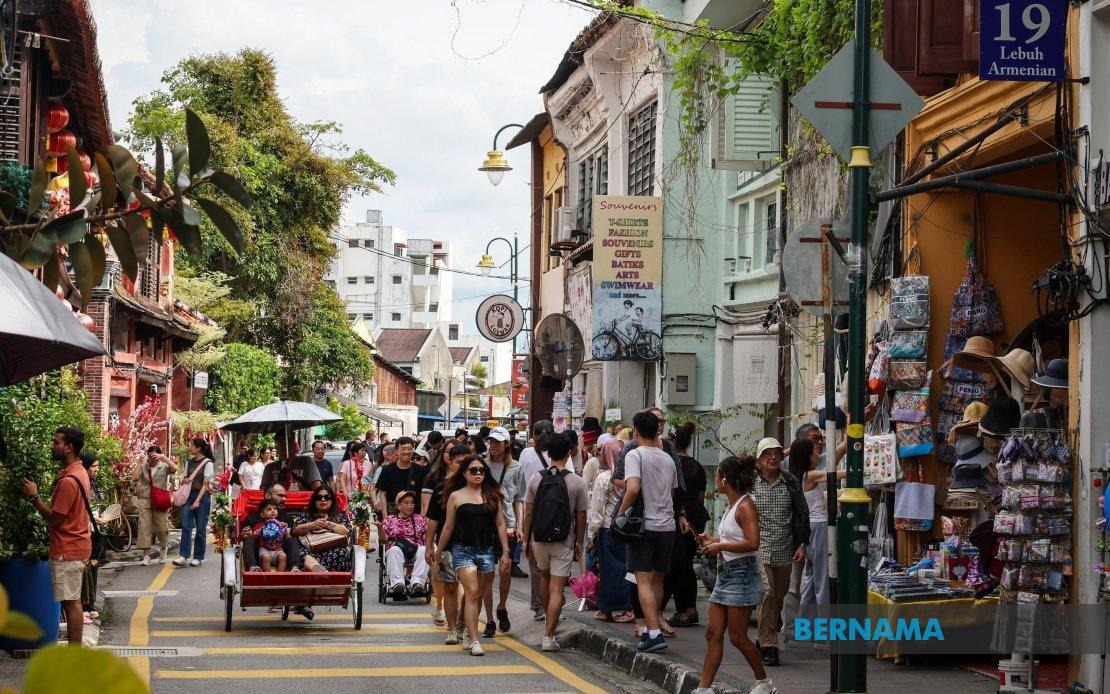
Penang's government has moved swiftly to address public safety concerns in its historic districts after a significant structural failure yesterday along Armenian Street, where wooden beams and concrete debris dislodged from a heritage shophouse, striking two visiting tourists. The incident, which left Mohamad Ammtar and Fatimah, both Sri Lankan nationals, requiring hospital treatment, has prompted state authorities to examine the broader condition of similar buildings throughout the state, highlighting the tension between preserving architectural heritage and ensuring visitor and resident safety.
State Local Government and Town and Country Planning Committee chairman Jason H'ng Mooi Lye outlined an ambitious programme to evaluate the structural integrity of heritage buildings across Penang, beginning with consultation between the state government and the National Heritage Department regarding the engagement of an independent engineering firm. This collaborative approach reflects a recognition that heritage preservation cannot proceed in isolation from contemporary safety standards and building codes. The assessment, once concluded, will identify structures requiring intervention and provide the Penang Island City Council with a framework for issuing directives to property owners regarding necessary restoration and remediation work.
Initial investigations into the Armenian Street collapse have identified termite damage as the primary cause of the structural failure, pointing to a broader vulnerability affecting heritage properties constructed with traditional materials. Timber components, particularly in buildings of significant historical age, face degradation from insect activity and environmental exposure that can compromise load-bearing capacity. This finding underscores how natural deterioration processes, compounded by deferred maintenance and the challenges of managing centuries-old structures, create genuine safety hazards that demand proactive identification and management across the historic quarter.
The incident occurred in George Town, Malaysia's most prominent World Heritage Site, a designation that brings both prestige and responsibility. The confluence of tourism appeal and heritage preservation creates competing pressures for authorities managing the district. Tourists like the injured visitors are attracted precisely by the authentic character of these aged structures, yet their safety during visits represents a non-negotiable obligation for local government. The visible consequences of the Armenian Street collapse—injuries requiring hospitalisation and specialist assessment—bring this abstract tension into sharp relief.
H'ng emphasised that preservation of heritage character must remain compatible with rigorous safety protocols, establishing a principle that should guide future conservation decisions. He noted that while restoration work must respect original architectural features and historical authenticity, contemporary materials offering superior durability and safety performance warrant consideration when original substances, particularly wood, have become structurally compromised. This balanced approach acknowledges that heritage value does not require accepting public risk and that thoughtful intervention can maintain historical integrity while meeting modern safety requirements.
Regarding the immediate outcome for the injured visitors, information indicated that Mohamad Ammtar was discharged from Penang Hospital following treatment. However, his wife Fatimah remained under medical care, undergoing computerised tomography scanning to fully assess the extent of her injuries. The ongoing treatment underscores the real human consequences when heritage building maintenance lags behind safety standards, affecting not only local residents but international visitors whose negative experiences can impact Penang's tourism reputation.
State Tourism and Creative Economy Committee chairman Wong Hon Wai reinforced the government's commitment to addressing heritage building safety by directing both George Town World Heritage Incorporated and the Penang Island City Council to disseminate advisories to building owners throughout the state. These communications will likely emphasise obligations to maintain structural soundness and alert proprietors to the regulatory framework that may compel remedial action. For a state whose economic interests extend beyond heritage preservation to hospitality and tourism, such communications represent the intersection of regulatory compliance and business imperative.
The incident highlights particular vulnerabilities in George Town's building stock. Many structures date to the 18th and 19th centuries, constructed using construction techniques and materials suited to their era but requiring careful management in contemporary contexts. Termite damage, moisture infiltration, foundation settlement, and the cumulative effects of tropical weather combine to create an environment where deterioration can accelerate unpredictably. Buildings that have remained standing for two centuries may exhibit apparent stability while harbouring hidden structural weakness, making professional assessment invaluable for distinguishing functionally safe buildings from those presenting genuine hazard.
The state government's decision to engage independent engineering expertise rather than relying on internal assessment capacity reflects appropriate pragmatism. Professional engineers specialising in heritage structures can evaluate load-bearing capacity, material integrity, and failure risk using sophisticated diagnostic techniques including non-invasive structural monitoring. Their involvement also creates defensible documentation of building conditions, establishing baseline records against which future deterioration can be measured and providing liability protection for local authorities and building owners.
For Malaysian heritage preservation broadly, the Penang incident illustrates the challenge facing many states with significant collections of historically significant buildings. The costs associated with comprehensive safety assessment and remedial work strain municipal budgets, particularly in economically constrained jurisdictions. Yet deferring such investment invites escalating risks and eventual crises that damage both heritage resources and public confidence in government stewardship. The Penang response, while reactive rather than preventive, establishes a template for other state governments managing comparable heritage districts.
The Armenian Street incident also raises questions about building owner accountability and incentive structures. Many heritage buildings in Malaysian historic districts are privately owned, with proprietors bearing maintenance costs while deriving value from historical designation. Financial instruments, including heritage conservation grants, tax incentives for restoration work, and subsidised engineering assessments, might encourage owners to proactively address deterioration rather than waiting for government intervention following accidents. Penang authorities may consider whether their assessment programme should incorporate such incentive mechanisms alongside regulatory requirements.
Looking forward, the safety assessment programme presents opportunity for developing more sophisticated understanding of George Town's built heritage. Comprehensive structural data can inform long-term planning regarding which buildings warrant intensive conservation investment, which require targeted interventions, and which may be approaching end-of-life for certain functions. Such knowledge enables strategic allocation of limited heritage preservation resources and helps authorities guide property owners toward sensible restoration priorities rather than reactive crisis management.

