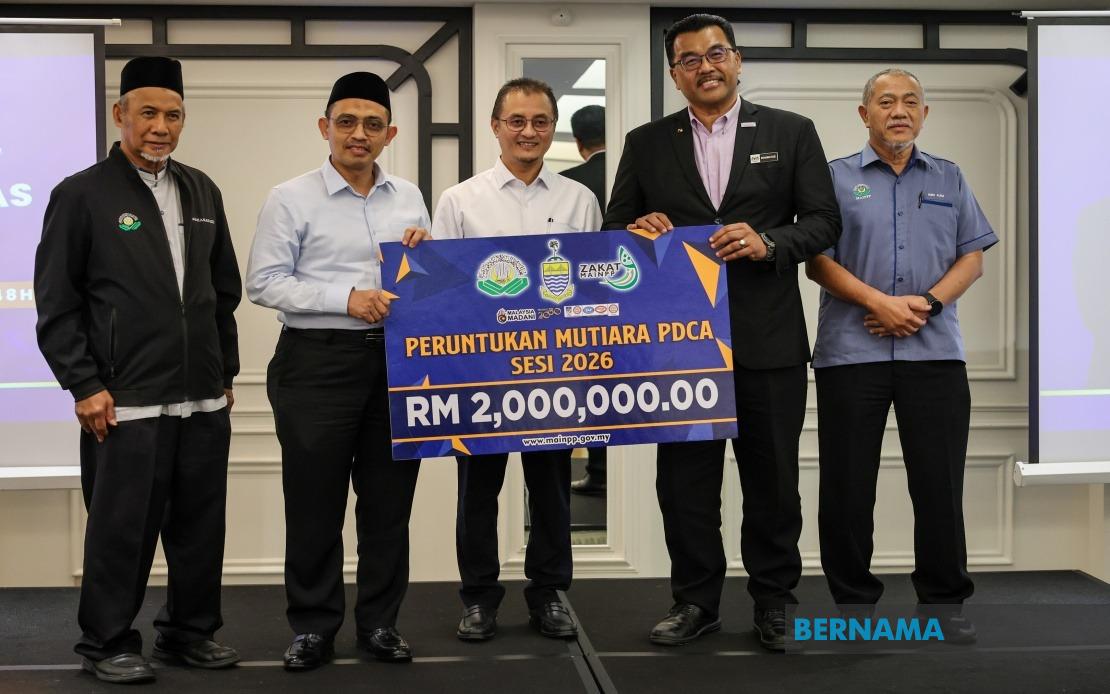
Penang's Penang State Islamic Religious Council (MAINPP) has channelled RM2 million into its flagship academic support initiative, the Mutiara Didik Cemerlang Akademik (MPDCA) Programme, expanding assistance to 7,403 Bumiputera pupils and students across the state in 2026. The funding represents a substantial commitment to strengthening educational outcomes within the Bumiputera community, addressing longstanding gaps in academic access and performance through a carefully structured intervention programme.
Deputy Chief Minister I Datuk Dr Mohamad Abdul Hamid, who also serves as MAINPP president, unveiled the allocation at a coordinating teachers' briefing in Kepala Batas. The financial commitment will support diverse educational interventions spanning tuition classes, customised learning modules, academic seminars and examination technique workshops designed to equip students with practical skills for academic success. This multi-pronged approach reflects recognition that effective student support requires simultaneous investment across several complementary delivery mechanisms rather than reliance on a single intervention.
The MPDCA initiative, originally launched in 2006, represents a collaborative effort involving MAINPP, the Penang State Education Department (JPNPP), the Penang Bumiputera Participation Coordination Division operating under the Prime Minister's Department Implementation Coordination Unit, and the Penang Regional Development Authority (PERDA). This institutional partnership structure ensures alignment between religious community organisations, government education authorities and regional development bodies—a configuration that positions the programme at the intersection of community welfare, educational policy and regional economic development.
For the 2026 academic year, the programme mobilises 698 coordinating teachers distributed across 71 primary institutions and 38 secondary schools throughout Penang. This substantial teaching resource allocation demonstrates the scale of the initiative and reflects institutional confidence in tuition-based intervention as a mechanism for addressing achievement gaps. The deployment of dedicated coordinating teachers suggests a structured, monitored approach rather than ad-hoc support, potentially enabling consistent quality and accountability.
At the primary level, MPDCA tuition concentrates on four foundational subjects: Bahasa Melayu, English, Mathematics and Science. This curricular focus targets literacy and numeracy competencies essential for progression through the education system, recognising that mastery of these subjects underpins success across subsequent academic pathways. For students preparing for the Sijil Pelajaran Malaysia (SPM) examination, the programme expands substantially to cover thirteen subjects including Bahasa Melayu, History, English, Mathematics, Science, Arabic, Additional Mathematics, Physics, Chemistry and Biology. This expanded offering accommodates diverse academic interests while maintaining comprehensive coverage of examination subjects.
Beyond mainstream curriculum support, MPDCA encompasses three subjects from the Integrated Dini Curriculum offered at government-aided religious schools: Dini-Lughatul Arabiyyah Mu'asirah (LAM), Dini-As Syariah and Dini-Usuluddin. This religious curriculum integration reflects MAINPP's institutional mandate to strengthen Islamic educational content whilst demonstrating awareness that community educational support must accommodate the diversity of school types within Penang's education landscape.
Available institutional data suggests the programme has generated measurable positive outcomes since its inception. JPNPP assessments indicate consistent improvements in academic performance among participating students, lending empirical credibility to the initiative's continuation and expansion. Such evidence-based programme continuation stands in contrast to initiatives maintained through inertia or political convenience, suggesting institutional commitment to demonstrating tangible returns on educational investment.
Beyond the core MPDCA allocation, MAINPP's broader 2026 educational investment commitment extends to RM22.36 million in Higher Education Bursaries, RM6.3 million for the Permulaan IPT Scheme supporting initial tertiary education participation, RM3 million for Early Schooling Aid and RM3 million for School Uniform Aid. This comprehensive funding architecture addresses educational support across the entire learning trajectory from early childhood through tertiary education, reflecting long-term human capital development philosophy rather than episodic intervention.
Teachers directly involved in programme delivery emphasise the transformative impact on participating students. Hartina Arjan, a Bahasa Melayu instructor at Sekolah Kebangsaan Permai Indah in Bukit Minyak, highlights how systematically developed learning modules enhance subject mastery whilst democratising access across students of varying academic backgrounds. She notes particular value in the programme's focus on developing integrated language competencies—speaking, reading and writing—whilst preparing students for Classroom-Based Assessment and academic session evaluations through targeted skill development rather than rote learning approaches.
Sadiah Roslan, teaching at Sekolah Rendah Islam Al-Masriyah Halimatun in Bukit Mertajam, identifies programme beneficiaries as predominantly students from economically disadvantaged backgrounds unable to afford private tuition services. Her testimony underscores the programme's equity function, extending academic support to populations typically excluded from supplementary education through cost barriers. She emphasises that interactive, quiz-based learning methodologies integrated into updated modules capture student engagement more effectively than traditional approaches, translating elevated participation rates into measurable academic performance improvements.
For Malaysian policymakers observing Penang's investment trajectory, the MPDCA model offers instructive lessons regarding integrated support architecture. The programme demonstrates how religious community institutions can leverage institutional capacity and community trust to deliver educationally substantive interventions addressing persistent Bumiputera achievement disparities. Rather than positioning religious organisations and government education authorities as competing entities, the collaborative model channels community resources toward complementary state objectives.
The investment commitment also reflects pragmatic recognition that educational inequality within disadvantaged communities rarely responds to single-instrument interventions. By combining tuition, module development, seminar participation and examination technique training, the programme acknowledges that achievement gaps stem from multiple reinforcing factors—limited household educational resources, exposure gaps to sophisticated examination techniques, confidence deficits and subject comprehension weaknesses—requiring correspondingly multifaceted response.

