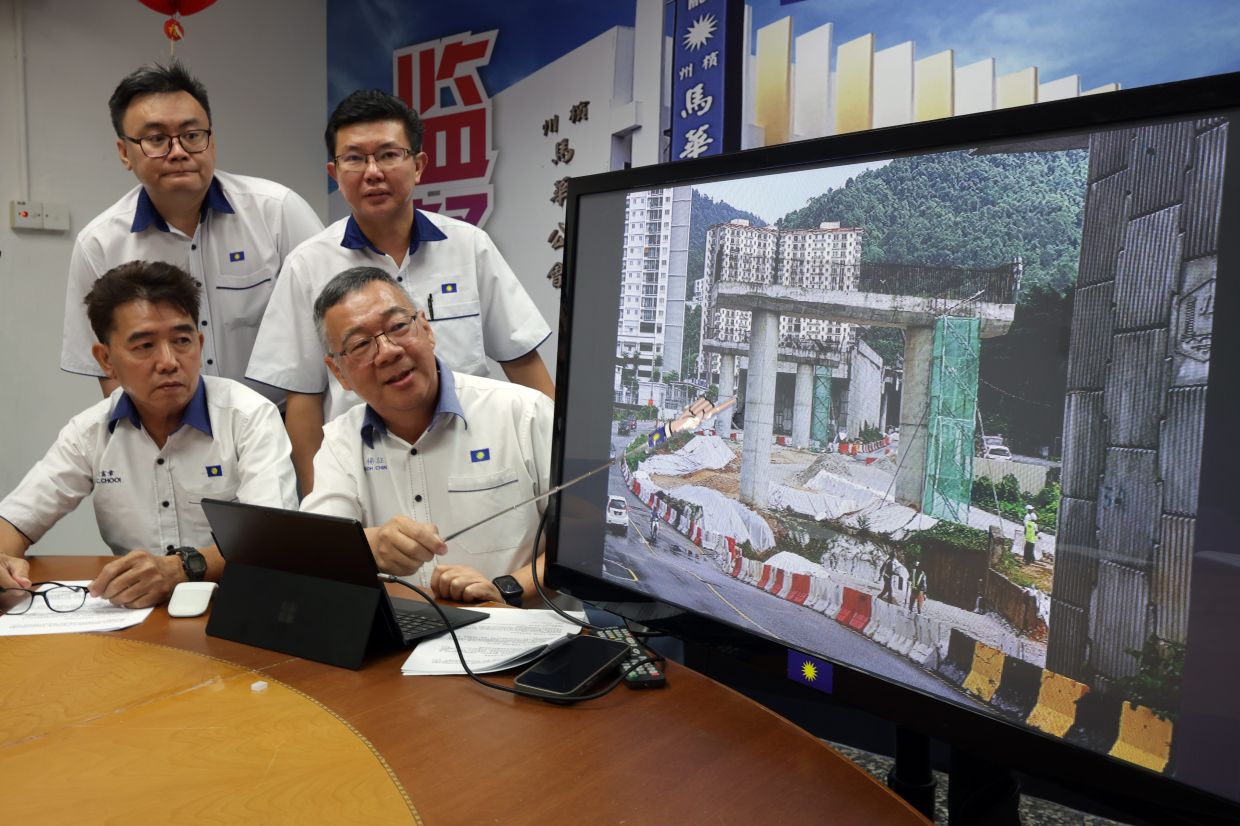
The Penang Malaysian Chinese Association has escalated pressure on the state government over the Air Itam-Tun Dr Lim Chong Eu Expressway bypass project, shifting the debate from simple project delays to fundamental questions of public accountability and financial transparency. Penang MCA secretary Yeoh Chin Kah has issued a formal demand for the immediate release of payment records, consultant certification reports, and comprehensive project assessment documents, framing the dispute as a crisis of public confidence rather than a construction scheduling matter.
The contention centres on the reported completion rate of the 6-kilometre toll-free bypass, which forms the second package of Penang's broader undersea tunnel and paired roads infrastructure initiative. State officials previously characterised the project as being in its "final sprint", yet Yeoh's scrutiny reveals a more problematic narrative. The completion figure jumped from 80 per cent in May to 89 per cent in December, an acceleration that Yeoh argues is mathematically inconsistent with conditions observed during an on-site inspection conducted on 1 July.
Yeoh's fieldwork assessment paints a considerably different picture from official progress reports. During their site visit, Penang MCA representatives documented multiple sections—including Valley Road, Changkat Tembaga, and Jalan Thean Teik—remaining substantially incomplete. Crucially, the team observed that while bridge piers had been installed, the essential structural components including bridge beams and decking remained absent. Road surfacing operations had not progressed to completion across numerous segments, and critical finishing elements such as guardrails, noise barriers, and mechanical and electrical systems were either absent or only partially implemented in many locations. The disconnect between these observable conditions and the claimed 89 per cent completion rate forms the crux of Yeoh's challenge to official methodology.
The political and administrative implications of this dispute extend beyond a single infrastructure project. For Penang, which has positioned itself as a progressive state capable of managing large-scale public works, questions about reporting accuracy and project supervision strike at the heart of governance credibility. The MCA's decision to escalate this matter signals that the issue has transcended partisan differences; both government and opposition figures now face mounting pressure to explain the discrepancies between reported metrics and ground-level reality. This pattern of concern about completion statistics has become familiar across Malaysia's development landscape, where projects frequently experience significant delays while official updates suggest otherwise.
Yeoh has established a seven-day deadline for the state government to produce the requested documentation. Should authorities fail to comply, the MCA has explicitly threatened to lodge formal complaints with the National Audit Department and the Malaysian Anti-Corruption Commission, two institutions with investigative and enforcement authority over public sector accountability. Additionally, the party plans to establish a dedicated committee to monitor both reported progress and payment disbursement compliance, creating an independent oversight mechanism outside government control.
The bypass itself represents a critical infrastructure investment for the northern corridor of Penang Island. Spanning from Lebuhraya Thean Teik in Bandar Baru Air Itam to the existing Tun Dr Lim Chong Eu Expressway, the project utilises a combination of elevated viaducts, underground tunnels, and ground-level roadways to navigate Penang's topographical constraints. The facility is designed to serve approximately 300,000 residents in the Air Itam, Bandar Baru Air Itam, and Paya Terubong areas, with projected benefits including reduced traffic congestion and shortened commute times for these communities.
The original 2024 completion target has already slipped significantly. The project has received two formal time extensions, with the most recent contractual completion date established as 12 April 2027. This extended timeline represents considerable delays that have accumulated over several years of construction, reflecting either initial underestimation of project complexity or implementation challenges not adequately communicated to the public. For residents whose neighbourhoods depend on this road, the repeated postponements have created frustration and scepticism about official timelines.
Paya Terubong assemblyman Wong Hon Wai, speaking for the state government, has maintained that the project stands at 91 per cent completion and remains positioned for delivery by the contractual date. Wong references ongoing meetings with the construction team and asserts that the contractor has confirmed adherence to schedule. Specifically, he indicates that twelve bridge beams on the Gelugor side are scheduled for installation between the current period and August, with the remaining six beams targeted for the fourth quarter. Wong acknowledges that all bridge beams on the Bandar Baru Air Itam side have already been installed, though he notes that road opening will not occur immediately upon construction completion.
Wong's additional comments regarding post-construction procedures reveal the gap between structural completion and public availability. Following the completion of deck slab and parapet works, a Road Safety Audit conducted by the relevant government agency will be required before the Public Works Department determines an actual opening date. This staged approach, while administratively standard for major infrastructure, further complicates attempts to predict when residents will actually benefit from the investment. The timeline separating substantial construction completion from operational opening introduces another variable that could extend delays beyond the official 2027 target.
For Malaysian readers and regional observers, this dispute exemplifies recurring challenges in large-scale infrastructure governance across Southeast Asia. The tension between officially reported progress metrics and independently verified physical conditions reflects broader questions about project management standards, reporting mechanisms, and public sector accountability. Penang's predicament is not unique; similar controversies have emerged in other Malaysian states regarding major road, rail, and port projects, where completion percentages have appeared inflated relative to observable progress.
The MCA's intervention introduces important dynamics into what might otherwise remain an internal administrative dispute. As a component of the ruling Barisan Nasional coalition, the MCA's willingness to escalate public pressure on a state government demonstrates that even coalition partners will challenge accountability lapses when public confidence is at stake. This development suggests that infrastructure accountability will increasingly become a focal point for political contestation across Malaysia, regardless of party affiliation.
The outcome of this dispute carries implications extending beyond Penang. If the state government fails to produce satisfactory documentation or if investigations reveal reporting discrepancies, the precedent will likely influence how future infrastructure projects are monitored and reported across Malaysia. Conversely, if the government successfully demonstrates that reported metrics are accurate and legitimate, it may vindicate the methodologies used in calculating project completion rates. The seven-day window beginning from Yeoh's formal demand has become a critical testing point for institutional accountability and transparency standards in Malaysian public administration.

