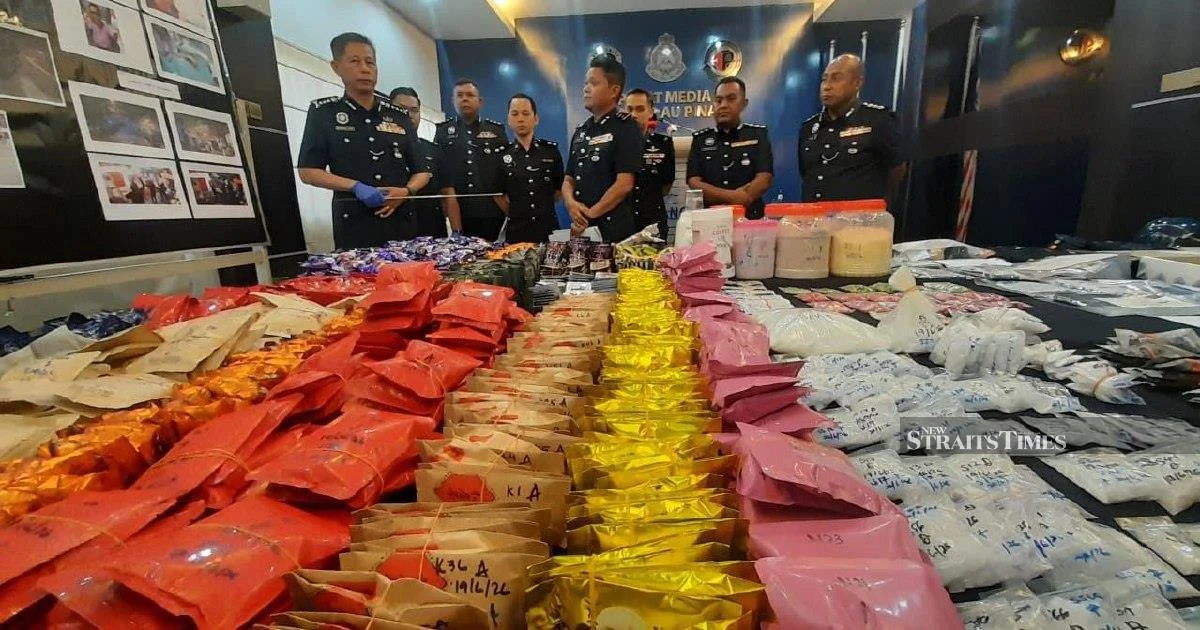
In a significant breakthrough against organised crime in northern Malaysia, the Penang Police contingent has apprehended two suspects and disrupted what investigators describe as a well-organised narcotics enterprise spanning production and street-level distribution. The operation, which centred on illicit manufacturing and redistribution of controlled substances, was concealed within residential quarters at a condominium complex located in Butterworth, highlighting the challenge authorities face in detecting drug operations hidden within seemingly ordinary living spaces.
The seizure of narcotics totalling RM9.7 million represents a major haul for the state, demonstrating the scale and profitability of the smuggling networks operating across the Strait of Malacca region. Such quantities typically indicate involvement in mid to upper-tier trafficking rather than street-level dealing, suggesting the detained pair maintained connections with larger syndicates responsible for supply chain management across multiple states. The discovery underscores how drug trafficking organisations have adapted their methods to exploit residential properties as front locations, complicating enforcement efforts that traditionally focused on detecting manufacturing facilities in industrial zones.
The apprehension of a couple rather than a larger cell reflects evolving operational structures within Southeast Asian drug networks, where intimate partnerships provide insulation from detection and reduce the number of individuals with knowledge of the entire operation. This model has proven effective at minimising exposure points for law enforcement, as romantic relationships often involve higher levels of trust and compartmentalisation compared to purely commercial arrangements. The Penang discovery suggests that intelligence-gathering and community reporting may have provided crucial leads that conventional surveillance techniques missed.
Butterworth's location as a gateway community between Penang Island and the mainland peninsula makes it strategically valuable for distribution networks seeking to move products northward into Thailand or southward toward Kuala Lumpur and beyond. Residential condominiums in the area have become increasingly scrutinised by authorities who recognise their vulnerability to misuse by criminal enterprises seeking anonymity. The seizure highlights how major transport corridors and transit hubs continue to attract trafficking operations regardless of enforcement presence.
The sophistication evident in the condo operation—transforming standard residential accommodation into a functional processing laboratory—illustrates the technical knowledge and resources available to organised crime groups in the region. Manufacturing narcotics requires expertise in chemistry, procurement of precursor chemicals, and understanding of supply chain logistics to ensure consistent product quality. The fact that authorities could identify and dismantle this operation suggests either a significant intelligence breakthrough or systematic improvements in Penang Police's narcotics investigation capabilities.
For Malaysian law enforcement agencies, the RM9.7 million seizure provides temporary disruption to a specific criminal network but raises broader questions about the resilience of drug trafficking organisations. History suggests that successful busts targeting mid-level operators often result in temporary supply shortages that are quickly remedied as networks reorganise and adjust their routes and personnel. Unless the arrest of the couple yields intelligence regarding upstream suppliers or downstream distributors, the impact may prove temporary.
The case carries implications for real estate developers and property management companies across Malaysia, as residential buildings increasingly become sites of police operations and security concerns. Condominium complexes must balance residents' privacy expectations with security responsibilities, a tension that may intensify if drug manufacturing locations continue to proliferate in residential areas. Insurance implications and liability concerns may prompt developers to implement enhanced screening or monitoring protocols.
Regionally, the bust reflects ongoing cooperation and capability building between Malaysian law enforcement agencies and international partners focused on narcotics interdiction. The Penang discovery coincides with broader efforts across ASEAN nations to combat the synthetic drug trade, particularly methamphetamine production and trafficking that has surged across Thailand, Malaysia, and other Southeast Asian territories. Coordinated enforcement actions targeting manufacturing sites and distribution hubs represent an evolving strategy to attack supply rather than merely prosecuting users or low-level dealers.
Investigators will now focus on interrogating the detained couple to establish supply chains, identify customers, and map the distribution network. Financial records associated with the property and the individuals involved may reveal downstream contacts and upstream suppliers whose identities remain unknown to authorities. Such intelligence typically requires months of analysis and cross-referencing with existing databases and informant networks before resulting in secondary arrests.
The broader significance of this Penang operation lies in demonstrating that despite substantial law enforcement resources and cross-border cooperation initiatives, Malaysia remains a critical transit and distribution centre for narcotics throughout Southeast Asia. The continued discovery of high-value manufacturing and distribution operations—even as authorities improve detection capabilities—suggests that demand for controlled substances and profit incentives remain sufficient to sustain replacement operators and networks. Until fundamental drivers of drug market dynamics shift, Penang and similar strategic locations will continue attracting trafficking enterprises willing to accept operational risk in exchange for substantial returns.