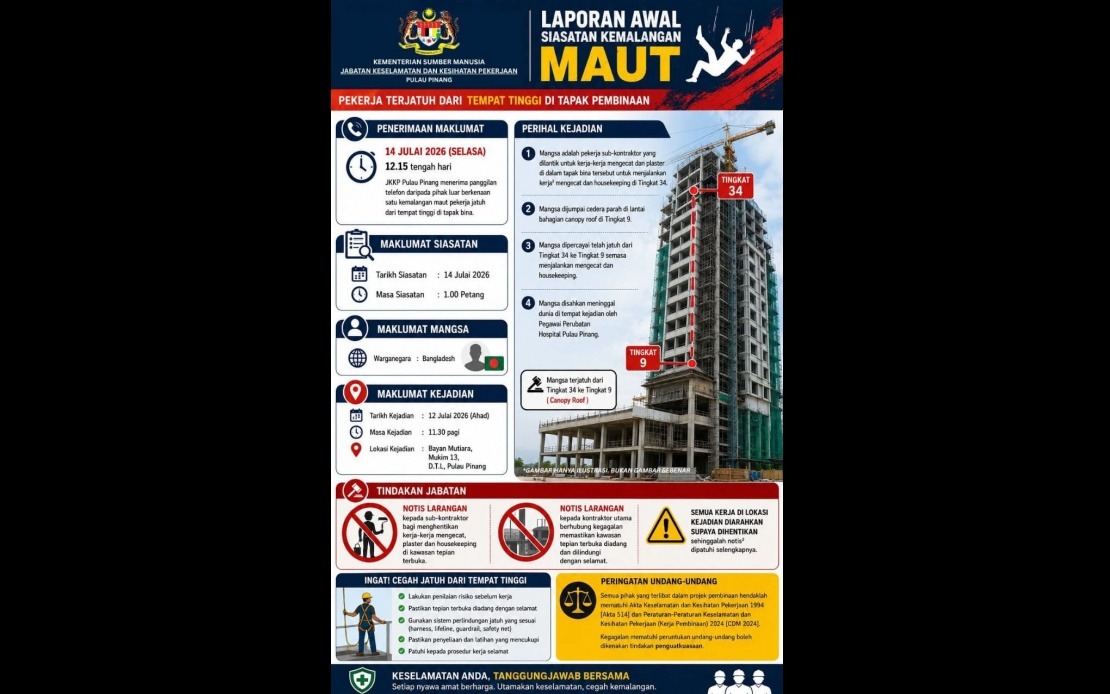
The Penang Department of Occupational Safety and Health (DOSH) has launched a formal investigation into a fatal workplace incident that claimed the life of a Bangladeshi migrant worker at a major construction site in the Bayan Mutiara district of George Town. The incident, which unfolded on July 15, has reignited questions about safety protocols at high-rise construction projects and the protection of foreign workers in Malaysia's building sector.
According to Penang DOSH director Hairozie Asri, the department was notified of the incident by an external party at 12.15 pm on July 14, prompting the immediate dispatch of investigating officers to the location. The sequence of events that followed revealed a catastrophic workplace tragedy with a vertical distance of 25 storeys between the point of incident and final discovery. Upon reaching the site, investigators determined that the deceased worker had been employed through a subcontracting arrangement focused on painting, plastering and housekeeping services. The victim was engaged in work on the 34th floor at the time of the incident but was subsequently discovered in critical condition on the canopy roof structure at Level 9, indicating a severe fall during the course of his duties.
Medical personnel from Penang Hospital attended to the injured worker immediately, though their assessment confirmed that he had succumbed to his injuries at the scene. The rapid deterioration of the worker's condition—from the moment of discovery to death—underscores the severity of the trauma sustained in the fall and highlights the life-threatening nature of unprotected work at such heights. The incident represents a significant failure in workplace safety systems that are designed to prevent precisely such catastrophic outcomes.
In response to the findings, DOSH has taken decisive regulatory action by issuing prohibition notices to the subcontracting entity responsible for the painting, plastering and housekeeping operations. These notices specifically forbid continuation of work in open-edge areas of the construction site—zones where fall hazards are substantially elevated and protective measures are critical. The main contractor has also received a prohibition notice, reflecting the broader accountability structure that exists within Malaysia's construction industry. These regulatory tools represent the primary mechanism through which DOSH enforces compliance with occupational safety standards.
Furthermore, authorities have mandated a complete halt to all work operations at the affected site until the subcontractor and main contractor fully satisfy the conditions outlined in their respective prohibition notices. This work stoppage, though disruptive to project timelines and financially consequential for contractors, reflects the seriousness with which Malaysian authorities treat workplace fatalities. The requirement for full compliance before resumption signals that safety deficiencies must be systematically addressed rather than merely acknowledged.
This incident adds to a concerning pattern within Malaysia's construction industry, where migrant workers—who constitute a substantial proportion of the building workforce—face disproportionate occupational hazards. The predominance of migrant labourers in high-risk roles such as high-altitude painting and finishing work reflects both workforce demographics and economic factors that influence task assignment on construction sites. Bangladeshi workers, in particular, represent a significant contingent within Malaysia's migrant worker population, numbering in the hundreds of thousands across various sectors.
The reliance on subcontracting arrangements, evident in this case, introduces additional layers of complexity into safety accountability. When primary contractors delegate hazardous work to subcontractors, responsibility for worker safety can become fragmented, potentially creating gaps in supervision, training and provision of protective equipment. This structural arrangement warrants scrutiny from both regulators and industry observers, as it may inadvertently distribute accountability in ways that diminish protective outcomes for workers.
Fall prevention remains a persistent challenge within the Malaysian construction industry despite regulatory frameworks and established safety standards. The absence of adequate fall protection systems—whether through harnesses, safety nets, guardrails or other engineering controls—continues to feature in workplace fatalities across the region. The recovery of the victim from a Level 9 canopy roof suggests that whatever safety systems existed at this particular site failed to prevent the initial fall or provide secondary protection against catastrophic impact.
The incident also illuminates broader questions about worker welfare and safety culture within Malaysia's construction sector. Language barriers, limited familiarity with local safety regulations, and power imbalances between migrant workers and employers can create conditions where safety concerns are underreported or inadequately addressed. Training provisions for migrant workers, whether delivered in their home language or through qualified interpreters, require strengthening to ensure comprehension of hazards and proper use of safety equipment.
Regulatory agencies like DOSH play an essential role in this ecosystem, but their effectiveness depends upon adequate resourcing, timely reporting of incidents, and industry cooperation. The fact that DOSH learned of this incident from an external party rather than through immediate employer notification raises questions about reporting mechanisms and industry compliance with notification obligations. Enhanced requirements for immediate incident reporting, coupled with penalties for non-compliance, may strengthen the regulatory framework.
As investigations proceed, the findings are likely to inform broader policy discussions regarding construction safety, migrant worker protections, and subcontracting accountability in Malaysia. The incident also carries implications for other Southeast Asian nations with substantial migrant construction workforces, where similar vulnerabilities may exist. Industry associations, employer federations, and trade unions will likely scrutinise the circumstances that permitted such a fall to occur and evaluate whether existing safety standards require strengthening or whether implementation gaps represent the primary concern.

