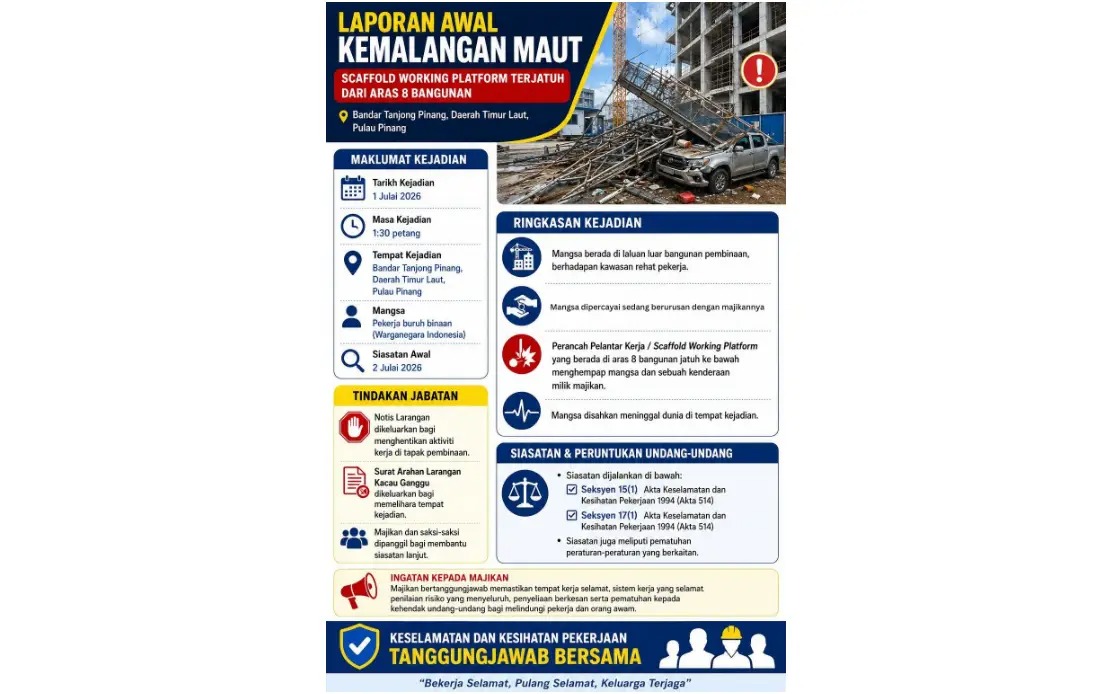
The Department of Occupational Safety and Health (DOSH) Penang has moved swiftly to shut down operations at a Bandar Tanjong Pinang building site after a construction worker died in a scaffolding collapse on July 1. The prohibition notice, issued in the incident's immediate aftermath, represents a critical safety intervention aimed at preventing further loss of life and preserving evidence for ongoing investigations into what appears to be a serious workplace safety breach.
The fatal accident occurred at approximately 1:30 pm when a scaffolding working platform detached from the eighth floor of the building under construction. According to preliminary information gathered by DOSH investigators, the platform fell directly onto an Indonesian worker who was positioned on a lower-level external walkway near the workers' rest area. The victim was engaged in discussion with his employer at the time of the incident, placing him directly in the path of the falling structure. The impact was severe enough to also strike the employer's vehicle, underscoring the considerable force and weight involved in the collapse.
The issuance of the prohibition notice serves multiple critical functions within Malaysia's occupational safety framework. Beyond simply halting work activities at the site, DOSH simultaneously imposed a non-disturbance order designed to preserve the scene in its original condition. This dual approach is essential for forensic investigation, allowing DOSH inspectors and engineers to examine how and why the scaffolding failed, whether proper installation procedures were followed, and what systemic breakdowns contributed to the tragedy. Such preservation is particularly important in construction fatalities, where physical evidence often provides the most reliable indicators of negligence or non-compliance.
Investigations are now concentrated on determining whether the employer, contractor, or project developer violated fundamental workplace safety obligations. DOSH has specifically indicated that the probe will examine compliance with Sections 15(1) and 17(1) of the Occupational Safety and Health Act 1994 (Act 514), provisions that establish the core duties of employers to ensure the health and safety of workers. These sections require employers to implement comprehensive risk management systems, provide adequate training, and maintain equipment in safe working order. The fact that these specific sections are under scrutiny suggests DOSH believes systemic failures rather than isolated incidents may be at play.
The involvement of an Indonesian migrant worker in this incident highlights a persistent vulnerability in Malaysia's construction sector. Foreign workers, who comprise a substantial portion of the construction labour force across the region, often face language barriers, unfamiliarity with local safety regulations, and potential exploitation by unscrupulous employers. Many migrant workers lack the power to refuse unsafe working conditions without risking their employment status and income. This tragedy raises questions about whether adequate safety briefings were conducted in languages the worker understood, and whether the employer maintained culturally sensitive safety protocols for its diverse workforce.
Enforcement action looms for any parties found responsible for violations. DOSH has explicitly warned that if investigations uncover breaches of occupational safety legislation, appropriate legal proceedings will be initiated. This could encompass penalties ranging from substantial fines to potential criminal charges for gross negligence, depending on the severity and nature of the violations discovered. The regulatory approach signals that Malaysian authorities view workplace fatalities with utmost seriousness and are prepared to prosecute cases where preventable failures cost workers their lives.
The agency has also broadened its messaging beyond this immediate incident to address systemic concerns within Penang's construction industry. DOSH's statement directed a comprehensive warning to employers, developers, main contractors, and subcontractors operating across the state, emphasizing that all work activities must be properly planned and executed in accordance with safety standards. This collective messaging reflects recognition that construction site safety is not merely an individual company responsibility but a shared obligation across the entire supply chain. Main contractors, who hold ultimate responsibility for site safety regardless of subcontracting arrangements, must establish robust safety cultures and enforcement mechanisms.
For Malaysian readers and the broader Southeast Asian construction sector, this incident serves as a sobering reminder of the human cost of safety negligence. Penang, as a major industrial and manufacturing hub with substantial ongoing construction development, has particular responsibility to maintain rigorous safety standards. The proximity of the Bandar Tanjong Pinang site to urban areas means that unsafe practices not only endanger workers but potentially threaten public safety. Neighbouring construction sites and projects should view this stop-work order not as an isolated enforcement action but as a warning signal that DOSH will actively intervene when hazards threaten worker welfare.
The broader context of workplace safety in Malaysia and Southeast Asia remains troubling. Construction remains one of the region's most hazardous industries, with fatality and serious injury rates substantially exceeding most other sectors. Inadequate supervision, cost-cutting measures, insufficient training, and poor maintenance of equipment combine to create environments where preventable tragedies occur regularly. The scaffolding collapse that killed this Indonesian worker likely resulted from a combination of such factors rather than a single catastrophic failure, suggesting systemic rather than exceptional problems at the site.
Moving forward, DOSH's investigation will produce technical findings that should inform broader policy discussions about construction safety standards in Penang and across Malaysia. Whether current regulations are adequately stringent, whether enforcement resources are sufficient, and whether penalties are punitive enough to deter violations are questions that industry observers will scrutinize carefully. For workers and their families, particularly those from migrant communities with limited political voice, ensuring that investigations result in genuine accountability represents their best protection against future tragedies.

