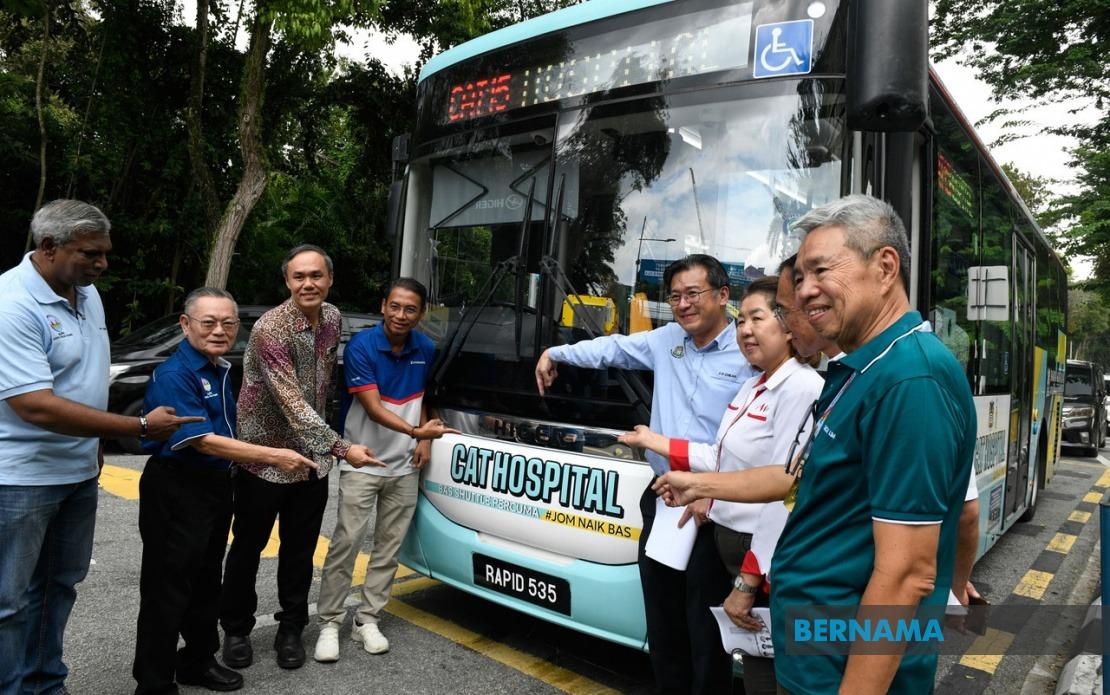
The Penang Island City Council (MBPP) is investing substantially in public health accessibility by dedicating RM900,000 each year to operate a free shuttle bus service that serves hospital patients, elderly residents, and caregivers across George Town. Launched on January 1, the Central Area Transit (CAT) service links Komtar with Penang Hospital (HPP), three private medical facilities, and several health-related institutions clustered in the central business district, addressing long-standing transportation challenges in the area.
According to MBPP Engineering Director Cheah Chin Kooi, the initiative reflects a deliberate policy shift toward reducing vehicle dependency and easing congestion in one of the city's most traffic-prone zones. The decision to underwrite the service free of charge removes a financial barrier for vulnerable populations accessing critical healthcare, a consideration particularly important in an ageing Malaysian demographic. By removing the transport cost from the equation, the council aims to ensure that financial constraints do not prevent individuals from seeking necessary medical attention.
The service has demonstrated stronger-than-expected uptake in its early months of operation. Initial projections anticipated around 300 daily passengers when the route commenced operations at the start of the year. Current ridership figures reveal nearly a 100 percent increase to approximately 600 passengers daily, suggesting both genuine demand for the service and successful public awareness of its availability. This momentum indicates that the investment is meeting a real need rather than addressing a hypothetical gap in the transport network.
The operational backbone of the service comprises three Rapid Penang buses traversing an eight-kilometre route throughout the day. Buses operate between 6 am and 8 pm, covering the prime hours when patients attend appointments and hospital activity peaks. The schedule includes 36 daily trips at consistent 20-minute intervals, providing reliability that encourages commuters to time their journeys around the published timetable rather than viewing the service as unpredictable or unreliable. This frequency represents a substantial public transport commitment in a city where bus intervals sometimes extend far beyond this standard.
The initiative emerged from systematic planning rather than ad-hoc decision-making. MBPP conducted a dedicated survey following the completion of Penang Hospital's expansion project, which created additional capacity but also exacerbated parking constraints in the surrounding residential and commercial area. The expanded facility drew more patients and visitors, intensifying the search for parking spaces and creating traffic bottlenecks on adjacent streets. Rather than viewing this as purely a hospital management problem, the council recognised its role in providing complementary public transport infrastructure that could simultaneously serve hospital users and reduce broader congestion.
The service design specifically prioritises accessibility for demographic groups with particular transportation needs. Senior citizens, whose mobility may be limited by age or health conditions, benefit from having a dedicated free transport link to medical facilities. Caregivers accompanying patients receive the same benefit, reducing the need for multiple private vehicles when hospital visits occur. Patients themselves, potentially experiencing reduced capacity to drive due to their medical conditions or treatment outcomes, gain independence through access to reliable public transport.
Physical infrastructure improvements complement the bus service implementation. Penang Hospital has upgraded the pedestrian walkway along Jalan Residensi to provide safer, more comfortable passage for those arriving by bus. Concurrently, modifications to the main entrance on Jalan Utama are under way to ensure that the bus stop area integrates smoothly with the hospital's access points. These complementary investments demonstrate recognition that successful public transport integration requires coordinated effort across multiple agencies and departments.
The stakeholder support evident at the service launch reflects broad institutional buy-in. Rapid Bus's Northern Region leadership participated in the inspection and endorsement of the service, indicating commitment from the private transport operator. Penang Hospital's director publicly acknowledged the initiative and detailed the complementary infrastructure improvements being undertaken. The Penang Women's Development Corporation's presence signals recognition of the particular benefits for female patients and caregivers, though this dimension received limited elaboration in available reporting.
For Malaysia's broader transport policy environment, the Penang initiative offers a valuable case study in targeted public investment returning measurable results. Rather than attempting system-wide transformation at enormous cost, the council identified a specific congestion point linked to a major institutional anchor and deployed resources efficiently. The doubling of ridership suggests that similar analyses of other healthcare, educational, or employment nodes across Malaysian cities could justify comparable investments in feeder transport services.
The financial sustainability of the RM900,000 annual commitment warrants monitoring as the service matures. If ridership continues its upward trajectory, cost per passenger will decline, potentially creating space within the budget for service expansion. Conversely, if ridership plateaus, the council may need to reassess whether the investment level remains justified or whether service adjustments could improve cost efficiency. Regular review mechanisms will help ensure that the allocation continues serving public interest rather than persisting from institutional inertia.
From a Southeast Asian perspective, Penang's approach aligns with emerging recognition that accessible public health infrastructure requires supporting transport services. As regional economies develop and healthcare facilities expand, the transportation implications deserve explicit policy attention rather than appearing as secondary considerations. The Malaysian initiative demonstrates that cities need not view transport and health policy in silos; coordinated action yields benefits across multiple objectives simultaneously.

