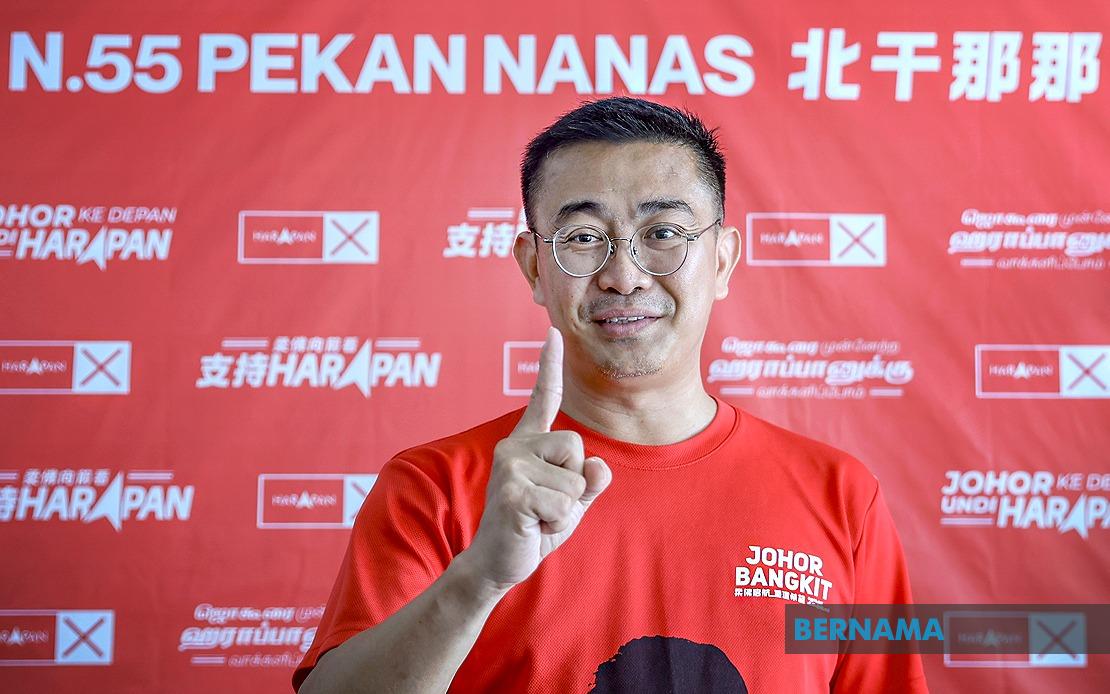
Yeo Tung Siong, the Pakatan Harapan candidate contesting the Pekan Nanas state constituency in Johor's latest election cycle, is building his campaign strategy around a decade of prior legislative service. The former two-term assemblyman, who represented the area from 2013 until 2022, believes his established track record and connections within the community position him favourably to recapture the seat from the incumbent Barisan Nasional representative, Tan Eng Meng. In an interview conducted in Pontian, Yeo expressed confidence rooted not merely in nostalgia but in demonstrable engagement metrics throughout the campaign period.
Central to Yeo's confidence is his assertion that his team has successfully connected with approximately 60 per cent of the constituency's voters through an intensive ground operation. The outreach strategy has encompassed traditional door-to-door canvassing, informal gatherings in residential areas, marketplace visits spanning wet markets and flea market environments, and engagement sessions at local food establishments. This methodical approach reflects a calculated effort to rebuild the grassroots network that sustained his previous electoral victories. The breadth of interactions, Yeo maintains, has generated consistently positive reception, suggesting receptiveness to his return to office.
Yeo's professional background as a former vice-principal and discipline teacher informs his political persona and campaign messaging. He presents himself as an accessible, protocol-light representative who prioritises constituent service over ceremonial trappings. This characterisation stands in implicit contrast to the formality sometimes associated with traditional political hierarchies in Malaysia. His stated philosophy emphasises immediate availability and personal responsiveness, positioning him as someone willing to undertake site visits and direct problem-solving rather than delegating constituent concerns through administrative channels.
During his previous tenure, Yeo secured infrastructure allocations that addressed longstanding local challenges. Most notably, he obtained a RM500,000 allocation directed toward rectifying flow issues in the Pulai River, a perennial source of flooding vulnerability in the area. This initiative demonstrates capacity to navigate state budgetary processes and secure resources for hydraulic management. Additionally, his collaboration with private sector partners yielded a drainage project on the periphery of Kampung Melayu Raya, illustrating his willingness to mobilise multi-stakeholder partnerships for localised infrastructure improvement.
The campaign feedback Yeo has gathered reveals persistent grievances that likely resonate across comparable Malaysian constituencies. Traffic congestion and employment scarcity emerge as dominant concerns among voters. These issues reflect broader Southeast Asian urbanisation pressures, particularly acute in regions proximate to major economic centres. Johor's geography, positioned between Pontian and the state capital of Johor Bahru, intensifies these mobility challenges. The commuter burden affects both economic productivity and household budget allocation, making transportation infrastructure a politically salient issue.
Responding to traffic concerns, Yeo has identified two shortcut initiatives as priority projects should voters return him to office. The first involves constructing a route between Ulu Pulai and Pekan Nanas, while the second encompasses establishing a junction linking Pulai to Sri Bunian. Both interventions are designed to reduce transit times along the Pontian-Johor Bahru corridor, thereby alleviating bottlenecks that currently impose time costs on commuters and commercial transport operators. Such infrastructure projects carry significance for regional logistics efficiency and worker competitiveness in the wider Johor labour market.
Employment generation represents Yeo's second major campaign commitment. He proposes reviving a career carnival initiative that operated during his previous tenure, structured as a collaborative vehicle between his office and major employers operating in the Pekan Nanas vicinity. The mechanism seeks to address a mismatch between local job availability and workforce capacity, a structural problem affecting many secondary Malaysian constituencies. By fostering direct engagement between corporate recruiters and local job seekers, the initiative sidesteps conventional employment service bureaucracies and generates immediate labour market connections.
Beyond these flagship infrastructure and employment commitments, Yeo emphasises enhanced social safety-net administration. He indicates intentions to strengthen coordination with government welfare bodies including the Social Welfare Department (JKM) and the Social Security Organisation (SOCSO), ensuring that eligible residents receive appropriate assistance to which they are entitled. This pledge targets administrative efficiency within existing programme frameworks rather than advocating for expanded entitlements, a positioning that acknowledges fiscal constraints whilst promising improved service delivery on established schemes.
The Pekan Nanas contest unfolds as a direct two-candidate race, rendering it a bellwether contest within Johor's broader electoral dynamics. The one-on-one structure between Yeo and incumbent Tan Eng Meng eliminates vote-splitting scenarios and produces a zero-sum contest where victory margins directly reflect comparative voter preference rather than being mediated by third-party candidates. For PH, recapturing Pekan Nanas would represent meaningful progress in Johor, a state where the coalition faces structural challenges in challenging BN's entrenched dominance.
Yeo's campaign architecture reflects broader PH strategy in Johor: mobilising candidates with established local legitimacy and concrete achievement records to challenge incumbent BN representatives. This approach contrasts with deploying centralised party machinery or celebrity candidates, instead emphasising constituency-specific continuity and personal service delivery. The success or failure of such efforts will illuminate whether Johor voters prioritise party affiliation or individual representative performance when making electoral decisions.
The Pekan Nanas dynamics extend beyond local significance. Johor's status as Malaysia's second-largest state by population, combined with its economic importance as a manufacturing and logistics hub, renders its electoral outcomes consequential for national political trajectories. The state election's outcome will partially determine whether PH can consolidate support in peninsular Malaysia's southern tier or whether BN retains its traditional stronghold. Individual contests like Pekan Nanas represent the granular mechanisms through which such broader shifts either emerge or fail to materialise.

