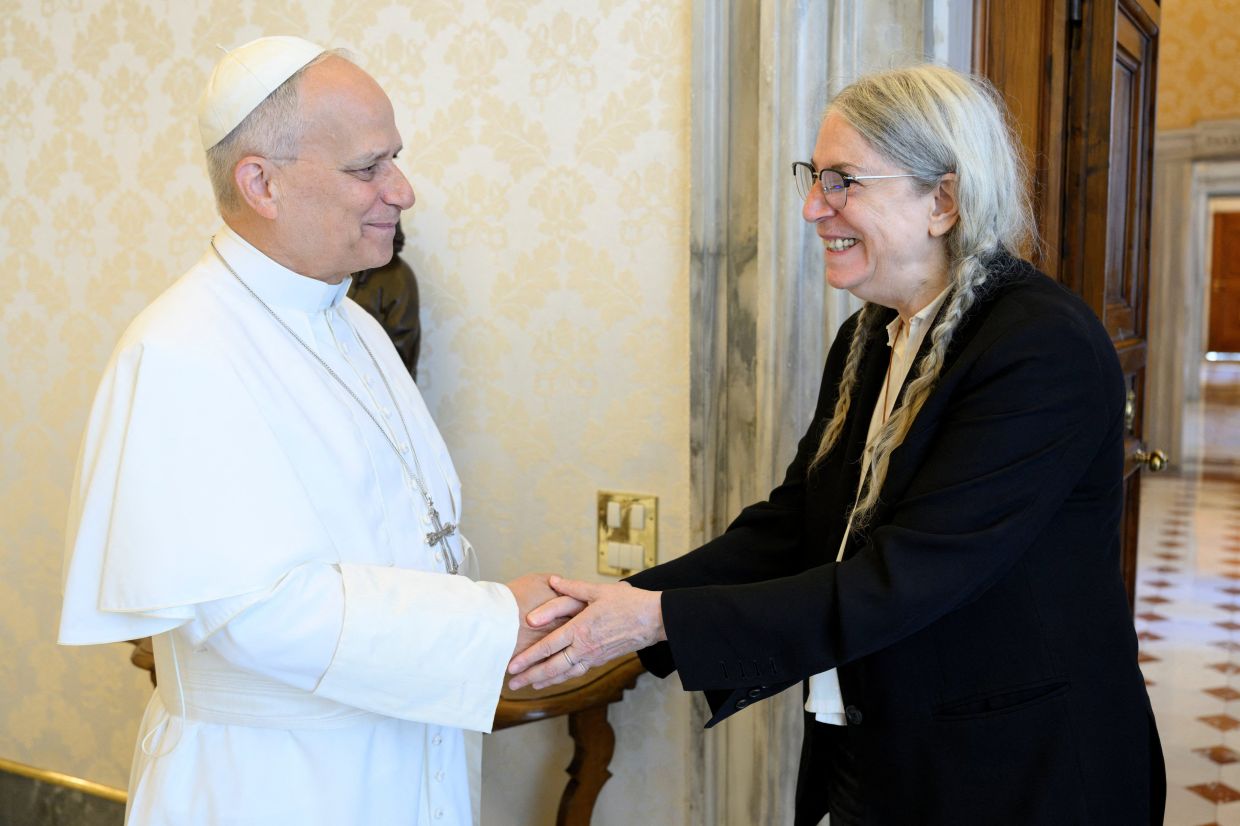
Rock music legend Patti Smith found herself momentarily speechless during a Friday audience with Pope Leo XIV at the Apostolic Palace, managing only a soft greeting as she settled into conversation with the pontiff. The encounter, lasting approximately forty minutes, represented a remarkable convergence of two worlds: the rebellious spirit of punk rock and the solemn traditions of the Vatican's highest office. What began as a simple "Hi" blossomed into what observers described as an unexpected meeting of kindred spirits, each bearing the imprint of Chicago's cultural legacy.
Smith's growing presence within Vatican circles reflects her unlikely but genuine spiritual journey over recent decades. Despite her continued stance outside the Catholic faith, the Grammy-winning artist has cultivated a meaningful connection with Church leadership, particularly through her friendship with Rev Antonio Spadaro, a senior Vatican official overseeing cultural affairs. This relationship has provided Smith with an extraordinary platform to participate in some of the Church's most significant artistic and institutional moments. Adorned with her signature crucifix necklace and characteristic braided hairstyle, Smith has become an increasingly recognisable figure at papal events, bridging the often-distant worlds of contemporary music and religious ceremony.
Smith's spiritual interests have long transcended denominational boundaries, rooted instead in humanistic values and artistic expression. Her publicly stated admiration for Pope Francis centred on what she described as his "gentle, open, and steadfast sense of humanity"—qualities that resonated deeply with her own artistic philosophy and worldview. This attraction to Francis's papacy, combined with her documented affection for earlier pontiffs, demonstrates how personal connection and shared values rather than theological conformity have shaped her relationship with the institution. Her reverence for spiritual leadership that prioritises compassion and openness has made her a natural ally for a modernising Vatican seeking to strengthen its appeal among creative communities and younger generations.
The significance of Smith's Friday encounter extends beyond mere celebrity spectacle. Spadaro's characterisation of the meeting as a conversation "between two people discovering they were old friends, sharing memories woven from words and music, dreams, visions, and hopes" suggests a genuine intellectual and emotional exchange. Both figures, despite their vastly different domains of influence, occupy positions as cultural commentators and voices for alternative perspectives. For the Vatican, such encounters with internationally respected artists serve a strategic purpose: they humanise the institution and demonstrate its commitment to engaging with contemporary culture beyond purely religious contexts.
Smith's involvement with the Vatican's cultural initiatives has expanded notably this year. In May, she performed during the formal inauguration of the Holy See's pavilion at the Venice Biennale, one of the world's most prestigious contemporary art exhibitions. The timing held particular symbolic weight, coinciding with the anniversary of Pope Leo XIV's election. This performance positioned Smith as a key figure in the Vatican's efforts to establish itself as a patron and participant in global artistic discourse, rather than merely an observer of cultural trends. Through music, Smith articulated values of spirituality, human dignity, and artistic freedom that align with contemporary papal messaging.
Smith's emotional response to Pope Francis's death in April 2025 provided poignant testimony to the depth of her connection with the late pontiff. She published a poem on social media comparing Francis to a humble yet resilient dandelion, reflecting on how "nature and poetry and the suffering shall miss their champion." This public grieving, expressed through characteristically poetic language, demonstrated that her Vatican involvement represented far more than ceremonial appearances or networking opportunities. Rather, her engagement with the Church reflected a genuine spiritual affiliation with leaders she perceived as advocates for the marginalised and champions of human compassion.
The relationship between prominent musicians and the papacy remains relatively uncommon, making Smith's sustained presence at Vatican events particularly noteworthy. Historically, such collaborations have tended toward the ceremonial and traditional, featuring classical composers or liturgical specialists. Smith's participation signals a deliberate broadening of the Vatican's cultural horizons, acknowledging that spiritual and artistic truth can manifest through contemporary musical forms. Her punk-rock background, once considered antithetical to institutional religion, now appears compatible with a papacy increasingly willing to challenge conventions and meet contemporary society on unfamiliar ground.
Smith's journey from rock rebel to papal confidante reflects broader shifts in how established institutions engage with cultural creativity. Rather than insisting on conformity or traditional expressions of faith, the Vatican under recent leadership has demonstrated willingness to collaborate with artists whose work transcends conventional religious frameworks. For Smith, this represents validation that artistic integrity and spiritual inquiry need not be compartmentalised or compromised. Her presence at the Apostolic Palace symbolises the possibility of meaningful dialogue between seemingly incompatible worldviews—the antithesis of polarised thinking that increasingly characterises global discourse.
The Friday meeting occurred within a week of other significant cultural engagements at the Vatican. On Wednesday, Pope Leo XIV attended a concert honouring his papacy performed by renowned tenor Andrea Bocelli, suggesting a deliberate papal strategy to cultivate relationships with major cultural figures. These carefully orchestrated encounters serve multiple purposes: they generate positive international media coverage, reinforce the Vatican's cultural relevance, and provide opportunities for dialogue between Church leadership and influential voices outside traditional religious structures. For leaders like Smith and Bocelli, such engagements offer platforms to express values of compassion and transcendence through their respective art forms.
Smith's quiet "Bye. Bye." at the conclusion of her audience with Leo XIV brought a characteristically understated closure to a meeting laden with symbolic significance. Yet the encounter extends implications far beyond the Apostolic Palace walls. In a world increasingly fractured by ideological rigidity and institutional distrust, the image of an iconic rock musician and the Pope engaged in genuine conversation suggests possibilities for unexpected understanding. For Malaysian and Southeast Asian observers, the meeting exemplifies how cultural diplomacy and artistic engagement can bridge seemingly insurmountable divides, offering models for interfaith and intercultural dialogue in our own religiously and culturally diverse region.

