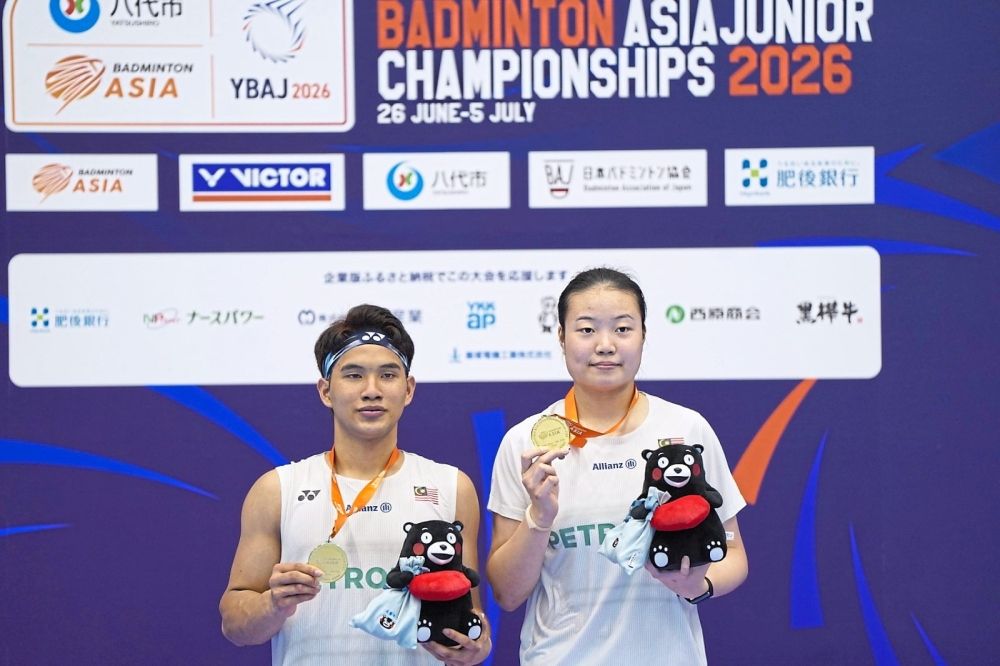
Malaysia has ended a 19-year drought in mixed doubles at the Asian Junior Badminton Championships with an impressive victory in Yatsushiro, Japan. The pairing of Ahmad Redzuan Zulwaqqarizal and Low Zi Yu defeated China's Zheng Weigang-Li Menghan in a competitive final, securing a 21-15, 22-20 triumph that took just 43 minutes to complete. The victory marks only the second time since 2007 that Malaysian shuttlers have claimed the mixed doubles crown at this prestigious tournament, underlining the significance of the achievement for the national junior badminton programme.
The nature of the final revealed much about why this Malaysian combination succeeded where so many before them have faltered. Trading points in an increasingly tense second game, Redzuan and Zi Yu found themselves positioned at 20-20, seemingly locked in a battle that could have tilted either way. It was precisely at this critical juncture that the Malaysian pair demonstrated the mental fortitude required to convert opportunity into triumph. Zi Yu reflected on the psychological dimensions of their performance, noting that composure and strategic patience ultimately separated the two teams. The Chinese challengers, despite their strength and technical abilities, appeared unable to match the Malaysian duo's focus when the pressure intensified in the final moments.
Beyond individual technique and tactical awareness, Zi Yu highlighted an often-overlooked element in competitive sport: the power of team support. Even though Malaysia's other junior representatives had concluded their competitions without capturing medals, their continued encouragement from the sidelines provided emotional sustenance during the closing stages of the mixed doubles final. This intangible advantage—the knowledge that teammates were invested in their success regardless of their own results—apparently sharpened rather than distracted the pair. For young athletes competing at international level, such solidarity within national contingents can prove decisive when matches reach their most fraught moments.
For Redzuan specifically, this success represented vindication after three consecutive disappointing campaigns at the Asian Junior Championships. The Terengganu-born player first competed at the 2023 edition in Yogyakarta, entering both the boys' doubles and mixed doubles competitions but encountering early eliminations in each event. Rather than improving trajectory, the subsequent 2024 Yogyakarta championships and 2025 Surakarta championships both delivered similar frustrations. Through three iterations of the tournament, Redzuan accumulated experience but little silverware, making his breakthrough in mixed doubles all the more significant. His perseverance through multiple setbacks speaks to the patience and resilience that Zi Yu identified as crucial to their final victory—qualities that Redzuan has clearly internalized through his tournament journey.
Redzuan's own assessment of his performance provided revealing insights into the gap between preparation and execution at elite junior level. He emphasized that his primary satisfaction derived not from the medal itself but from successfully implementing the tactical and technical work developed during training sessions with his coaching team. This distinction—between process-oriented improvement and result-oriented achievement—reflects maturity in how he frames his development. Redzuan acknowledged that despite capturing a major title, significant room for growth remains as he contemplates progression to senior international circuits, where the standards, pace, and physical demands escalate considerably. This realistic perspective suggests he recognizes the Asian Junior Championships victory as a milestone rather than a destination.
Zi Yu's parallel commitment to competing in both girls' doubles and mixed doubles added another layer to her contribution to this championship. At just 15 years old, managing two distinct partnerships simultaneously could theoretically create complications, with different tactical approaches and relational dynamics across events. However, Zi Yu indicated that having capable partners in both categories actually simplified rather than complicated her mental preparation. With Genevie Lim in girls' doubles and Redzuan in mixed doubles, she described both athletes as sufficiently skilled to manage their own court responsibilities independently. This allowed Zi Yu to concentrate on executing her own assignments without the burden of compensating for weaker partners—a considerable advantage for a young player still developing her own technical consistency.
The girls' doubles campaign, while ultimately unsuccessful, still yielded a bronze medal following Zi Yu and Lim's semi-final loss to Japan's second-seeded pairing of Aoi Banno-Yuzu Ueno. The Japanese combination prevailed 21-16, 17-21, 17-21 in a match that saw the Malaysian pair force a deciding game but ultimately fall short. Despite this setback, a bronze medal represents respectable achievement at an Asian-level junior championship, particularly for a 15-year-old competing in a secondary event. The contrast between collecting bronze in girls' doubles while capturing gold in mixed doubles underscores the different variables in play across badminton's specialized disciplines—even talented young players cannot expect consistency across multiple categories.
Malaysia's return to the mixed doubles throne carries broader implications for the nation's junior badminton pathway. The previous Malaysian victors, Tan Wee Kiong and Woon Khe Wei, claimed their title nearly two decades ago in 2007 when Kuala Lumpur hosted the championships. That such a lengthy interval has elapsed since the last Malaysian mixed doubles success suggests either changing competitive dynamics in the region or evolving challenges within Malaysia's youth development system. The emergence of Redzuan and Zi Yu indicates that pathways for nurturing junior talent remain functional, though the 19-year gap raises questions about sustainability and consistency in identifying and developing mixed doubles combinations specifically.
The broader results from this edition reveal a championship landscape in which China and Japan continue to dominate most categories. China captured both singles titles—Yin Yiqing in women's and Hong Tianyue in men's—while also pushing to the mixed doubles final through Zheng Weigang-Li Menghan. Japan established control over the doubles events, winning women's doubles through Aoi Banno-Yuzu Ueno and claiming the men's doubles crown via Huang Tzu-yuan-Lin Sheng-ming, though Taiwan also produced a men's doubles finalist. In this competitive context, Malaysia's isolation of mixed doubles gold represents a genuine breakthrough, suggesting that targeted investment in this particular specialty has produced returns.
For Malaysian badminton observers, the championship provides optimism about the pipeline of junior talent available to transition into senior international competition. Both Redzuan and Zi Yu remain firmly at the junior level, with years of development ahead before they would typically be expected to contribute meaningfully to senior national teams. However, their demonstrated ability to perform under pressure in Asian-level finals indicates that the groundwork for future senior contributions is being established. Whether they can translate this junior success into sustained senior-level achievement will depend on the quality of their continued coaching, the robustness of their physical development programmes, and their capacity to adapt to the significant step up in competition standard that awaits them.

