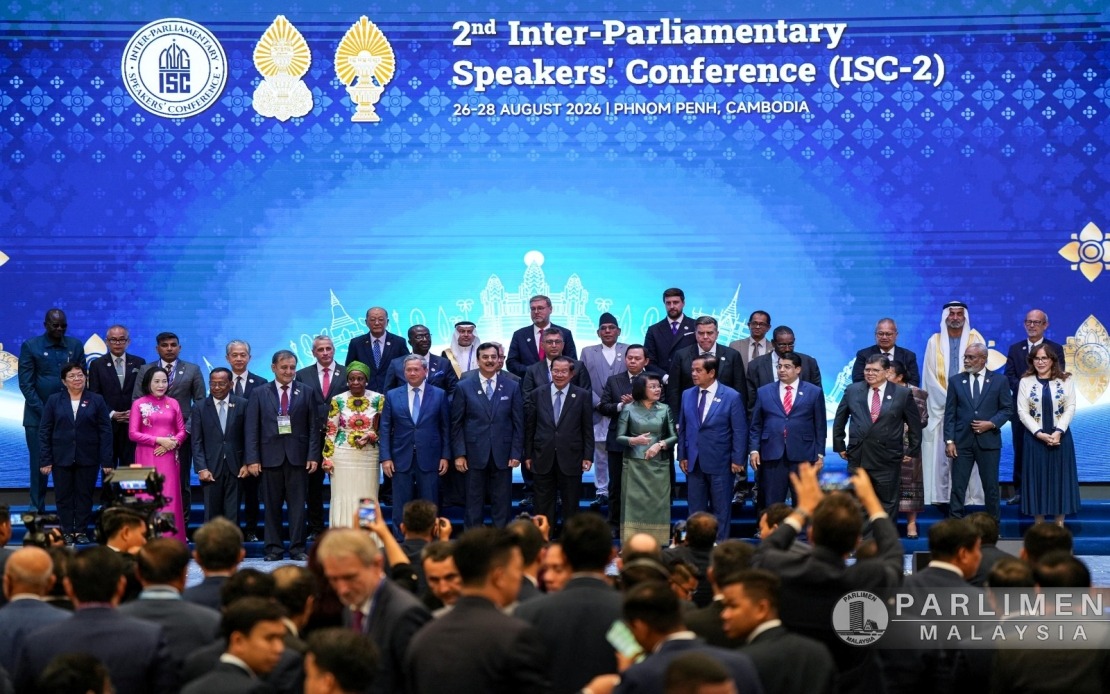
The distinction between the work of elected legislatures and sitting governments has grown increasingly blurred in addressing the world's most pressing security challenges, according to Tan Sri Dr Johari Abdul, Speaker of the Dewan Rakyat. Speaking at the Second Inter-Parliamentary Speakers' Conference in Phnom Penh on Friday, Johari made the case that parliaments possess unique institutional advantages that remain underutilised when it comes to building durable solutions to conflict, geopolitical fractures, and the climate crisis now destabilising communities across multiple continents.
The conference, convened jointly by Cambodia's National Assembly and Senate under the banner "Solidarity for Peace and Shared Prosperity: Strengthening International Law and Resolving Conflicts Peacefully," has drawn legislative leaders from across regions to discuss how their institutions can operate more effectively on the international stage. For Malaysia's top parliamentary official, the gathering represents an opportunity to reshape assumptions about where diplomatic leverage and problem-solving authority should rest. Johari contended that the Inter-Parliamentary Speakers' Conference itself demonstrates the value of creating dedicated forums where legislators can collaborate on transnational dilemmas that transcend the capacity of any single government to resolve.
The Malaysian speaker identified a fundamental asymmetry in how the world currently tackles peace and security. Executives and their bureaucracies typically command the formal machinery of diplomacy, treaty-making, and international relations. Yet parliaments, he argued, often possess a more granular understanding of the actual impact of geopolitical decisions on ordinary citizens. When governments negotiate or take unilateral action on matters of war, sanctions, or territorial disputes, the human cost registers immediately in legislative chambers, where members answer directly to voters. This constituency connection equips parliaments with both moral authority and practical insight that executive bodies may lack or deprioritise when navigating realpolitik considerations.
Johari emphasised that the complementary strengths of executive and legislative branches create a more robust decision-making architecture. While governments necessarily weigh strategic and political calculations, parliaments can inject concerns about sovereignty, rule of law, and the welfare of affected populations into deliberations that might otherwise reduce complex human situations to tactical problems. He suggested that this division of institutional perspective, far from creating friction, actually strengthens governance when the two branches work in concert rather than operating in silos. The synergy between executive expertise and legislative wisdom, he maintained, produces outcomes more likely to endure and command legitimacy across multiple constituencies.
Climate-related challenges amplify the need for this parliamentary engagement. As environmental degradation displaces populations, triggers resource competition, and deepens existing grievances, the human dimensions of climate security have become inseparable from traditional military and diplomatic concerns. Parliaments, whose members grapple daily with constituent demands for liveable environments and sustainable development, bring essential perspective to these overlapping crises. When climate impacts and geopolitical tensions converge—as they increasingly do across Africa, South Asia, and the Pacific—legislative bodies are uniquely positioned to articulate the connections that government negotiators might compartmentalise.
Parliamentary diplomacy offers a distinct advantage when formal state-to-state relations deteriorate or freeze. Unlike official government channels, which can be suspended or severed in moments of crisis, legislative engagement persists across political ruptures. Parliamentarians from rival nations can continue conversations, exchange information, and explore common ground even when their governments declare hostile postures. This sustained dialogue creates what Johari termed space for reflection and trust-building across otherwise hardened divides. By keeping communication alive and humanising opponents through direct encounter, parliamentary channels help prevent conflicts from calcifying into zero-sum contests where each side assumes the worst about the other's intentions.
For Southeast Asia specifically, Johari framed parliamentary engagement as essential reinforcement of ASEAN's foundational commitment to dialogue and non-interference. The region achieved decades of relative stability by anchoring its architecture in principles of sovereignty, non-aligned diplomacy, and consultation rather than coercion. Yet these hard-won norms face mounting pressure as great-power competition intensifies across the South China Sea and as internal tensions within member states threaten regional cohesion. Malaysian parliaments, alongside their counterparts across the ten-member bloc, can actively defend and strengthen these principles by reinforcing them at the legislative level and building relationships between parliamentarians that mirror and support the state-to-state relationships that ASEAN maintains.
The practical mechanism Johari proposed involves parliaments institutionalising their role in foreign policy deliberation and international engagement. Rather than limiting legislatures to rubber-stamping executive decisions on treaties or military deployments, systems should embed parliamentary scrutiny and debate into these processes from the outset. Committees focused on international relations, human rights, and humanitarian concerns should operate with genuine investigative and recommendatory power. Bilateral and multilateral parliamentary exchanges should be resourced and prioritised as mechanisms for confidence-building and early warning about deteriorating situations.
Indonesia's forthcoming hosting of the third Inter-Parliamentary Speakers' Conference signals momentum behind this institutional evolution. The conference series, initiated by Pakistan in 2025, represents an attempt to create recurring platforms where legislative leaders can coalesce around shared principles and develop practical collaborative mechanisms. Each conference builds on the previous gathering's outcomes and allows participating nations to demonstrate concrete progress in parliamentary cooperation on global challenges. For countries like Malaysia, these forums provide opportunity to amplify Malaysian perspectives on international law, peaceful dispute resolution, and the protection of smaller nations' interests in an increasingly multipolar world.
The challenge ahead involves translating rhetorical commitment into institutional change. Many governments remain reluctant to dilute executive control over foreign policy by granting parliaments genuine influence. Domestic legislative institutions in different nations possess vastly different authority and resources, creating potential disparities in who wields voice at inter-parliamentary gatherings. Questions also persist about whether parliamentary diplomacy can actually alter outcomes or merely provide cathartic debate without consequences. Yet Johari's insistence that peace and justice cannot remain executive monopolies reflects growing recognition that durable solutions to global problems demand broader societal participation and legitimacy than technocratic governance alone can provide. As conflicts grow more complex and geopolitical divides deepen, the case for parliamentary engagement becomes increasingly difficult to dismiss.

