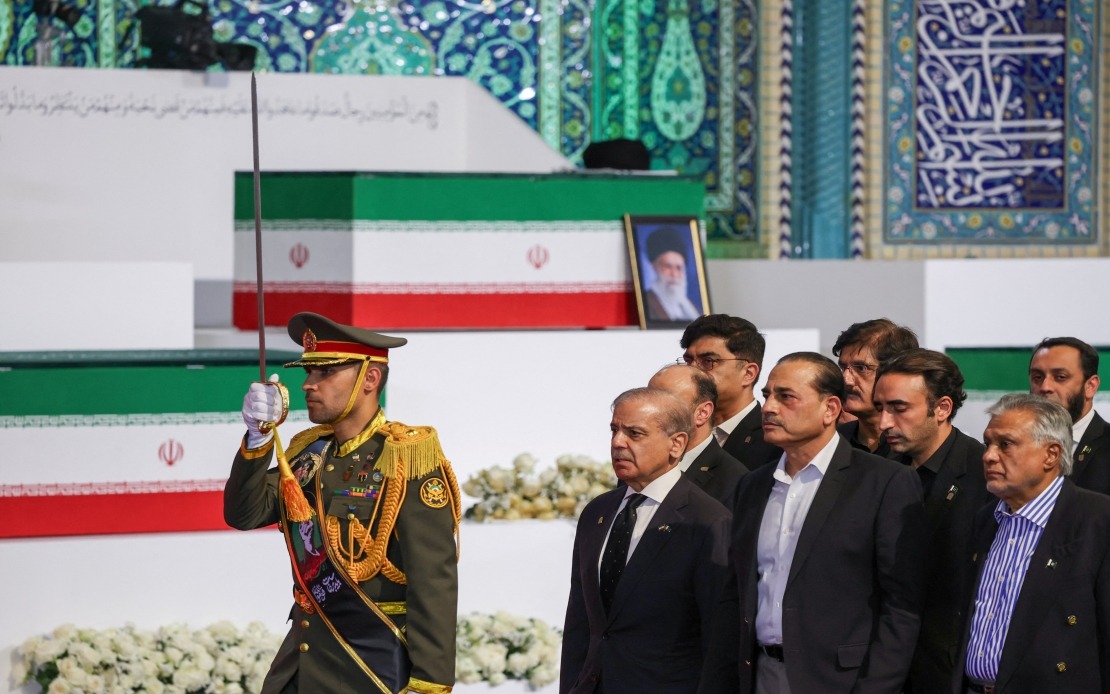
Pakistan's decision to send a delegation of exceptional seniority to the funeral of Iran's Supreme Leader Ayatollah Ali Khamenei has been celebrated by Tehran as a powerful reaffirmation of the bilateral relationship between the two neighbouring Islamic nations. The ceremony, held in Tehran on Friday following Khamenei's death in a February 28 attack, drew representatives from approximately 100 countries, positioning Pakistan's participation as particularly significant within a global context of mourning.
The composition of Pakistan's delegation underscored the weight Islamabad placed on the occasion. Prime Minister Shehbaz Sharif headed the party, accompanied by Deputy Prime Minister and Foreign Minister Ishaq Dar, Chief of Army Staff Field Marshal Syed Asim Munir, and several other cabinet members and legislative leaders. This arrangement reflected Pakistan's view of Khamenei's role as a consequential regional figure whose passing warranted engagement at the highest governmental and military levels. The inclusion of the military's top commander alongside civilian political leadership demonstrated a unified national posture.
Iranian Ambassador to Islamabad Reza Amiri Moghadam issued a formal commendation via social media, describing Pakistan's participation as occurring "at the highest possible level." The ambassador further characterised the Pakistani delegation as the largest sent by any single country to the funeral ceremony, a distinction that carried diplomatic weight. This numerical prominence allowed Iran to frame the attendance as reflective of Pakistan's comparative importance within Tehran's broader international relationships and regional sphere.
Moghadam's comments transcended ceremonial courtesy, explicitly invoking the historical relationship between the two countries. He referenced "enduring friendship, mutual respect, and fraternal bonds," language that positioned the funeral attendance as a symbolic moment in a longer continuum of partnership. The ambassador's invocation of "shared values" and "historic ties" suggested that Pakistan's gesture was being interpreted in Tehran not merely as formal respect for a deceased leader but as affirmation of deeper structural connections between the nations.
The funeral itself became a tableau of international engagement, with dignitaries from Malaysia, Bangladesh, Saudi Arabia, Turkey, Qatar, Oman, Egypt, Russia, Iraq, China, and India present alongside Pakistan. The flag-draped coffins of Khamenei and family members formed the ceremonial centrepiece. For Malaysian observers, the attendance of fellow Southeast Asian delegations alongside major powers illustrated how Khamenei's death carried global significance beyond the Middle East, touching calculations of international standing in multiple regions.
Prime Minister Shehbaz Sharif's own remarks during the ceremony emphasised the Supreme Leader's regional influence. He described Khamenei's "wisdom, leadership and profound influence on Iran and the wider region" as qualities that would endure in collective memory. This framing acknowledged Khamenei's impact beyond Iranian borders, resonating with Pakistan's own position as a state navigating complex regional geopolitics where Iran's strategic decisions carry direct consequences.
Khamenei had held the position of Supreme Leader continuously from 1989 until his assassination at age 86, meaning his tenure spanned over three decades of Pakistan's own political transformations, military interventions, and shifting allegiances. The funeral thus marked an inflection point in bilateral relations, occurring at a moment when both nations face significant internal and external pressures. Pakistan's generous commitment of senior figures to the ceremony suggested strategic intent to maintain stable ties with Tehran despite broader regional uncertainties.
Iran's public funeral observances commenced on Saturday following Khamenei's death, with his burial scheduled for July 9 in Mashhad, his native city. This extended funeral calendar provided a sustained diplomatic window during which the significance of various countries' attendance could be assessed and discussed within Iranian political circles. Pakistan's early and prominent participation positioned it favourably within such assessments, potentially translating into diplomatic capital for future engagements.
For Southeast Asian policymakers including Malaysia's leadership, Pakistan's demonstrated commitment to maintaining strong Iran relations carries instructive implications. Both Pakistan and Malaysia maintain their own carefully calibrated approaches to relationships with Iran, balancing strategic partnership with other international commitments. Pakistan's public performance of solidarity at Khamenei's funeral, through high-level delegation deployment, illustrates how states signal commitment to valued partnerships during moments of national significance in the partner nation.
The bilateral relationship between Pakistan and Iran encompasses security cooperation, trade arrangements, and shared concerns regarding terrorism and sectarian extremism. Iran's appreciation of Pakistan's funeral attendance reflects mutual interest in preserving channels of communication and collaborative frameworks that have proven valuable across multiple domains. Pakistan's military leadership presence alongside civilian officials reinforced that the partnership extends across defence and strategic sectors rather than remaining confined to diplomatic formalities.
The emphasis placed by Tehran on describing Pakistan's delegation as exceptional—both in rank and in numerical representation—suggests that attendance levels and delegation composition function as legible signals within international relations. For Pakistan, the investment in sending senior figures to a funeral ceremony represented a calculated diplomatic gesture that simultaneously honoured a deceased neighbour, affirmed bilateral ties, and positioned Pakistan as a state of sufficient international standing to warrant such symbolic gestures.
Moving forward, the goodwill generated through Pakistan's participation at Khamenei's funeral may facilitate smoother bilateral negotiations on matters ranging from border security to trade facilitation. Iran's effusive public praise for Pakistan's showing indicates receptiveness to closer engagement, potentially creating diplomatic momentum that both nations can leverage to address shared challenges and expand areas of mutual benefit during the period following Khamenei's succession.

