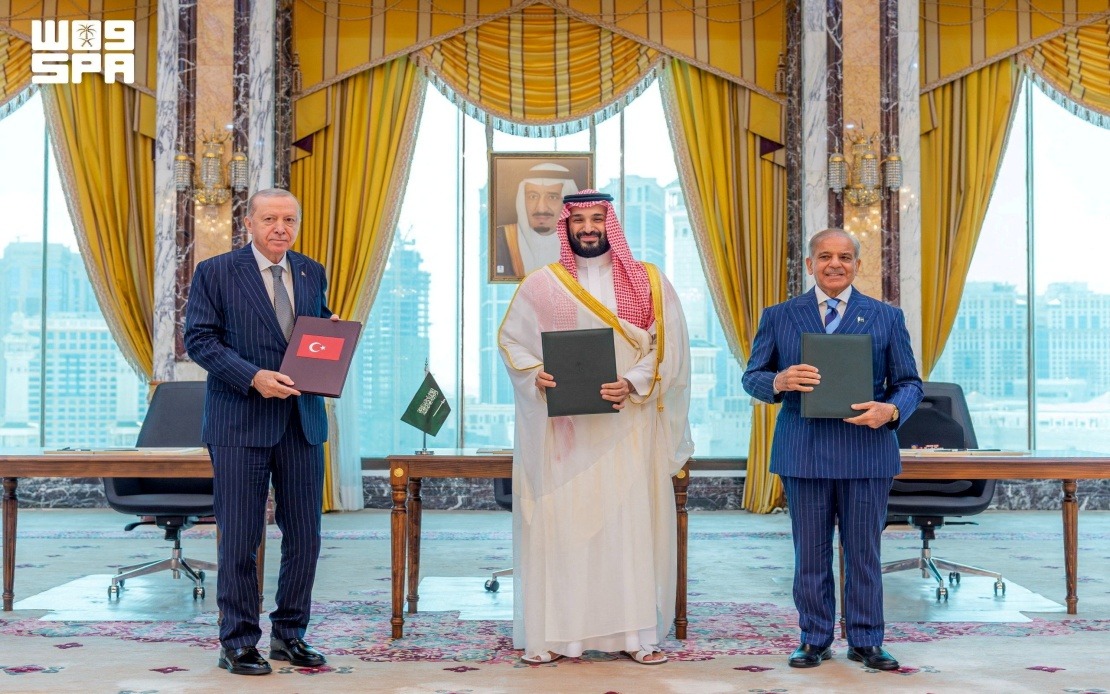
Three major regional powers—Pakistan, Saudi Arabia and Türkiye—have formalised a landmark collective defence agreement designed to strengthen their mutual security architecture and regional standing. The pact was signed on Friday at Al Safa Palace in Makkah by Saudi Crown Prince Mohammed bin Salman bin Abdulaziz Al Saud, Pakistan Prime Minister Shehbaz Sharif and Turkish President Recep Tayyip Erdogan, following a trilateral summit that underscores the deepening alignment among the three nations.
The Joint Defence Agreement establishes a binding commitment whereby any armed attack directed at one of the three signatories shall automatically be treated as an aggression against all parties involved. This provision creates a formal mutual defence framework that goes beyond rhetoric, obligating each nation to treat threats to others as threats to themselves. The agreement extends beyond this core pledge to encompass comprehensive enhancement of defence cooperation across multiple dimensions, signalling an intention to build integrated military and strategic capabilities that can operate in concert.
Pakistan brings substantial weight to this arrangement as one of the world's nine nuclear-armed nations. Its historical ties with both Türkiye and Saudi Arabia have long been characterised by defence collaboration, intelligence sharing and military-to-military exchanges. The Makkah accord formalises what has been an evolving relationship, transforming bilateral partnerships into a tripartite framework that potentially creates a new power balance in a strategically vital region spanning South Asia, the Middle East and the Eastern Mediterranean.
The three nations frame their accord as rooted in shared commitment to strengthening collective security and advancing regional peace and stability. The joint statement emphasises their vision of a secure and prosperous future pursued through coordinated action. This language suggests the agreement transcends immediate security concerns and reflects a longer-term strategic vision for reshaping regional dynamics through institutionalised cooperation among three pivotal Muslim-majority states.
Saudi Arabia's Deputy Public Diplomacy Minister Rayed Krimly elaborated on the pact's operational dimensions in remarks posted on social media platform X, highlighting its capacity to facilitate development of joint defence capabilities and strengthen strategic deterrence. He underscored that the agreement aims to enhance military readiness and enable the three states to integrate their respective defence systems for addressing shared threats. Critically, Krimly stressed that the pact carries no aggressive intent toward other regional actors and does not constitute an escalatory move between any two states—a careful diplomatic formulation that seeks to frame the accord as a stabilising measure rather than a provocation.
The timing of this agreement reflects evolving regional equations. Pakistan and Saudi Arabia previously executed their own bilateral defence accord in September last year, which established mutual obligations for military assistance in response to external aggression. That foundational agreement paved the way for the more expansive trilateral arrangement now formalised. The progression demonstrates how bilateral partnerships can mature into multilateral frameworks that serve the collective interests of all participants.
For Malaysia and Southeast Asian observers, this development carries several implications. The emergence of institutionalised defence cooperation among major Muslim-majority nations in other regions underscores how geopolitical alignment often follows religious and civilisational lines while pursuing tangible strategic interests. Southeast Asia hosts its own Muslim-majority states and communities with varying defence relationships and strategic orientations, making the Makkah accord a relevant case study in how regional powers operationalise shared interests through formal mechanisms.
The agreement also reflects broader patterns of multipolarity in international relations, where nations increasingly seek alternatives to traditional Cold War-era alignment patterns. Rather than adhering to competing superpower blocs, Pakistan, Saudi Arabia and Türkiye have constructed an independent framework rooted in their own regional calculations and security imperatives. This approach resonates with how Southeast Asian nations pursue strategic autonomy through mechanisms like ASEAN, which similarly emphasise collective action without requiring alignment with distant powers.
The defence cooperation dimensions outlined in the accord likely include joint military exercises, defence industry collaboration, intelligence sharing protocols and coordinated strategic planning. Such arrangements typically require establishing mechanisms for regular consultation, creating unified command structures for contingencies and potentially developing interoperable weapons systems. The commitment to integrate defence capabilities suggests planning for scenarios where threats might materialise simultaneously or serially across the three nations' territories.
Regionally, the pact may influence the calculations of other states, particularly those in the Middle East and South Asia. It demonstrates that medium and major powers can construct security architecture that serves their interests without antagonising all competitors simultaneously. The deliberate messaging that the agreement threatens no one attempts to prevent counterbalancing coalitions from forming, though neighbouring powers will certainly take the accord into account when formulating their own strategies.
Looking forward, the durability and effectiveness of this trilateral arrangement will depend on sustained political commitment and the absence of bilateral disputes among the three signatories that could undermine collective action. Historical precedent suggests that alliance frameworks often prove more resilient when rooted in converging threat perceptions and shared strategic interests rather than ideological affinity alone. Whether the Makkah accord can weather potential disagreements on regional issues, particularly those involving Middle Eastern conflicts, will ultimately determine whether it becomes a transformative framework or primarily a symbolic gesture of solidarity.

