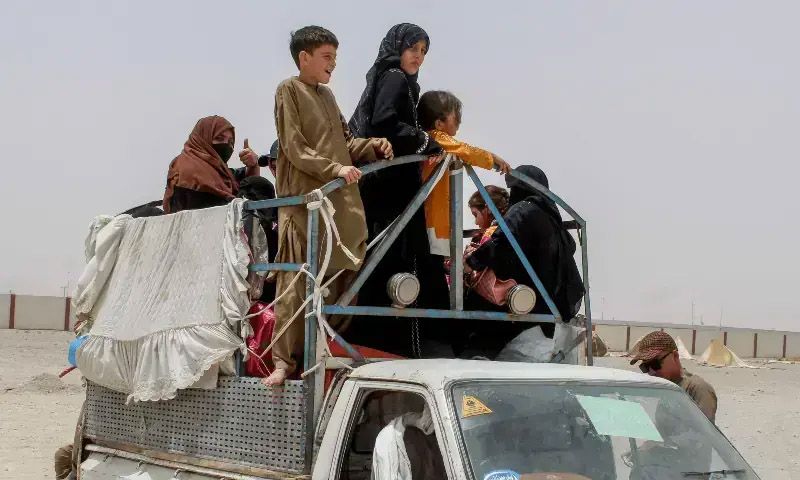
Pakistan's government has moved aggressively to expel approximately 2.59 million Afghans who were residing in the country without valid documentation since 2023, marking one of the largest deportation operations undertaken by Islamabad in recent years. The coordinated effort between federal authorities and provincial governments, particularly in Punjab, reflects a hardened stance on irregular migration and has raised questions about the humanitarian dimensions of such large-scale removals during a period of regional instability.
Punjab, as Pakistan's most populous province and a primary destination for Afghan migrants, has emerged as the focal point of this enforcement drive. The provincial home department's foreign national security cell has assumed direct responsibility for managing detention and deportation procedures, currently operating 36 functional holding centres scattered across Punjab. These facilities serve as processing hubs where undocumented migrants are registered, documented, and prepared for their return journey across the border.
The scale of Punjab's involvement in the operation has been substantial. The province has independently detained some 138,342 Afghan nationals within its holding centre network, completed the necessary administrative paperwork for each individual, and arranged their subsequent deportation back to Afghanistan. This represents a significant portion of the overall 2.59 million national figure and underscores how heavily the deportation burden has fallen on Punjab's administrative and security apparatus.
Currently, the deportation machinery continues to operate at considerable capacity. Punjab's holding centres maintain custody of approximately 53 Afghan nationals at any given time across its facility network, suggesting that while the pace of new detentions may have moderated from earlier phases of the campaign, the system remains active and engaged in ongoing enforcement activities. These facilities provide basic accommodation, conduct identity registration, and coordinate travel arrangements for deportees destined for Afghanistan via the Torkham border crossing, one of the primary transit points between the two nations.
Pakistani government officials have justified the sweeping deportations by emphasizing that visa compliance represents a non-negotiable principle underlying the country's immigration framework. According to statements from the federal home department, individuals lacking valid travel documentation have no legal entitlement to remain within Pakistani territory and must be processed for removal. This position reflects a stricter interpretation of immigration law that prioritizes documentation status over other humanitarian or practical considerations.
The enforcement strategy has encompassed systematic surveys conducted across commercial districts, residential neighbourhoods, and market areas throughout Punjab and other provinces. Authorities have deployed personnel to identify undocumented individuals in high-density Afghan population zones, arrest those lacking proper credentials, and transfer them to the centralized holding centres for processing. The home department has framed these operations as standard security protocol aimed at maintaining public order and protecting national sovereignty.
To sustain and expand these operations, Pakistani authorities have encouraged public participation in identifying undocumented migrants. Citizens are being urged to report suspected illegally residing Afghans through emergency hotline 15, a mechanism that facilitates grassroots information gathering and intelligence collection. The government has simultaneously promised that the identities of those providing such tips will be kept confidential, attempting to address potential concerns about exposure or retaliation.
The humanitarian backdrop to these deportations warrants consideration. Afghanistan remains engulfed in protracted conflict and humanitarian crisis following the Taliban's return to power in 2021. Many Afghan migrants fled to Pakistan seeking refuge from violence, persecution, or economic collapse at home. The rapid removal of such large numbers raises concerns among international humanitarian organizations about the conditions awaiting returnees and the sustainability of Afghanistan's capacity to absorb millions of deportees simultaneously.
For Malaysia and other Southeast Asian nations monitoring this situation, Pakistan's approach offers a case study in the tensions between immigration sovereignty and humanitarian responsibility. The region has its own considerable undocumented populations from Myanmar, Bangladesh, and other source countries, and Pakistan's aggressive model may influence policymaking discussions across ASEAN. The economic and social integration challenges posed by mass deportations, particularly of long-resident populations, remain understudied but potentially significant.
The Torkham border crossing, serving as the primary deportation transit point, has faced logistical strain from the volume of deportees requiring passage. Pakistan has established dedicated administrative arrangements at this frontier to facilitate the handover of deportees to Afghan authorities, though reports suggest inadequate coordination mechanisms and reception capacity on the Afghan side have sometimes created bottlenecks.
Pakistan's campaign reflects broader regional migration pressures and the political difficulties that host nations face when managing large refugee and migrant populations. With an estimated 1.7 million registered Afghan refugees alongside numerous undocumented residents, Pakistan has long carried a disproportionate share of Afghanistan's displacement burden. The intensified deportation policy represents an attempt to redistribute this demographic and economic responsibility, though its effectiveness in achieving sustainable migration management remains contested among analysts.
The operation also signals Pakistan's shift toward prioritizing legal status verification over length of residence or integration into local communities. Afghans who may have lived in Pakistan for decades, established businesses, or raised families born within Pakistani territory face deportation if their documentation remains irregular. This rigid application of immigration law, while legally defensible, has disrupted communities and created uncertainty across Pakistan's Afghan diaspora.

