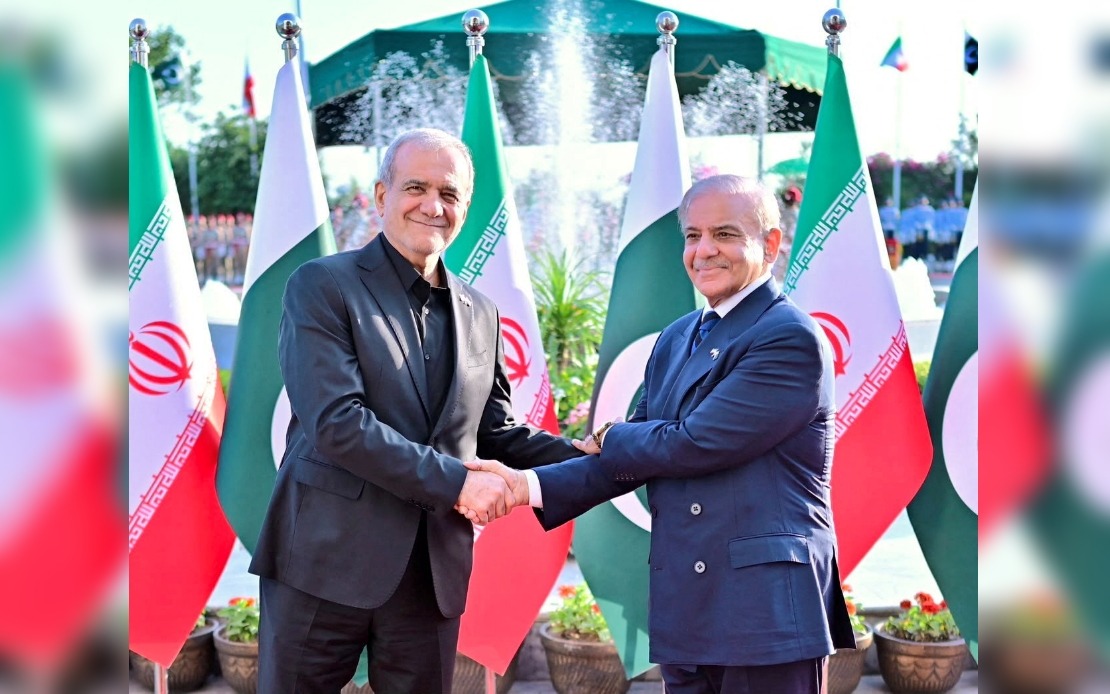
Pakistan's Prime Minister Shehbaz Sharif threw his weight behind Iran's ballistic missile programme on Tuesday, rejecting international criticism of Tehran's defence capabilities during a bilateral meeting with Iranian President Masoud Pezeshkian in Islamabad. The Pakistani leader argued forcefully that Iran's missiles were deliberately excluded from the memorandum of understanding reached between Tehran and Washington on June 17, and therefore should not become a subject of contention or scrutiny now that the agreement has been sealed.
Speaking alongside Pezeshkian at a joint news conference, Shehbaz stressed the principle of non-discrimination in military capabilities, contending that it would be unjust to permit some nations to maintain ballistic arsenals while denying the same security tools to Iran. His comments represent a significant diplomatic statement from Islamabad, signalling Pakistan's alignment with Tehran's position on a weaponry issue that has long divided Washington and its allies from Iran. The Prime Minister's remarks underscored Pakistan's role as a serious intermediary in Middle Eastern geopolitics, having successfully facilitated multiple rounds of negotiations between the two regional powers over recent months.
The backdrop to this declaration lies in Iran's heightened security concerns following military strikes conducted against Iranian territory by Israel and the United States on February 28. Tehran views its missile capabilities as a cornerstone of national defence and deterrence in a volatile region where it faces existential threats. This context shaped the Iranian delegation's firm position during discussions in Islamabad, with Pezeshkian making clear that his country's defensive arsenal constituted a non-negotiable element of sovereignty. The Iranian president deployed blunt language to justify his nation's military posture, suggesting that without credible deterrent capacity, Iran would face the kind of destruction that has befallen Gaza.
Pakistan's mediation efforts in the Iran-US dispute represent a significant diplomatic achievement that extends beyond the June accord. Earlier in April, Pakistani officials had brokered a temporary ceasefire between the two adversaries, demonstrating Islamabad's capacity to engage both sides constructively. Shehbaz acknowledged the instrumental roles played by Deputy Prime Minister and Foreign Minister Ishaq Dar, as well as Field Marshal Syed Asim Munir, the country's Chief of Army Staff, in facilitating these breakthrough negotiations. The Prime Minister's personal gratitude toward Pezeshkian reflected Pakistan's investment of considerable diplomatic capital in achieving stability between Tehran and Washington.
Yet Shehbaz also sounded a cautionary note, warning that external actors were actively attempting to undermine the fragile US-Iran agreement. He identified what he termed "spoilers all over the world" as threats to the nascent peace framework, signalling awareness that the June understanding remained vulnerable to sabotage. This assessment reflects growing concerns within South Asia and across the Muslim world that certain powers oppose rapprochement between Iran and the United States. Israel has figured prominently in analyses of parties opposing the agreement, with observers noting that Jerusalem views Iranian military capability and great-power engagement as impediments to its regional objectives.
Certainly, international reaction to the US-Iran understanding has been mixed and conditioned by geopolitical positioning. Significantly, United States President Donald Trump has adopted a remarkably permissive stance on the question of Iranian ballistic missiles. During remarks to journalists in Paris on the day the June agreement was announced, Trump acknowledged that denying Iran missile capabilities whilst permitting other nations to retain such weapons constituted an unfair double standard. Trump's candid observation lent unexpected support to the position now being articulated by Pakistani and Iranian officials, though his statement also underscored the contentious nature of missile questions within American foreign policy circles.
The ceremonial aspects of Pezeshkian's Islamabad visit underscored the significance Pakistan attaches to its relationship with Iran. Pakistan's Air Force dispatched six fighter jets to escort the Iranian president's aircraft during its arrival, a gesture typically reserved for state visits of major strategic importance. Pezeshkian received a formal welcome from both Shehbaz and President Asif Ali Zardari, whilst a 21-gun salute announced his arrival at the capital. These protocols communicated to regional observers that Pakistan considers Iran a first-tier partner deserving maximum diplomatic courtesy and respect.
For Malaysia and other Southeast Asian nations, the Pakistan-brokered Iran-US rapprochement carries implications for regional stability and international commerce. Improved relations between Tehran and Washington could reduce the risk of escalatory military confrontation in the Middle East, a region through which vital sea lanes serving Southeast Asian trade pass. Conversely, any collapse of the agreement could trigger renewed tensions affecting global energy markets and shipping security in ways that would reverberate across Southeast Asia. Pakistan's role as a credible mediator in this context also elevates Islamabad's diplomatic profile and potentially expands its capacity to influence outcomes on issues of concern to the broader Islamic world.
The question of ballistic missiles has consistently proven one of the most intractable issues in global arms control discussions. Iran's insistence that its missile programme falls outside the purview of nuclear diplomacy reflects a fundamental disagreement with Western powers over what constitutes legitimate defence versus regional destabilisation. By lending explicit support to Iran's position, Pakistan has signalled that it rejects the framework whereby Middle Eastern nations accept limits on conventional military capabilities in exchange for sanctions relief. This stance positions Islamabad alongside a coalition of nations that view asymmetric military capabilities as essential equalizers against more militarily powerful adversaries.
The diplomatic success in June represents the culmination of months of intensive shuttle diplomacy and back-channel communications. Pakistan's willingness to host talks between parties with fundamental disagreements, and to refrain from pressuring either side toward unwelcome compromises, appears to have been central to brokering the breakthrough. Shehbaz's public affirmation of Pakistan's commitment to continued mediation and his assurance that Islamabad would not betray Iran's trust suggested that Pakistan intends to maintain an active role in managing Middle Eastern tensions going forward. Whether such mediation can survive the inevitable disagreements and provocations that arise in this volatile region remains an open question.
Looking ahead, the stability of the US-Iran understanding will depend substantially on whether both parties can navigate the inevitable disputes that arise from their competing interests and ideologies. Pakistan's demonstrated capability to serve as an honest broker may prove invaluable should tensions spike again. However, the presence of "spoilers" as Shehbaz identified them suggests that external actors opposed to rapprochement will continue probing for vulnerabilities and opportunities to reignite conflict. For regional observers and stakeholders like Malaysia, developments in Pakistan's ongoing mediation efforts warrant close monitoring, given the implications for global stability and commerce.