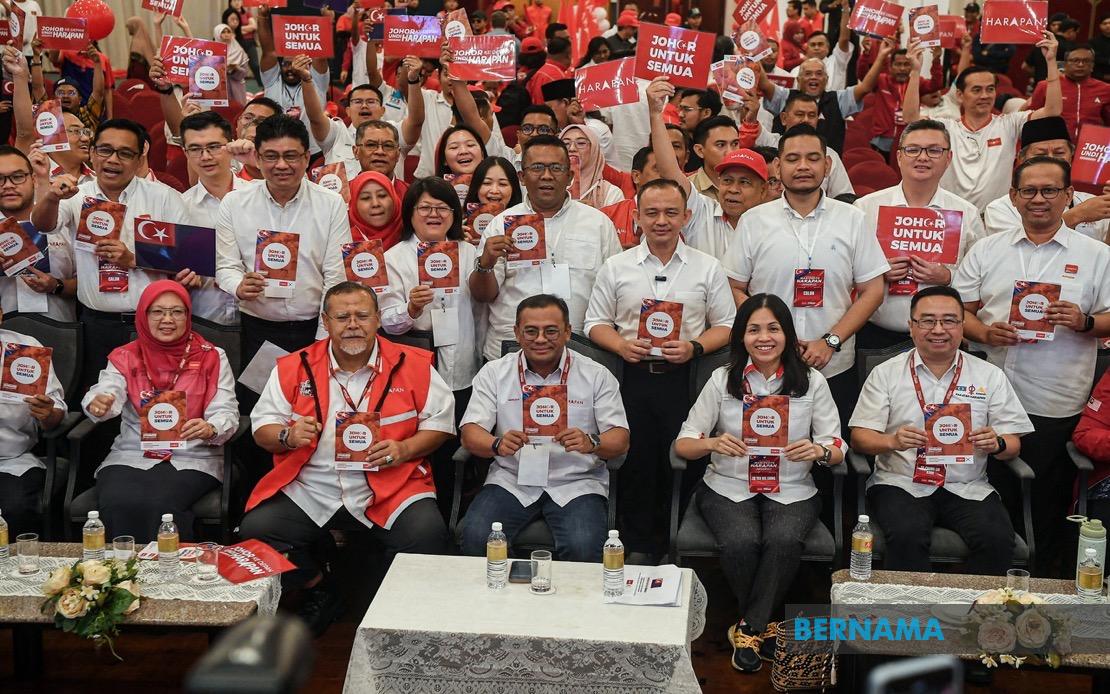
Pakatan Harapan rolled out its campaign blueprint for the Johor state election on July 3, positioning the 'Johor Untuk Semua' (Johor For All) manifesto as a pragmatic document grounded in tangible community requirements rather than hollow political promises. The ten-point platform emerged following what party leaders describe as careful consideration of the state's socioeconomic landscape and the aspirations expressed by voters across different demographics. Johor DAP chairman Teo Nie Ching, who holds the position of Deputy Communications Minister at the federal level, articulated this framing during remarks following the formal launch in Johor Bahru, suggesting the initiative reflects genuine engagement with grassroots concerns rather than generic pledges disconnected from implementation capacity.
The manifesto extends its reach across multiple population segments, deliberately crafted to resonate with young voters entering the job market, mothers managing household finances, and children whose educational futures depend on system quality. This broad-based approach signals PH's strategy to build a coalition spanning age groups and family structures, acknowledging that electoral success requires addressing overlapping rather than siloed priorities. By positioning themselves as attentive to lifecycle challenges—from education access for children to employment prospects for youth to welfare support for parents—the coalition attempts to disarm criticism that opposition parties focus narrowly on single-issue constituencies.
Teo's emphasis on federal-state coordination reveals an important caveat embedded within the manifesto's ambitions. The viability of these commitments depends substantially on cooperative frameworks between a PH state government in Johor and the federal administration in Kuala Lumpur. This interdependency is particularly significant for border-related initiatives, where federal agencies including the Home Ministry exercise primary authority over immigration procedures and security protocols. The manifesto commits to reducing waiting times at the Johor-Singapore border crossings by 50 per cent—a laudable target that would substantially improve economic efficiency and quality of life for the approximately 300,000 daily cross-border commuters. Yet achieving such reductions requires technical coordination, infrastructure investment, and possibly bilateral negotiations with Singapore authorities, making success contingent on political will at multiple governance levels.
Education emerges as a cornerstone policy pillar within the platform, reflecting both the state's needs and broader Southeast Asian demographic trends. Johor's relatively young population and economic diversification into technology and manufacturing sectors create demand for workforce skills aligned with modern employment markets. By prioritizing education in the manifesto, PH signals recognition that state-level improvements—curriculum quality, teacher training, vocational pathways—can meaningfully influence graduate competitiveness and long-term economic trajectory. This emphasis also carries political weight in a state where concerns about educational outcomes have intensified amid pandemic disruptions and evolving parental expectations regarding digital literacy and technical proficiency.
The proposed Johor Health Scheme represents perhaps the most instructive case study for evaluating manifesto credibility. Teo explicitly invoked Selangor's parallel healthcare initiative as evidence that implementation is realistic and that outcomes are measurable. Selangor's health scheme, which provides subsidized healthcare access to eligible residents, offers a tested model that reduces political risk around the Johor proposal. By anchoring the Johor promise to an existing precedent rather than an entirely novel scheme, PH seeks to convince voters that this commitment rests on proven mechanisms rather than untested theory. The psychological effect of this comparison is significant: voters can observe directly how a similar PH government delivers on healthcare pledges, potentially strengthening confidence that Johor would receive comparable service quality and financial stewardship.
Financial assistance targeting first-time homebuyers addresses one of Malaysia's most acute affordability crises, particularly acute in urbanizing areas of Johor including the Klang Valley spillover zones and the Johor Bahru metropolitan region. Property prices in secondary urban markets across Johor have appreciated substantially over the past decade, outpacing wage growth and pricing younger households entirely out of ownership paths their parents enjoyed. By proposing deposit assistance mechanisms, PH acknowledges this structural challenge and positions itself as responsive to millennial and Gen-Z economic anxieties. The policy also intersects with broader national concerns about household debt, intergenerational equity, and the sustainability of housing markets driven increasingly by investment rather than primary residency demand.
The RM500 million youth development fund signals substantial resource commitment to employment creation, skills development, and entrepreneurship support. Johor's economy, while diversified across port operations, petrochemicals, automotive manufacturing, and increasingly digital sectors, faces structural employment challenges where skills mismatches limit youth opportunities despite available positions. A dedicated fund suggests PH would move beyond rhetorical commitment to youth and deploy capital toward tangible interventions—training programs, startup capital provision, mentorship infrastructure, and sector-specific development initiatives. The magnitude of this commitment (RM500 million) represents a credible budget allocation that could support meaningful programs across multiple districts rather than token gestures concentrated in urban centers.
The timing of this manifesto launch, occurring just over a week before the July 11 polling date, reflects campaign mechanics common to Malaysian state elections where manifestos often arrive relatively late in the electoral cycle. This compressed timeline means voter engagement with detailed policy proposals remains limited compared to general elections where manifestos circulate across longer periods. For Malaysian audiences accustomed to evaluating opposition promises against historical delivery records, Teo's repeated invocation of federal coordination and Selangor precedent serves a rhetorical function: by tying Johor promises to entities voters can directly assess, she attempts to shift evaluation criteria away from abstract promises toward comparative performance metrics.
The manifesto's comprehensive character—spanning healthcare, housing, education, border efficiency, and youth employment—suggests PH's effort to present itself as a governing alternative addressing multiple policy domains rather than a single-issue challenger. This breadth reflects lessons from Malaysia's recent electoral history, where voter decisions increasingly hinge on perceptions of competence across varied domains rather than ideological positioning alone. Whether voters in Johor perceive this manifesto as credible hinges not merely on the policies themselves but on whether they trust PH's capacity to execute despite potential federal obstacles and whether they believe the coalition has genuinely internalized lessons from areas where previous pledges encountered implementation difficulties.
For regional observers, the Johor election represents another data point in Malaysian federalism's evolution. State governments' ability to deliver on manifestos increasingly depends on federal coordination, resource allocation, and policy flexibility—dynamics that shift power calculations between coalition parties and between state and federal levels. PH's emphasis on federal cooperation, rather than state autonomy, implicitly acknowledges this reality and potentially signals that a PH state government would prioritize collaborative frameworks over confrontational approaches to Kuala Lumpur. This pragmatism could either reassure voters concerned about governance instability or alienate those expecting state governments to assert greater independence from federal structures.

