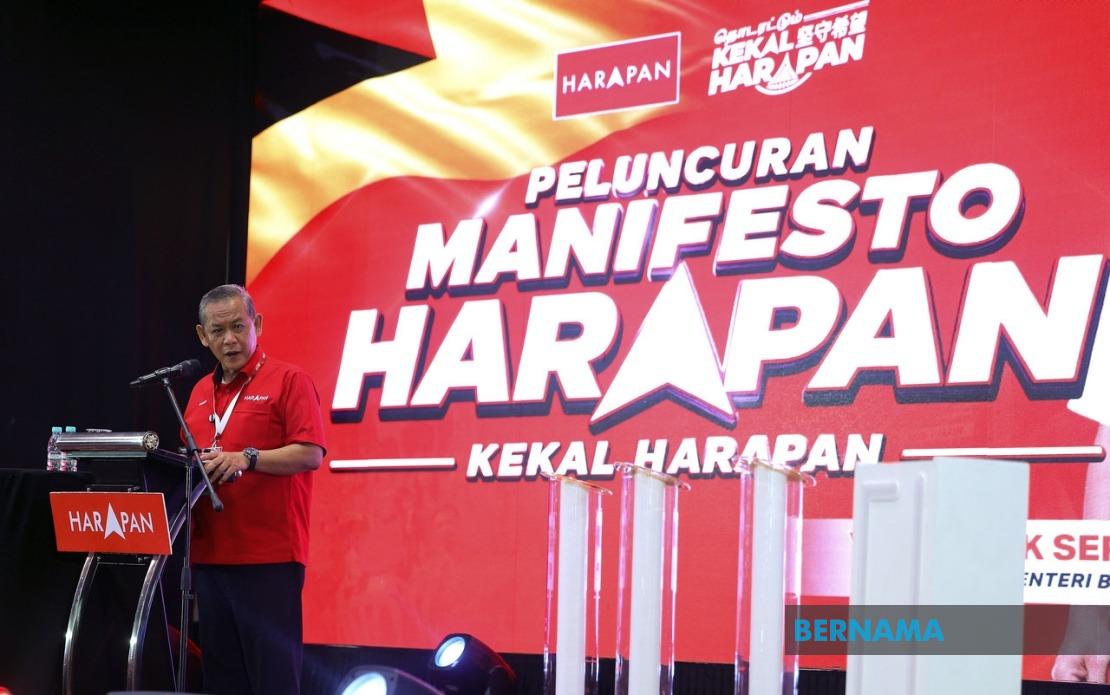
Pakatan Harapan formally launched its election manifesto for Negeri Sembilan on July 20, anchoring its campaign around ten substantial commitments designed to guide the state's development over the coming term. The manifesto, unveiled by Negeri Sembilan PH chairman and Menteri Besar Datuk Seri Aminuddin Harun in Seremban, carries the thematic title 'Negeri Sembilan Kekal Harapan' (Negeri Sembilan Stays With Harapan), signalling the coalition's intention to retain voter confidence heading into the 16th state election.
The manifesto's foundational pillar rests on establishing governance structures characterised by stability, transparency, and responsiveness to citizen concerns. This commitment reflects broader electoral sentiment across Malaysia's states, where voters increasingly demand administrations that demonstrate fiscal accountability and visible delivery on promises. For Negeri Sembilan specifically, this pledge carries particular resonance given the state's historical experience with political transitions and the coalition's desire to project continuity.
Economic revitalisation forms a central plank of the coalition's platform, with specific targets outlined for job creation and sectoral development. The manifesto commits to generating 30,000 high-income employment positions, a figure that would materially expand the state's formal job market and potentially attract retained talent from workers who might otherwise seek opportunities in Klang Valley or other major economic centres. This employment strategy appears calibrated toward addressing skills mismatches and wage stagnation that have characterised peripheral states, positioning Negeri Sembilan as a destination for quality employment rather than merely low-cost manufacturing.
Housing affordability emerges as a secondary economic priority, with a pledge to construct 20,000 affordable residential units alongside comprehensive resolution of land-related disputes. This dual approach acknowledges that housing accessibility remains a critical electoral concern across Malaysian constituencies, particularly affecting young professionals and first-time buyers. The manifesto's inclusion of land-issue resolution suggests recognition of customary land complications and regulatory ambiguities that have historically hindered property transactions in the state.
Educational expansion and quality enhancement constitute another substantive commitment within the manifesto framework. The coalition pledges universal access to quality education, reflecting national concerns about educational inequality and regional disparities in school infrastructure and teacher deployment. This commitment carries particular salience in Negeri Sembilan, where rural constituencies have historically experienced resource constraints compared to more urbanised areas.
The manifesto specifically emphasises strengthening the 'Skim Sejahtera Rakyat' (People's Wellbeing Scheme), suggesting a continuation and possibly expansion of targeted welfare programmes. This social protection focus responds to cost-of-living pressures facing middle and lower-income households, whilst potentially serving as an electoral differentiator against opposition platforms. The SSR framework has emerged across Malaysian states as a mechanism for delivering targeted assistance without resorting to universal subsidies, allowing administrations to calibrate support according to household circumstances.
Healthcare service delivery receives dedicated manifesto attention, with promises of expanded access and quality improvement. This commitment reflects both national health system challenges and state-specific capacity constraints. Negeri Sembilan, as a moderately-sized state with dispersed population centres, faces particular difficulties in healthcare provision, particularly in rural constituencies where specialist services remain geographically distant.
Demographic considerations appear woven through multiple manifesto commitments, particularly those addressing youth empowerment, women's advancement, and family support structures. These pledges acknowledge evolving voter demographics and shifting social priorities, particularly among younger voters who increasingly factor gender equality and family policy into electoral calculations. The coalition's explicit inclusion of these dimensions suggests strategic recognition that electoral success increasingly hinges on satisfying diverse demographic constituencies rather than pursuing monolithic appeals.
Tourism and cultural heritage development features as an economic diversification strategy within the manifesto architecture. This sectoral focus reflects Negeri Sembilan's considerable heritage resources and cultural assets, including sites of historical and archaeological significance. Strategic investment in this sector could generate employment whilst enhancing community pride and preserving cultural identity, creating synergies with other manifesto commitments around job creation and sustainable development.
Agricultural modernisation and food security improvements address rural constituency concerns whilst responding to broader national food security imperatives. These commitments acknowledge Negeri Sembilan's agricultural heritage and contemporary farming community anxieties regarding input costs, market access, and climate variability. The manifesto's framing of agricultural enhancement as connected to food security suggests recognition of supply chain vulnerabilities exposed during recent global disruptions.
Infrastructure development and interfaith unity constitute the manifesto's closing commitments, addressing physical connectivity and social cohesion respectively. Strategic infrastructure delivery affects state competitiveness for investment and business activity, particularly connectivity to Kuala Lumpur and Selangor. The emphasis on interfaith harmony reflects Malaysia's plural society and the electoral importance of projecting inclusive governance across religious and ethnic lines.
The Felda Development Plan implementation commitment indicates PH's intention to address concerns within agricultural communities, particularly amongst scheme participants facing evolving economic pressures. This focus provides specific outreach to a traditionally influential constituency within Negeri Sembilan's electoral geography.
Collectively, the manifesto presents a comprehensive policy platform spanning economic diversification, social protection, demographic inclusion, and infrastructure modernisation. For Malaysian voters, particularly those in Negeri Sembilan assessing coalition performance and opposition alternatives, the manifesto provides substantive policy commitments against which to evaluate electoral choices and hold the administration accountable following the forthcoming state election.

