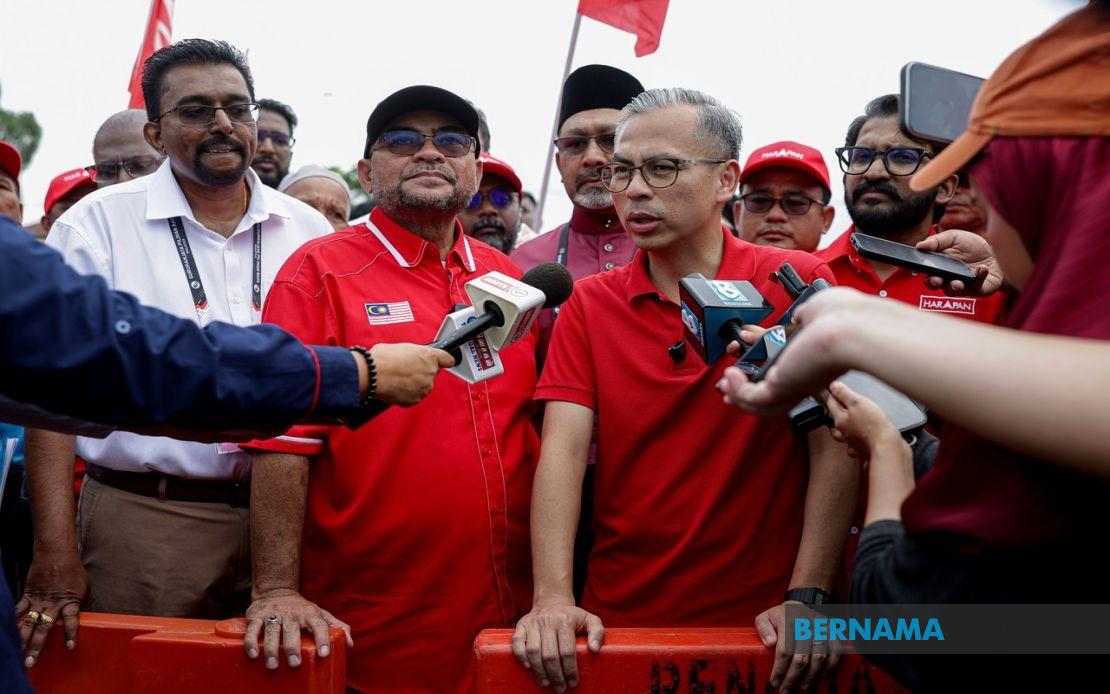
The Pakatan Harapan coalition has identified administrative continuity and the proven leadership of Menteri Besar Datuk Seri Aminuddin Harun as the pillars of its campaign strategy for the upcoming Negeri Sembilan State Election. Communications director Datuk Seri Fahmi Fadzil announced this approach after the candidate nomination process concluded for four state seats in the Jempol parliamentary constituency, signalling that the coalition intends to leverage its incumbent advantage by emphasizing tangible economic gains achieved over the past six years.
At the heart of PH's electoral pitch lies a narrative of measurable prosperity. Since Aminuddin assumed office as Menteri Besar in 2018, the state administration has overseen a series of economic initiatives that PH officials contend have strengthened Negeri Sembilan's financial position. These include a notable increase in zakat collections, which reflects broader confidence in the state's Islamic financial institutions and governance framework, alongside enhanced revenue collection for the state government. The coalition also points to a consistent stream of foreign direct investment flowing into the state, culminating in infrastructure projects such as a new port facility—developments that PH strategists believe demonstrate tangible commitment to economic diversification and regional connectivity.
The decision to foreground economic performance rather than partisan rhetoric reflects a calculated electoral gambit. In state elections, voters often assess incumbents based on bread-and-butter concerns: employment, service delivery, and visible development. By anchoring its campaign to these concrete outcomes, PH seeks to position Aminuddin's administration as a stable custodian of Negeri Sembilan's economic trajectory. This approach also insulates the coalition from potential attacks on national-level political controversies, allowing candidates to concentrate on local governance narratives where the incumbent has a stronger platform.
Fahmi's emphasis on continuity also carries broader implications for the Anwar Ibrahim-led coalition's positioning ahead of the next general election. Should PH retain control of Negeri Sembilan, it would reinforce the government's claim to electoral relevance and administrative competence at the state level—a foundation upon which federal legitimacy increasingly depends. Conversely, any loss of ground would signal weakening support and provide ammunition to opposition parties contesting the coalition's fitness to govern.
The campaign strategy extends beyond macroeconomic metrics to granular constituency-level issues. In the Jeram Padang state seat, where PH has fielded lawyer and Prime Minister Anwar Ibrahim's political secretary G. Manivannan, the party is explicitly prioritising employment opportunities—a concern frequently articulated by younger voters. This signals an attempt to connect national development initiatives with local economic aspirations, positioning Manivannan as a bridge between federal resources and community needs. The candidate faces a four-way contest against Barisan Nasional incumbent Datuk Mohd Zaidy Abdul Kadir, Perikatan Nasional's R. Sri Sanjeevan, and Dayana Dal, the sole Orang Asli candidate fielded in these seats.
The Jempol parliamentary constituency races underscore the fragmented nature of Malaysia's contemporary electoral landscape. Three of the four state seats—Serting, Palong, and Jeram Padang—will be contested by at least three parties each, complicating vote calculations for all sides. In Serting, PH's Yaacob Mahmood challenges incumbent Perikatan Nasional representative Mohd Fairuz Mohd Isa and Bersatu's Muhammad Noraffendy Mohd Salleh. The Palong seat presents a similar competitive dynamic, with BN's incumbent Datuk Mustapha Nagoor facing challenges from PH's Muhammad Zahin Zinal Abidin and Bersatu's Rebin Birham. Only Bahau will see a straight two-way fight between PH's DAP incumbent Teo Kok Seong and MCA's Chong Fui Ming of Barisan Nasional.
This fragmentation reflects the broader realignment of Malaysian politics post-2022, where Perikatan Nasional and Bersatu have established themselves as significant competitive forces, capable of splitting opposition votes or challenging both PH and BN simultaneously. For PH, the persistence of three-cornered and four-cornered contests complicates vote efficiency; the coalition must achieve not merely plurality but sufficient margin to overcome split opposition.
Fahmi's call for responsible campaigning and avoidance of sensitive topics involving religion, race, and the institution of rulers also deserves scrutiny. While framed as an appeal for civility, this directive effectively sets boundaries around legitimate campaign discourse—areas where any party pushing provocative narratives risks media criticism and potential regulatory intervention. The emphasis on guarding against misinformation similarly positions communications discipline as a competitive advantage, potentially benefiting the incumbent coalition's superior access to institutional communication channels.
The election timeline affords candidates precisely two weeks for intensive campaigning, with early voting scheduled for July 28 and polling day set for August 1. This compressed period favours well-resourced parties with established ground networks capable of rapid mobilization. PH's emphasis on continuity and administrative track record, rather than transformative promises, aligns with this temporal constraint—existing voters require less persuasion than swing constituencies require conversion.
Fahmi's assurance regarding media practitioner welfare during the campaign period also reflects heightened awareness of press freedom concerns in Malaysia's contemporary political environment. By publicly committing to monitor journalist safety and access, the Communications Minister signals official concern for the information ecosystem while simultaneously courting favourable media coverage for the governing coalition.
The Negeri Sembilan election occurs within a broader context of state-level contests that collectively shape perceptions of the Anwar-led government's electoral viability. With the next general election potentially two to three years away, state elections serve as both testing grounds for campaign narratives and confidence indicators for party machinery and voter base alike. A convincing PH victory in Negeri Sembilan would consolidate the coalition's claim to represent continuity and competent governance, while simultaneously providing tactical learning for future national contests.
Ultimately, PH's decision to campaign on administrative performance reflects both strategic calculation and necessity. The coalition possesses a genuine record of economic achievement to highlight, even as broader national political currents create uncertainty. Whether Malaysian voters in Negeri Sembilan will reward demonstrated competence over alternative visions remains the central question PH must resolve across the forthcoming campaign fortnight.

