The Pahang government has committed itself to developing a strategic, multi-phase approach to tackle the progressive shallowing of Sungai Pahang, a natural waterway that is increasingly compromising economic activities and daily life in affected riverside communities. Menteri Besar Datuk Seri Wan Rosdy Wan Ismail disclosed that state authorities are preparing a thorough diagnostic assessment of river conditions across vulnerable zones, including Kampung Pesagi in Maran district, before finalising any intervention plans.
The decision to ground the response in empirical data reflects official recognition that river management requires precision rather than ad-hoc remedies. Wan Rosdy explained that the report, which will be gathered from all relevant district agencies and technical bodies, will serve as the foundation for designing short-term emergency measures, medium-term stabilisation efforts, and long-term structural solutions. Once compiled, this documentation will be tabled before the state's executive council for rigorous examination, refinement, and approval prior to implementation.
The shallowing of Sungai Pahang represents more than an environmental concern; it directly destabilises the livelihoods of residents whose economic activities depend on adequate water flow and navigation. Farmers, fishermen, and businesses relying on river-based transport have experienced disruptions, and further degradation could force communities to relocate or abandon traditional practices. The Menteri Besar underscored that any corrective measures must emerge from comprehensive study to guarantee effectiveness and sustainability, signalling that the government rejects superficial fixes in favour of evidence-based planning.
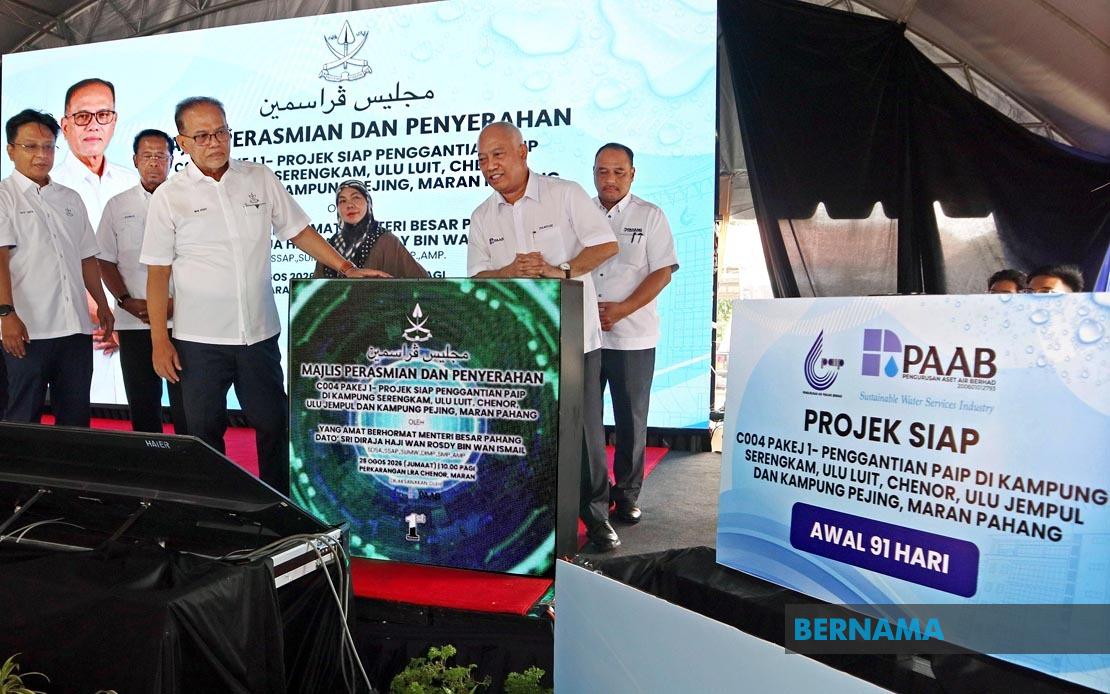
Parallel to addressing the river crisis, Pahang is accelerating its broader infrastructure modernisation agenda. The state has been rolling out an extensive pipe replacement programme designed to eliminate water supply shortages that have plagued multiple districts. Progress has been measurable, with four districts already achieving resolution rates exceeding ninety percent, and Maran expected to join this cohort soon. Wan Rosdy made these remarks while presiding over the official handover of the completed water pipe replacement initiative at the Chenor Water Treatment Plant in Maran, confirming that water security remains a cornerstone of the government's development strategy.
Beyond water management, Pahang is positioning itself as an emerging energy hub in Malaysia's eastern corridor. Tenaga Nasional Berhad, the national electricity utility, is constructing a major 500-kilovolt Transmission Main Intake Substation in Kampung Awah, representing an investment of approximately RM350 million with completion slated for 2030. This substation will function as a critical node in an expanding electrical network linking strategic locations across the East Coast, creating a more resilient energy infrastructure capable of supporting industrialisation and economic growth across the region.
The TNB project exemplifies how state governments are leveraging large-scale infrastructure to attract multinational investors and manufacturing enterprises seeking stable, high-capacity power supplies. Pahang has calculated that enhanced electrical infrastructure will bolster its competitiveness relative to other Malaysian states, potentially drawing semiconductor manufacturers, petrochemical refineries, and data centres that demand uninterrupted power at scale. By investing in these foundational systems now, the state is laying groundwork for a decade of accelerated economic expansion that could create tens of thousands of jobs across construction, operation, and downstream sectors.
From a Southeast Asian perspective, Pahang's twin focus on environmental remediation and infrastructure development reflects evolving priorities across the region. As major river systems face degradation from silt accumulation, uncontrolled upstream deforestation, and climate variability, governments increasingly recognise that passive management is unsustainable. Thailand, Vietnam, and Cambodia face analogous challenges with the Mekong and Chao Phraya systems, where shallow stretches have disrupted transport networks and agricultural productivity. Pahang's commitment to studying the Sungai Pahang issue comprehensively may eventually generate replicable solutions applicable to comparable waterways throughout Southeast Asia.
The interconnection between water infrastructure, energy systems, and economic development in Pahang's strategy illustrates a mature understanding that modern state competitiveness depends on integrated planning rather than sectoral silos. Communities cannot thrive without reliable electricity, potable water, and navigable waterways simultaneously. By addressing the Sungai Pahang shallowing while expanding electrical capacity and upgrading water supply networks, Pahang is attempting to position itself as a model for holistic regional development.
The timeline for delivering solutions varies significantly across these initiatives. Water pipe replacement may be resolved within months or a year or two for Maran, whereas the TNB substation will reach operational status only in 2030, and river remediation could require five to ten years or longer depending on engineering requirements. This staggered approach allows the state to achieve visible wins in the near term whilst pursuing transformative projects with longer horizons, maintaining political momentum and public confidence.
Moving forward, successful execution depends on sustained funding, inter-agency coordination, and technical expertise. The Menteri Besar's emphasis on rigorous review and refinement of the Sungai Pahang study before implementation suggests the government understands that premature action based on incomplete information risks wasting resources and disappointing affected communities. By contrast, methodical preparation increases the probability that interventions will address root causes rather than symptoms, ultimately delivering the durable solutions that residents deserve.

