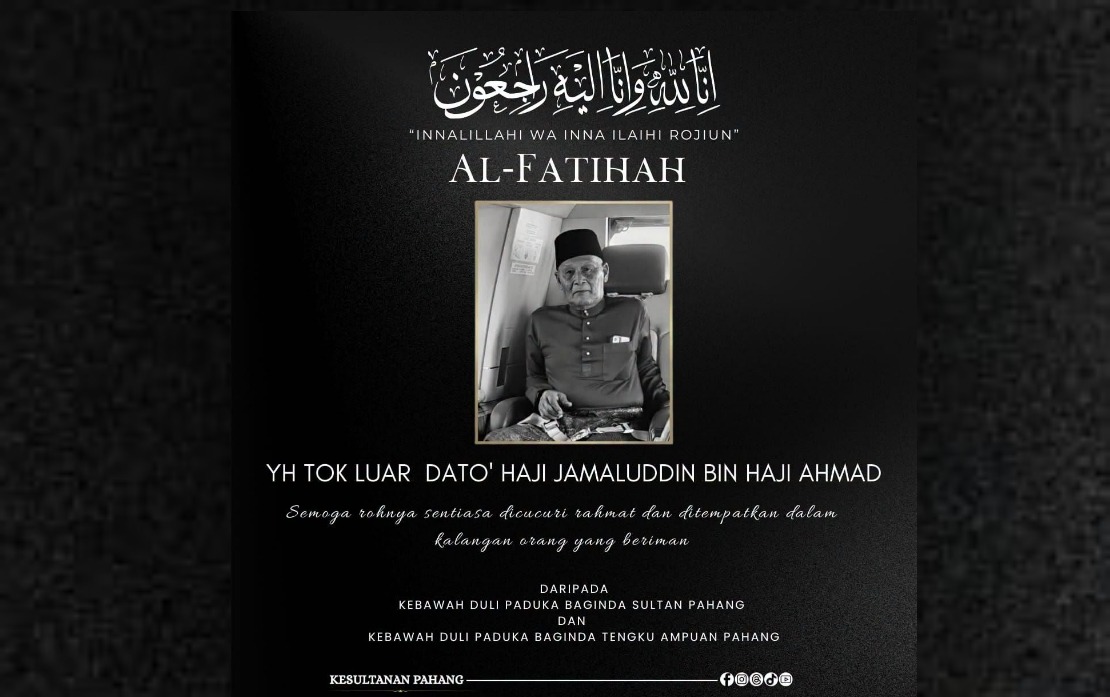
The royal household of Pahang has announced the death of Tok Luar Datuk Jamaluddin Ahmad, a prominent figure long associated with the sultanate, who passed away at Tengku Ampuan Afzan Hospital in Kuantan on the morning of June 28. Al-Sultan Abdullah Ri'ayatuddin Al-Mustafa Billah Shah and Tengku Ampuan Tunku Azizah Aminah Maimunah Iskandariah have formally conveyed their sympathies to his family, marking an acknowledgement of his contributions and standing within Pahang's institutional circles.
Through an official statement released on the Kesultanan Pahang Facebook page, the royal couple characterised Jamaluddin as a steadfast advocate for the Pahang Sultanate, underscoring the personal significance of his relationship with the institution. The Sultan and Tengku Ampuan's decision to publicly mourn his passing reflects the customary recognition accorded to senior figures who have maintained close ties with the royal establishment across decades of service. In the Malaysian context, such formal acknowledgements carry particular weight, signalling the departed individual's standing within the broader royal and administrative fabric of the state.
The statement issued by the palace revealed that the royal couple have offered prayers on behalf of Jamaluddin's soul, invoking divine mercy and forgiveness whilst also seeking acceptance of his righteous deeds. This spiritual dimension underscores the Islamic values that permeate official Malaysian condolences, with the royal household explicitly requesting that he be counted among the faithful servants of Allah. Such religious framing is standard in Malaysian public mourning, particularly when prominent state figures pass away, reflecting both personal piety and the constitutional role of the Sultan as the head of Islam in Pahang.
Jamaluddin's death occurred at 6.48 am on June 28, at one of Kuantan's major medical facilities. The circumstances surrounding his final illness remain undisclosed in the official statement, though his hospitalisation at Tengku Ampuan Afzan Hospital—a facility bearing the Tengku Ampuan's name—suggests the possibility of a prolonged medical condition requiring intensive care. The timing of his death in the early morning hours follows a pattern common to many hospital deaths, though no additional clinical details have been made public.
Beyond their expression of sorrow, the Sultan and Tengku Ampuan extended wishes of spiritual and emotional resilience to Jamaluddin's surviving relatives. The palace conveyed hope that his family would find the strength and patience necessary to navigate their bereavement, a sentiment that acknowledges the profound personal loss experienced by those closest to him. In Malaysian royal protocol, such expressions of support to grieving families serve not merely as courtesies but as meaningful gestures that often carry material and social implications for those receiving them.
The characterisation of Jamaluddin as a loyal supporter of the Pahang Sultanate institution speaks to a broader tradition of patronage and service that has historically underpinned relationships between senior administrators, professionals, and the royal households of Malaysian states. Figures accorded such recognition typically have maintained lengthy involvement with state affairs, whether through government service, advisory roles, or other contributions to institutional stability and prestige. The public nature of the royal condolence—disseminated through official channels—suggests that Jamaluddin held sufficient prominence to warrant this formal acknowledgement.
For Malaysian and Southeast Asian observers, the death of such figures often prompts reflection on generational transitions within state institutions and the continuity of institutional memory. The Pahang Sultanate, like other Malaysian royal institutions, has navigated significant constitutional and political developments over recent decades, and individuals like Jamaluddin often represented continuity across these periods of change. His passing represents the natural demographic transition occurring among earlier cohorts of state administrators and institution-builders.
The invocation of Al-Fatihah—the opening chapter of the Quran—in the palace's concluding remarks reinforces the Islamic spiritual dimension of the mourning process. This practice is ubiquitous across Malaysian public life, from parliamentary proceedings to official state functions, and its inclusion in the royal statement ensures alignment with the religious sensibilities of the overwhelming majority of Pahang's population. The repetition of such formulations across different official contexts creates a ritual consistency that binds together state ceremonial and Islamic observance.
The passing of individuals with long-standing connections to royal institutions typically triggers broader conversations within Malaysian political and administrative circles about institutional resilience, succession planning, and the preservation of institutional knowledge. In Pahang's case, the death of someone identified as a loyal supporter may prompt reflection on how such institutional loyalty manifests across generational lines and whether newer cohorts of officials maintain comparable commitment to the sultanate as an institution. These questions are particularly salient in a federal system where state institutions maintain considerable autonomy and symbolic importance.
The Kesultanan Pahang's decision to utilise social media for disseminating the condolence statement reflects contemporary Malaysian royal communication practices, where official announcements increasingly reach the public through digital platforms rather than exclusively through traditional media channels. This approach democratises access to official statements whilst maintaining their formal character and authenticity. For the general public, such announcements provide transparency regarding important state matters and contribute to the broader narrative of institutional accountability that modern Malaysian governance increasingly emphasises.

