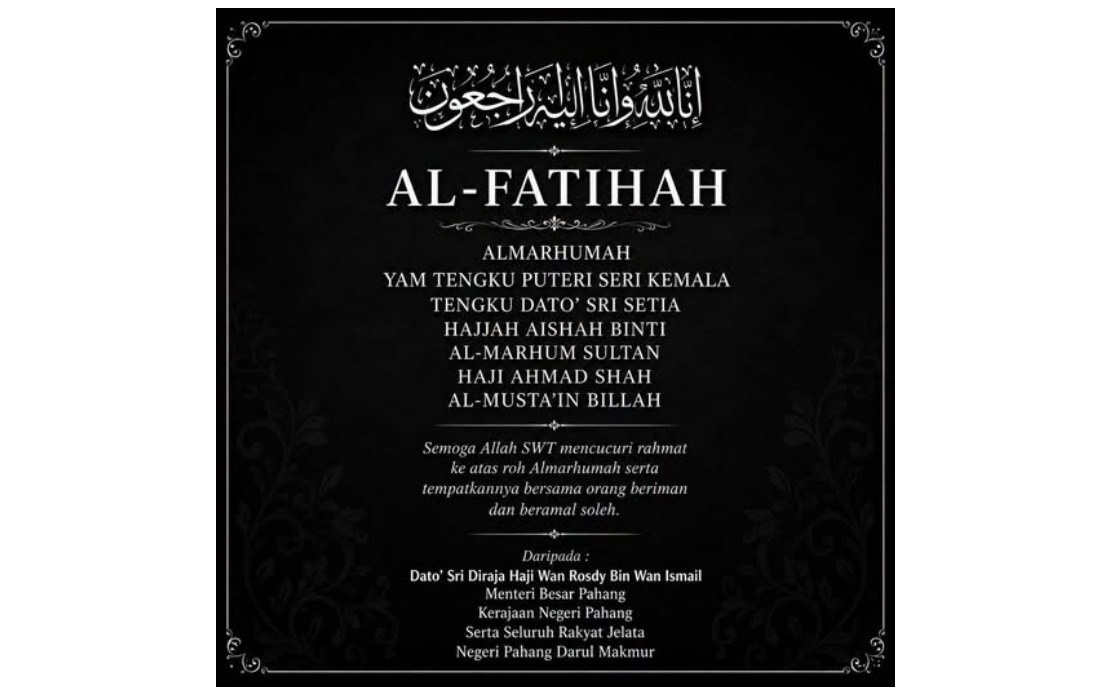
Pahang Menteri Besar Datuk Seri Wan Rosdy Wan Ismail has conveyed heartfelt condolences to the royal family following the death of Tengku Puteri Seri Kemala Tengku Datuk Seri Aishah Almarhum Sultan Ahmad Shah, the elder sister of Sultan of Pahang Al-Sultan Abdullah Ri'ayatuddin Al-Mustafa Billah Shah. The senior member of the Pahang Royal Family passed away on August 26 at a medical facility in Kuala Lumpur, marking a significant loss to the state's ruling institution and the broader Malaysian royalty network.
In his formal statement released from Kuantan, the Menteri Besar characterised the passing as a profound moment of grief, particularly for the reigning Sultan and his consort, Tengku Ampuan Pahang Tunku Azizah Aminah Maimunah Iskandariah. The loss reverberated beyond the palace walls, touching the entire Pahang state administration and the people of the state who share deep cultural ties to their royal household. Such transitions within royal families carry ceremonial and emotional weight in Malaysia's constitutional monarchy framework, where the Sultan embodies the spiritual and ceremonial leadership of the state.
Wan Rosdy's statement, shared through social media channels, represented the official position of the state government in acknowledging the family's bereavement. His words carried both formal protocol and genuine sentiment, invoking Islamic traditions by praying that Allah SWT would extend mercy upon the deceased's soul, forgive any shortcomings, accept her virtuous deeds, and grant her a place among the righteous believers. Such expressions reflect Malaysia's interweaving of governmental function with Islamic practice, particularly in matters concerning the royal institution.
Tengku Puteri Seri Kemala's death occurred at 9:15 pm on August 26, according to official records released by palace authorities. Her passing represents the loss of a figure who had witnessed and participated in significant chapters of Pahang's modern history, given her position within one of Malaysia's longest-established royal lineages. The timing of announcements and the coordination between state administration and royal household demonstrated the established protocols governing transitions within Malaysia's constitutional framework.
Arrangements for honouring the deceased proceeded according to royal custom, with her remains scheduled for interment at the Pahang Royal Mausoleum located in Pekan, the state capital. This final resting place holds particular significance as the traditional burial ground for members of the Pahang royal house, linking generations of rulers and their families through shared ceremonial space. The choice of venue underscored the dignity accorded to her position and her contributions to the state's royal heritage.
For Malaysian readers, particularly those in Pahang and the broader East Coast region, such developments carry cultural and constitutional resonance extending beyond typical political announcements. The state government's formal acknowledgement through its chief minister represents the established channels through which government and royalty maintain their constitutional relationship. This delicate balance has remained central to Malaysia's political stability since independence, with both institutions maintaining distinct roles while operating within a framework of mutual respect and institutional propriety.
The condolence expressed by Wan Rosdy also illuminated the broader significance of senior royal family members in Malaysian public life. Figures like Tengku Puteri Seri Kemala, though not in direct succession, played symbolic roles in maintaining royal continuity and dignity. Their passing prompted reflection on the institutional knowledge and historical connection they represented, particularly for a state like Pahang which maintains one of Malaysia's most established sultanates.
From a constitutional perspective, the careful wording of condolences and the observance of proper protocols reflect how Malaysia's monarchical system interacts with its political administration. State governments must navigate appropriate channels for expressing sympathy to royal households while maintaining the distinction between governmental and royal functions. Wan Rosdy's intervention as Menteri Besar rather than as a political party representative demonstrated this institutional awareness.
The religious dimensions of the statement, invoking Islamic prayers and values, aligned with Malaysia's constitutional framework where Islam holds a special position, particularly regarding royal matters in Muslim-majority states. The language employed—mercy, forgiveness, righteousness—resonated with both Islamic tradition and the cultural expectations of Malaysian society regarding appropriate mourning practices for senior family members, whether in royal or non-royal contexts.
For the broader Southeast Asian context, Malaysia's handling of royal transitions and institutional expressions of condolence provide insights into how constitutional monarchies in the region balance tradition with modern governance. The formality of Wan Rosdy's statement, released through contemporary social media yet adhering to classical protocols, illustrated this ongoing negotiation between historical practice and present-day communication methods.
The news of Tengku Puteri Seri Kemala's passing and the subsequent official responses would ripple through Pahang's government and society, with various state institutions and officials likely issuing their own statements in coming days. This cascading pattern of acknowledgement reflected the interconnected nature of Malaysia's political and social hierarchies, where respect for royal institution translates into coordinated governmental action.
Looking forward, the loss of senior royal family members often prompts reflection within their respective states about succession planning, institutional continuity, and the evolving role of constitutional monarchy in contemporary Malaysia. Pahang, as one of the federation's significant states with a sultanate dating back centuries, would continue navigating these questions while maintaining the equilibrium between democratic governance and royal institution that has characterised Malaysian political life.

