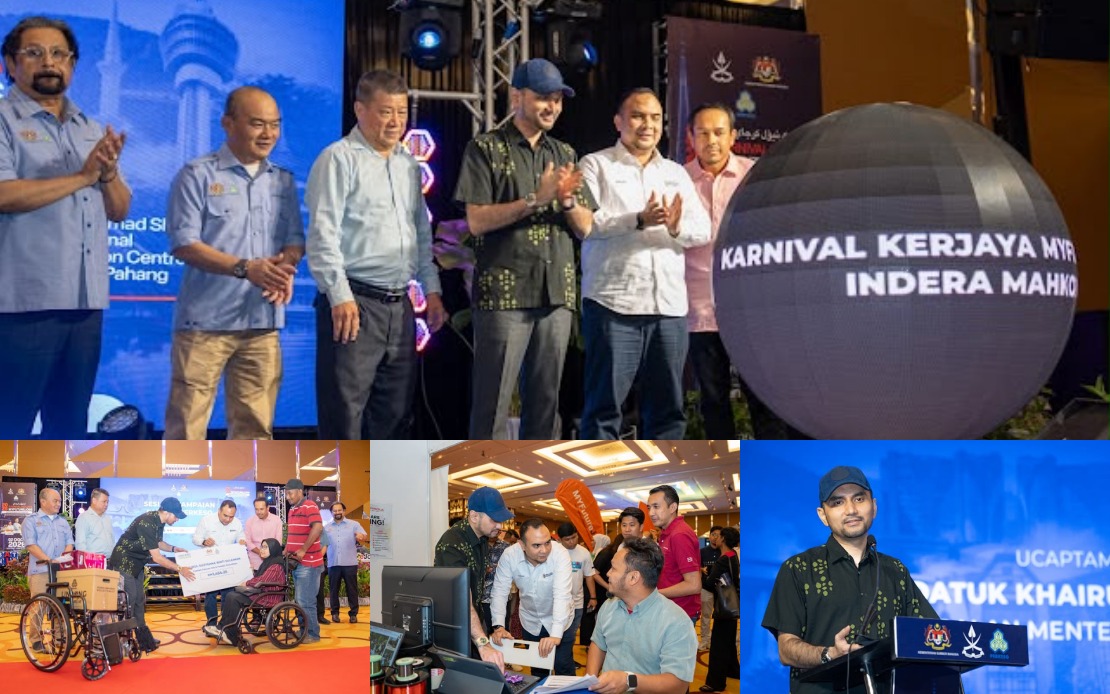
Pahang has established itself as the employment leader on Malaysia's east coast, recording a labour force participation rate of 65.3 per cent during the first quarter of 2026 while keeping unemployment levels exceptionally low at 1.9 per cent. The achievement underscores the effectiveness of targeted employment programmes in the region and reflects broader efforts to strengthen the country's labour market across diverse economic sectors.
The strong employment figures were highlighted during the opening of the Indera Mahkota MyFutureJobs Career Carnival 2026, a major recruitment event bringing together 30 employers offering 6,000 job vacancies across various industries. Deputy Human Resources Minister Datuk Khairul Firdaus Akbar Khan attributed the success to coordinated initiatives managed through the Social Security Organisation, known as PERKESO, which has become central to Malaysia's employment facilitation strategy. These programmes are designed to bridge the gap between job seekers and employers while ensuring equitable access to opportunities across different demographic groups and geographic areas.
Since the inception of the employment drive from 2023 through July 24, 2026, PERKESO's efforts have resulted in 26,877 job seekers in Pahang securing employment through the MYFutureJobs platform. This substantial figure demonstrates the programme's practical impact on the ground, transforming policy into tangible career advancement for thousands of workers. The scale of engagement has required significant organisational capacity, with PERKESO conducting 1,277 interview programmes and career carnivals throughout Pahang during the same period. Additionally, more than 10,000 job vacancies have been advertised via the MYFutureJobs portal, with 11,857 individuals registering on the platform in 2026 alone.
Beyond merely connecting workers with employers, the government's approach recognises that sustainable employment requires continuous skill development and adaptation to evolving industry standards. Deputy Minister Khairul Firdaus emphasised that PERKESO provides comprehensive training programmes designed to help workers meet contemporary workplace demands and enhance their professional capabilities. This two-pronged strategy—combining immediate job placement with long-term skills enhancement—addresses both immediate unemployment concerns and the structural challenges of matching workforce capabilities with economic opportunities.
The initiative's geographic reach carries particular significance for Malaysia's employment landscape. Rather than concentrating opportunities in urban centres, the government has committed to extending employment services closer to rural communities and hard-to-reach areas where access to job information and placement assistance remains limited. This decentralisation reflects recognition that unemployment and underemployment are not uniformly distributed across the nation, and that targeted interventions in less-developed regions can yield both economic and social benefits.
Complementing the employment focus, the Sahabat MADANI initiative was launched at the Pahang event, introducing a community volunteer movement designed to bridge government and grassroots populations. The programme's political secretary, Datuk Ahmad Farhan Fauzi, positioned Sahabat MADANI as more than conventional volunteerism, describing it as a structural mechanism through which the government maintains direct communication with local communities while mobilising youth participation in national development. This represents a strategic integration of employment initiatives with broader governance and community engagement frameworks.
The Sahabat MADANI initiative emphasises principles of collective responsibility, voluntary service, and inclusive community development, framing employment support within a larger ecosystem of social cohesion and mutual aid. The movement's values stress humanity, compassion, and mutual respect, suggesting that employment is understood not purely as an economic transaction but as part of comprehensive community welfare. The target of recruiting 2,000 Sahabat MADANI members in Pahang has been achieved, though organisers have signalled ambitions to expand this volunteer base significantly.
For young people and job seekers, the convergence of these programmes creates multiple pathways into formal employment. Career carnivals provide immediate access to hiring managers from diverse sectors, while the training component addresses skill gaps that might otherwise prevent successful job placement. The emphasis on continuous upskilling acknowledges that first-time employment is often only the beginning of a worker's journey, and that career progression requires ongoing professional development.
Pahang's outperformance on the east coast labour metrics suggests that concentrated investment in employment infrastructure, combined with multi-sector employer engagement, can achieve measurable results within defined geographic areas. The question facing Malaysian policymakers is whether this model can be scaled and adapted to other regions facing higher unemployment or lower participation rates. The east coast state's success provides a template for how systematic coordination between government agencies, employers, training providers, and community organisations can enhance labour market efficiency.
Looking forward, the sustainability of these employment gains depends on several factors. Economic growth must continue to generate sufficient job creation to maintain demand for labour. Skills training programmes must evolve alongside technological and sectoral changes to ensure relevance. The volunteer infrastructure created through Sahabat MADANI must successfully translate community engagement into practical employment support. For Malaysian workers and policymakers monitoring employment trends, Pahang's performance in Q1 2026 represents both an achievement to celebrate and a baseline against which future progress will be measured.

