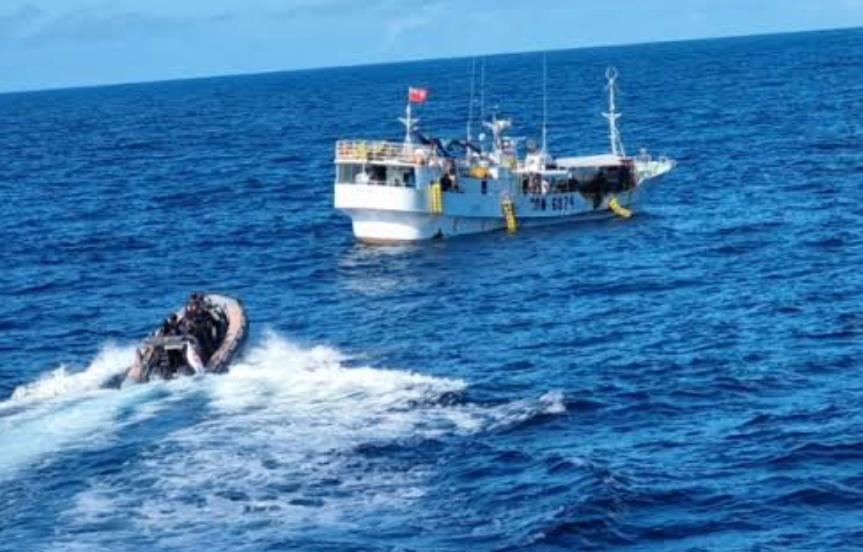
Pacific island nations have intensified enforcement against illegal fishing operations, with authorities in Kiribati, Palau and Papua New Guinea detaining at least four vessels suspected of breaching fishing regulations this month. The enforcement action, coordinated through the Pacific Islands Forum Fisheries Agency, reflects growing concern over unregulated activities in one of the world's most economically critical fishing zones. The detained vessels included Chinese and Indonesian flagged boats, according to FFA statements, marking a significant moment in regional maritime law enforcement at a time when fishing-related revenues face mounting pressure from both resource depletion and foreign overcapacity.
The detention operations emerged from Operation Island Chief, an ambitious two-week surveillance initiative conducted between early and mid-August that mobilised resources across 11 island nations. The operation demonstrated the scale of monitoring efforts required to patrol the region's vast waters, with authorities boarding more than 100 vessels across approximately 28 million square kilometres of ocean. The enforcement action was supported by an Australian military aircraft providing aerial surveillance capability and a United States Coast Guard vessel conducting maritime patrols alongside police forces from participating Pacific nations. This level of international cooperation underscores the strategic significance the major powers now place on Pacific maritime security and resource protection.
Further complicating the enforcement picture, authorities identified an additional 16 vessels categorised as being of particular interest during the operation, though the FFA declined to release specifics about these cases. The agency's reticence likely reflects the delicate diplomatic considerations surrounding fishing enforcement in the region, where naming specific nations or operators can provoke tension with trading partners and investors upon whom Pacific economies depend. This reluctance to detail findings reflects a broader challenge facing island governments as they attempt to balance resource protection with maintaining relationships with the foreign fishing interests that generate substantial government revenue.
The economic stakes driving enforcement efforts are substantial. The Pacific region supplies approximately half of the world's tuna catch, generating US$500 million annually in fishing access fees paid by foreign operators and contributing a further US$1.2 billion through export earnings. These revenues represent a critical income stream for island governments with limited economic alternatives. However, the benefits remain unevenly distributed, with only 15 per cent of the catch being processed or handled by Pacific Island countries themselves. This processing gap means most tuna is shipped to Asian markets by long-distance foreign fleets, which pay licensing fees to access island exclusive economic zones but retain the majority of value-added activities and profits.
Beyond government revenues, fishing remains woven into the fabric of Pacific island societies, supporting the livelihoods of approximately one-third of all Pacific households. This dependency creates complex policy tensions, as islanders benefit both from employment in fishing industries and from the access fees that governments collect from foreign operators. The situation has particular relevance for Malaysia and other Southeast Asian nations with substantial fishing fleets, as the region's enforcement actions potentially signal shifting attitudes toward how foreign operators conduct business in Pacific waters.
The detention operations carry particular diplomatic sensitivity regarding Chinese fishing activities. The region hosts large long-distance fleets operated by Chinese companies and several Chinese-Pacific island joint venture arrangements. Public naming of Chinese vessels engaged in illegal activities remains a delicate matter that authorities generally avoid, creating space for continued violations. Last month, Tuvalu authorities arrested a Chinese fishing vessel transmitting false location data while operating illegally in Tuvaluan waters. The vessel was fined and released following 24 days in detention, a relatively modest penalty that observers suggest may not create sufficient deterrence against future violations.
The Tuvalu incident carries added significance given that nation's diplomatic recognition of Taiwan rather than Beijing. The case demonstrates that even island nations maintaining ties with Taipei face complications in aggressively enforcement against Chinese fishing operators, suggesting that diplomatic considerations constrain enforcement action across the region. Peter Hammarstedt, captain of the conservation vessel Sea Shepherd, which supported Tuvalu's maritime patrol, observed the incident firsthand, highlighting the role international conservation organisations now play in documenting regional fishing violations.
Historical data on fishing violations provides context for current enforcement efforts. Between 2008 and 2026, the Western and Central Pacific Fisheries Commission issued 278 penalty notices to Chinese fishing boats, representing the second-largest tally globally. Taiwan vessels accumulated 319 infringements during the same period, suggesting that fishing violations remain a persistent challenge irrespective of operator nationality. The data indicates that enforcement mechanisms currently in place generate significant penalty volume without apparently eliminating underlying compliance problems, raising questions about deterrence effectiveness.
The timing of these enforcement actions precedes a significant diplomatic gathering that will shape regional fishing policy. An annual meeting of 18 Pacific Island leaders scheduled to begin on August 30 in Palau is expected to deliberate on strategies to strengthen Pacific island fishing rights protections and increase government revenues from fishing activities. Officials will likely discuss how enforcement operations fit within broader efforts to establish more effective resource management frameworks. Climate change impacts on tuna stocks will feature prominently in these discussions, as warming waters and shifting migration patterns threaten the sustainability of catches that underpin island economies.
For Malaysia and other Southeast Asian nations, the Pacific island crackdown carries implications beyond fishing enforcement. The operation demonstrates growing regional capacity for maritime surveillance and enforcement, potentially creating precedents for how other nations monitor foreign fishing activities within their own exclusive economic zones. Malaysian fishing operators and policymakers should monitor how Pacific island enforcement standards evolve, as increasingly sophisticated monitoring systems may establish benchmarks that other nations eventually adopt. The emphasis on bilateral cooperation, international naval support, and integration of conservation organisations suggests a model that could gain wider application across Asian maritime zones in coming years.

