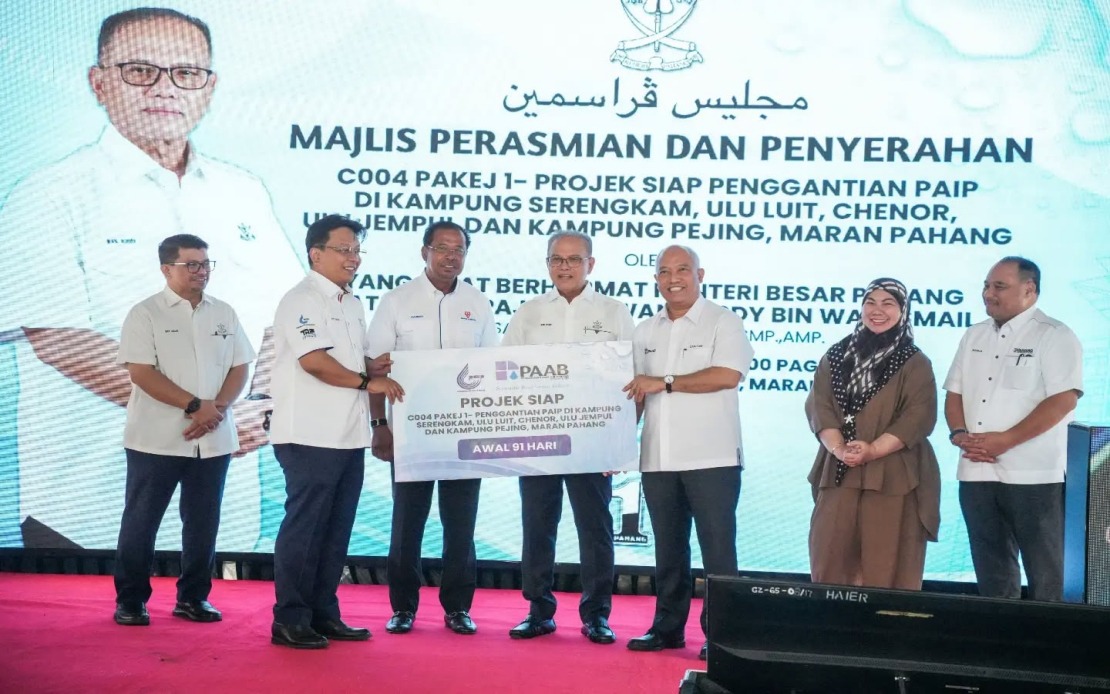
Pengurusan Aset Air Berhad (PAAB) has successfully concluded a RM11.19 million infrastructure overhaul in Maran that promises to end a persistent water crisis affecting thousands of Pahang residents. The project, which replaced 29.6 kilometres of ageing and damaged pipes across multiple localities including Kampung Serengkam, Ulu Luit, Pejing, Ulu Jempul and Chenor, was handed over at the Chenor Water Treatment Plant following completion three months ahead of schedule. Nearly 10,000 residents will benefit directly from this intervention, marking a significant milestone in addressing water security challenges that have plagued the district for nearly two decades.
The chronic water supply problems that prompted this intervention have been a defining feature of life in Maran, particularly for communities in the Chenor sub-district. Residents have endured recurring service disruptions stemming from the deterioration of pipe networks, with frequent burst pipes compounding operational inefficiencies. The ageing infrastructure had created cascading failures during peak demand periods, especially when water consumption surged during the dry season or major festive celebrations. By replacing the most compromised stretches of distribution piping, PAAB has directly targeted the root causes of these disruptions rather than pursuing piecemeal remedial measures.
Beyond restoring basic service reliability, the project carries substantial operational improvements for the broader water management system. The replacement of aged pipework reduces non-revenue water—a technical term describing losses through leakage, theft and metering inaccuracies—which has historically represented a substantial drain on system efficiency across Pahang's distribution networks. Simultaneously, the new infrastructure stabilises water pressure throughout the service area, ensuring consistent delivery even during periods of heightened consumption when older systems frequently experienced dramatic pressure fluctuations. These technical improvements translate into tangible quality-of-life gains for consumers who can now depend on continuous, adequate water supply.
The project handover on 28 August drew high-level political attention, reflecting the significance accorded to water infrastructure at state and federal levels. Pahang Menteri Besar Datuk Seri Wan Rosdy Wan Ismail officiated proceedings alongside Deputy Energy Transition and Water Transformation Minister Datuk Seri Abdul Rahman Mohamad and Deputy Economy Minister Datuk Mohd Shahar Abdullah. The presence of senior ministers underscored the interconnection between water security and broader economic development objectives, particularly given Maran's positioning within Pahang's industrial and agricultural landscape. PAAB chief executive officer Zulkiflee Omar and Pengurusan Air Pahang Berhad (PAIP) chief executive officer Datuk Saiful Zaini Mohd Bokhari oversaw implementation, representing the collaborative structure through which federal asset management and state-level service delivery are coordinated.
The Maran initiative represents merely one component of PAAB's substantially larger infrastructure ambition across Pahang. Over the next three years, PAAB and PAIP will pursue a coordinated development strategy encompassing multiple districts with compounding infrastructure challenges. A complementary project targets the Jengka Utama Water Treatment Plant, where upgrading electrical systems at clean water pumping stations will resolve persistent disruptions affecting communities surrounding the Felda Jengka settlement. This expansion demonstrates recognition that water supply reliability cannot be restored through isolated interventions but requires systematic, networked improvements across interconnected service zones.
Two additional major initiatives underscore the scale of PAAB's commitment to Pahang's water infrastructure modernisation. A RM35.7 million project will replace 76.2 kilometres of deteriorating pipes across Jerantut and Lipis, substantially upgrading distribution capacity serving areas around Pulau Tawar and Kuala Tahan. Simultaneously, a RM13 million intervention is underway in Felda Keratong, where 11 kilometres of water pipe replacement aims to enhance system efficiency throughout Rompin's supply network. Taken collectively, these projects address fundamental infrastructure decay that has accumulated across multiple districts over decades of deferred maintenance.
PAAB's financial commitment to Pahang's water sector provides quantifiable context for the scope of transformation underway. As of July 2024, the organisation had allocated RM1.17 billion toward water supply infrastructure throughout the state. This substantial allocation has been distributed across three implementation phases: RM69.79 million for projects already completed, RM66.94 million for initiatives currently under construction, and RM981.04 million earmarked for projects in advanced planning and design stages. The predominantly forward-looking composition of this budget indicates that major system upgrades remain in their early phases, with substantial physical works still ahead before Pahang achieves comprehensive infrastructure modernisation.
The institutional framework enabling these interventions reflects structural reforms implemented over the past two decades. PAAB itself was established in 2006 under the Water Services Industry Act 2006, tasked with assisting the federal government in executing the National Water Services Industry Restructuring Plan. As a statutory entity wholly owned by Minister of Finance Incorporated and regulated by the Ministry of Energy Transition and Water Transformation, PAAB functions as a dedicated vehicle for managing large-scale water infrastructure projects outside typical budgetary constraints. PAIP's 2020 execution of the Pahang State Water Supply Services Restructuring Agreement created the legal and operational framework through which state and federal entities coordinate service delivery, enabling the type of collaborative execution demonstrated in the Maran project.
For Malaysian readers, particularly those in Pahang, the Maran project carries implications extending beyond immediate service improvements. Water infrastructure reliability directly influences decisions by manufacturers, agricultural processors and other water-dependent industries regarding facility location and expansion. Communities with chronically unreliable water supply face competitive disadvantages in attracting investment, while improved infrastructure enhances development prospects. The two-decade duration of Maran's water crisis likely represented a significant drag on district-level economic development, constraining opportunities for value-added agricultural processing and light manufacturing that require dependable water access. Resolving this constraint positions Maran to participate more fully in Pahang's broader economic diversification strategies.
The broader strategic context involves transforming Malaysia's entire water sector toward greater resilience and sustainability. PAAB's intensive investment in Pahang exemplifies the federal government's commitment to replacing ageing infrastructure inherited from earlier development phases. Malaysia's urban water networks, in many cases, incorporate pipes and systems installed during the 1980s and 1990s that have exceeded their design lifecycles. Rather than continuing to manage deteriorating systems through reactive maintenance, the current approach pursues proactive replacement designed to establish modern, efficient networks capable of supporting future growth. Pahang, encompassing substantial geographic area and diverse settlement patterns, has experienced particularly acute infrastructure challenges requiring especially comprehensive intervention.
The Maran completion also reflects evolving methodologies in project delivery, with the three-month early completion noteworthy given Malaysia's frequent experience with infrastructure projects experiencing delays. Successful acceleration suggests effective coordination between PAAB, PAIP and local contractors, improved project planning, and adequate resource allocation enabling efficient execution. Such operational excellence, if replicated across subsequent phases of the broader Pahang programme, could establish templates for accelerated delivery of infrastructure improvements throughout the country. The demonstrated capacity to execute large pipe replacement projects efficiently within challenging terrain and existing settlement patterns provides valuable evidence that Malaysia can sustain accelerated infrastructure modernisation if appropriate institutional and financial frameworks remain in place.
Looking forward, sustaining momentum toward comprehensive water infrastructure modernisation requires continued prioritisation and funding. The RM981 million allocated to Pahang projects still in planning stages represents substantial future commitments dependent on sustained budgetary support and effective project preparation. Political attention demonstrated through ministerial participation in the Maran handover ceremony suggests water infrastructure modernisation retains high-level priority, though the financial demands of pursuing multiple concurrent projects across numerous districts demand careful sequencing and resource allocation. For residents in Maran and surrounding communities, the completed project represents vindication of long advocacy for infrastructure improvements, while for Malaysian policymakers, it demonstrates capacity to deliver transformative water sector improvements when adequate institutional frameworks and financing mechanisms are deployed.

