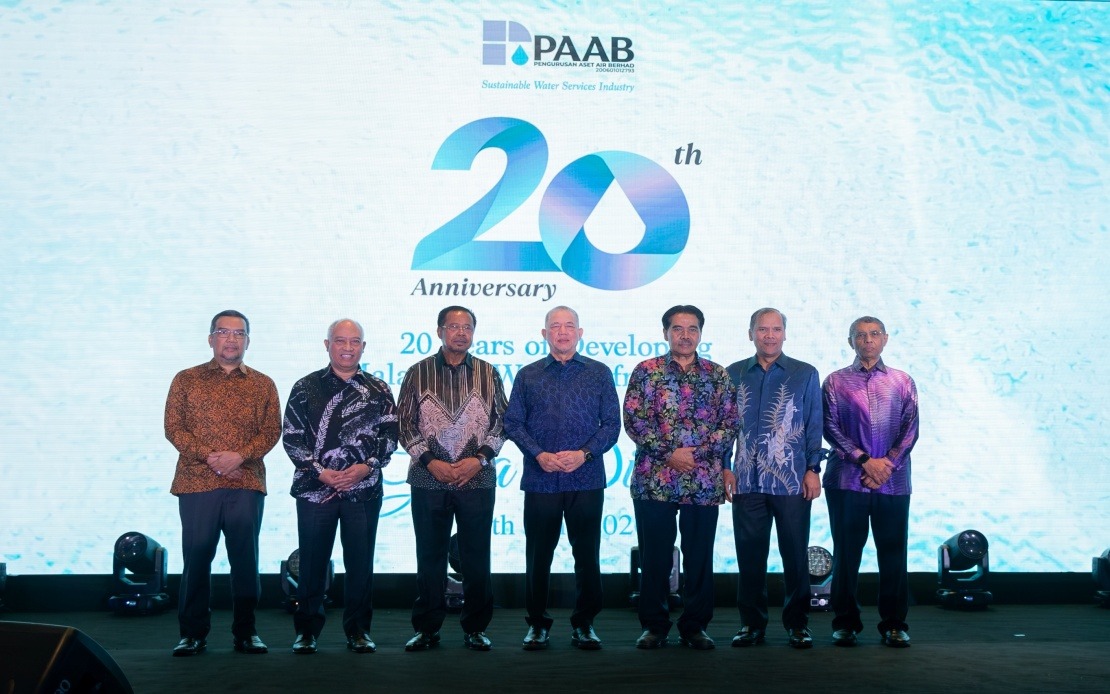
Pengurusan Aset Air Berhad (PAAB) has marked two decades since its establishment on May 5, 2006, as a wholly owned subsidiary of the Minister of Finance Incorporated. The milestone underscores the entity's pivotal role in reshaping Malaysia's water industry and securing reliable water supply for the country's expanding population and economic needs. The organisation's 20th anniversary dinner, held at Menara Felda Platinum Park with Deputy Prime Minister Datuk Seri Fadillah Yusof in attendance, highlighted the scale of transformation achieved and the challenges that lie ahead.
Over its two decades of operation, PAAB has emerged as a critical financial and infrastructure engine for the national water sector. The organisation has financed the takeover of water industry loans worth RM23.04 billion whilst simultaneously investing RM23.84 billion in capital projects across the country. Combined, these figures represent a total financial commitment of RM46.88 billion, positioning PAAB as one of the most significant contributors to Malaysia's public infrastructure development in recent times. This investment base reflects the scope of work required to modernise ageing water systems and expand capacity to serve growing urban and industrial demands.
The fruits of PAAB's investment strategy have become visible across Malaysia's water landscape. As of December 2025, ten states have formally signed onto the National Water Services Industry Restructuring Plan, which represents a coordinated approach to sector modernisation. Under this framework, tangible progress has materialised through the completion of 21 water treatment plants boasting a combined daily capacity of 2,085 million litres. Additionally, the organisation has overseen construction of 42 storage facilities capable of holding 783 million litres and facilitated the upgrade and extension of 3,263 kilometres of pipeline infrastructure nationwide. These projects collectively represent the physical embodiment of PAAB's financial commitments and signal measurable improvements in Malaysia's water supply infrastructure.
However, despite these substantial achievements, Malaysia's water sector confronts a persistent and troubling challenge that threatens to undermine gains made over the past two decades. Deputy Prime Minister Fadillah highlighted that non-revenue water, representing water lost through leaks, theft, and administrative failures, currently stands at approximately 40 per cent of total supply nationwide. This figure is not merely a technical concern but represents a significant economic and social problem. When such a large proportion of treated water disappears before reaching consumers, it wastes resources, inflates operational costs, and leaves communities vulnerable to supply disruptions during peak demand periods or drought conditions.
The urgency surrounding non-revenue water reduction reflects Malaysia's changing economic landscape and competitive positioning. The nation is actively courting foreign direct investment in capital-intensive, water-dependent sectors including data centres and advanced manufacturing. These industries require not merely adequate water supply but guaranteed, uninterrupted access to substantial volumes of consistent quality. Data centres, in particular, consume enormous quantities of water for cooling systems and cannot tolerate supply uncertainty without risking significant operational losses. Fadillah's emphasis on immediate action stems from recognition that Malaysia's ability to attract and retain such investments depends partly on demonstrating water security and reliability at scales currently impossible given the 40 per cent loss rate.
The challenge facing policymakers is fundamentally temporal. PAAB's restructuring roadmap extends to 2050, envisioning a phased approach through migration, stabilisation, consolidation, and full cost recovery phases spanning four decades. Yet Fadillah stressed that waiting a quarter-century to address water losses represents an unacceptable timeline given immediate economic imperatives and public needs. The tension between long-term strategic planning and short-term operational necessity reflects a broader pattern in Malaysian infrastructure development, where ambitious blueprints sometimes struggle to deliver rapid results. Achieving meaningful reductions in non-revenue water within the next decade would require coordinated, intensive action across federal agencies and state governments, each with competing budgetary priorities and institutional interests.
Resolving the non-revenue water problem demands intervention at multiple levels simultaneously. Technical solutions include accelerating pipeline replacement programmes to eliminate leakage-prone infrastructure, installing advanced metering systems for real-time loss detection, and upgrading treatment facilities to reduce operational waste. Administrative measures encompass strengthening revenue collection mechanisms, combating illegal connections, and improving maintenance protocols. Institutional coordination represents perhaps the most challenging dimension, as Malaysia's water sector involves multiple stakeholders including federal authorities, state governments, private concessionaires, and local communities. Historically, coordination gaps have hampered sector-wide initiatives, allowing inefficiencies to persist across fragmented operational domains.
PAB's capital expenditure breakdown as of December 2025 reveals the scale of ongoing work required. Of the RM23.84 billion invested, RM8.33 billion has been deployed toward completed projects now handed over to operating concessionaires. However, RM1.84 billion remains committed to projects under active construction, whilst RM13.67 billion has been allocated to schemes still in design and planning phases. This distribution indicates that substantial infrastructure development remains in early stages, with implementation challenges and cost overruns still possible. The pipeline of planned projects represents PAAB's confidence in the sector's trajectory, yet also underscores the lengthy timeframes typically required for large-scale water infrastructure deployment.
PAB chairman Datuk Seri Jaseni Maidinsa articulated the organisation's mandate through the Full Cost Recovery Roadmap extending to 2050. This framework recognises that sustainable water services cannot depend indefinitely on cross-subsidies and government grants but must ultimately generate sufficient revenue to cover operational and capital replacement costs. The phased approach aims to gradually transition the sector toward financial sustainability whilst managing tariff impacts on consumers. For Malaysia, where income disparities remain substantial and low-income households face water affordability challenges, balancing cost recovery against social equity represents an ongoing policy tension that no technical solution can fully resolve.
The performance metrics PAAB and sector leadership emphasise extend beyond purely financial indicators. Investment value and asset delivery counts, certainly, but the true measure lies in tangible improvements to water supply reliability, safety, and accessibility for ordinary Malaysians. Over the past two decades, millions of citizens have benefited from new treatment facilities, expanded pipeline networks, and improved storage capacity. Yet the persistence of non-revenue water at 40 per cent suggests that infrastructure expansion has not fully translated into proportional service improvements. This gap between investment and outcomes highlights that capital expenditure alone cannot solve sector challenges without simultaneous attention to operational efficiency, institutional governance, and enforcement of standards.
Looking forward, PAAB's role becomes more complex as Malaysia navigates competing demands on limited water resources. Population growth, industrial expansion, climate variability, and transboundary water agreements all impose pressures on the hydrological cycle and operational planning. The organisation's ability to finance and facilitate infrastructure development remains critical, yet equally important is driving behavioural and institutional change that reduces losses and optimises existing capacity. The next decade will test whether Malaysia can meaningfully reduce non-revenue water whilst expanding supply infrastructure, or whether pursuit of growth will perpetually outpace efficiency improvements, condemning the nation to persistent supply anxiety despite substantial infrastructure investment.

