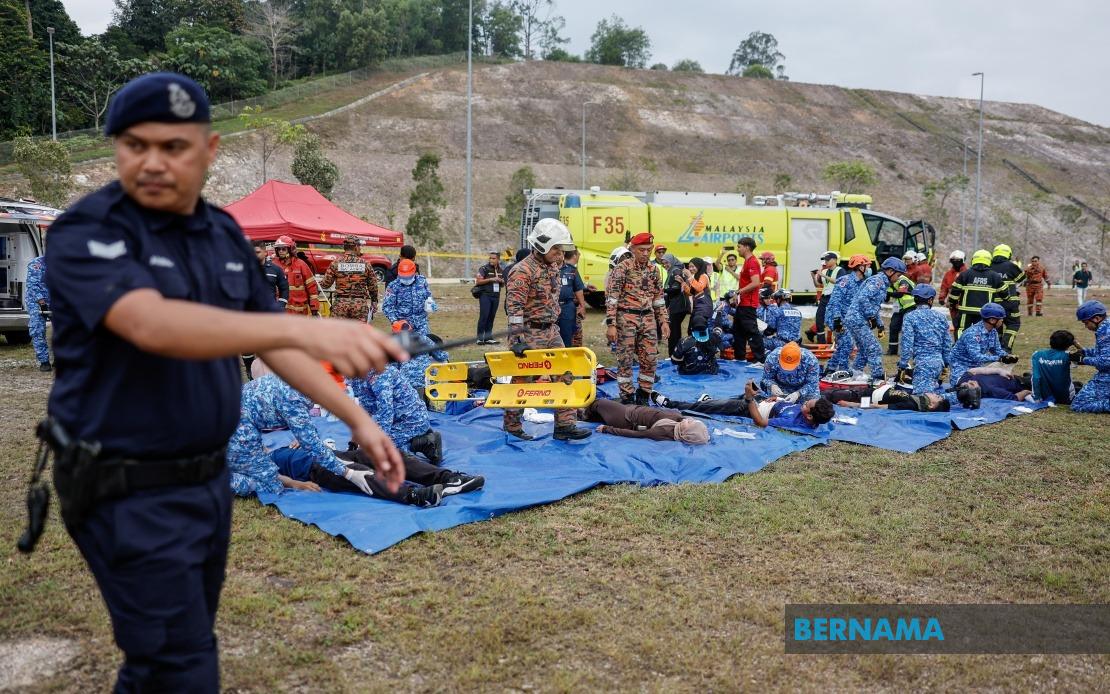
Malaysia's aviation safety framework got a real-world stress test this week when more than 20 government and emergency response agencies staged Ex Urban Falcon 2026, a comprehensive simulation of an aircraft disaster occurring well outside normal airport parameters. The exercise, held on July 16 at the Denai Alam Rest and Service Area along the Damansara-Shah Alam Elevated Expressway, represented a significant expansion of the nation's disaster preparedness protocols. Airport Fire and Rescue Services (AFRS) general manager Muhammad Hidayat Ismail explained that the drill centred on an ATR72 aircraft crash scenario approximately six kilometres from Sultan Abdul Aziz Shah Airport in Subang—a distance that stretched well beyond the typical exercise zones of previous years.
The exercise held particular significance because it tackled a rarely tested dimension of Malaysia's aviation emergency response architecture. Previous drills had predominantly focused on incidents occurring at or near airport boundaries, where established infrastructure and immediate proximity to emergency facilities provided structural advantages. Muhammad Hidayat underlined this distinction, noting that positioning the simulated crash outside the airport perimeter introduced complexities that demanded fresh solutions. Under the National Aeronautical Search and Rescue Manual (NAMSA), the AFRS maintains responsibility for a radius extending to eight kilometres from an airport's midpoint, yet operational readiness in such extended zones had received comparatively little practical validation until this exercise.
The logistical challenges revealed during Ex Urban Falcon 2026 exposed genuine vulnerabilities in current response protocols. Rescue teams confronted substantial delays navigating residential roads and manoeuvring through multiple toll plazas to reach the simulated incident site—obstacles that would prove critically consequential in an actual emergency. Muhammad Hidayat observed that responders nonetheless executed their assigned procedures competently, and the firefighting and rescue operations proceeded according to established standards. However, he candidly acknowledged that the exercise identified the foundation upon which future improvements must be constructed. The lessons extracted from this inaugural off-airport scenario would inform enhancements designed to compress response times and optimise resource deployment when speed determines survival.
One fundamental distinction separating off-airport aircraft emergencies from airport-based incidents concerns victim survival rates. Terrain irregularity at remote locations compounds injury severity and complicates rescue operations compared to controlled airport environments. Muhammad Hidayat highlighted this grim arithmetic: casualties in off-airport incidents frequently outnumber survivors, fundamentally altering triage protocols and resource allocation strategies. This reality necessitates intensified coordination around Disaster Victim Identification (DVI) operations, a function led by the Royal Malaysia Police. The drill provided rescue teams with a realistic crucible in which to rehearse the simultaneous management of mass casualties, forensic victim documentation, and family liaison activities that characterise genuine catastrophic events.
Technological preparedness, at least, appears to match international standards. Muhammad Hidayat noted that Malaysia's emergency response arsenal includes modern aircraft firefighting vehicles engineered to satisfy specifications and standards mandated by the International Civil Aviation Organisation (ICAO) and the Civil Aviation Authority of Malaysia (CAAM). Equipment adequacy, however, represents merely one component of effective disaster response. Coordination across diverse agencies operating under different command structures and standard procedures presents persistent organisational challenges. The Ex Urban Falcon 2026 exercise served as a crucible for identifying friction points in inter-agency communication and decision-making during high-stress scenarios where clarity and synchronisation determine outcomes.
The strategic partnerships underpinning this exercise reveal the scale of Malaysia's commitment to aviation safety. Malaysia Airports Holdings Berhad (MAHB), the National Disaster Management Agency (NADMA), the Selangor state government, and PROLINTAS-DASH—the expressway operator—united to mobilise approximately 450 participants from critical public and private-sector organisations. This coalition approach reflects recognition that modern disaster response demands seamless integration across traditional jurisdictional and institutional boundaries. Public security agencies, medical facilities, transportation authorities, and infrastructure operators must function as a coordinated system rather than independent silos. The exercise tested whether established relationships and communication protocols could withstand the confusion and pressure inherent in genuine catastrophic events.
Muhammad Hidayat emphasised that such coordinated preparedness directly influences public confidence in Malaysia's aviation safety architecture. International passengers and domestic travellers expect their host nation to maintain robust emergency response capabilities—not merely within airport confines but extending across surrounding inhabited areas. The investment in realistic scenario-based training demonstrates institutional commitment to that standard. When disasters strike, the public's perception of governmental competence hinges substantially on whether responders arrive swiftly, coordinate effectively, and communicate transparently. An exercise like Ex Urban Falcon 2026 signals to the travelling public that their safety transcends marketing slogans and reflects institutional practice.
The follow-up methodology further strengthens the exercise's value. Rather than concluding with the simulation itself, MAHB and participating agencies scheduled a comprehensive review workshop for July 26 and 27 specifically designed to extract lessons and develop improvement measures. This structured reflection process transforms raw operational experience into codified knowledge that shapes future protocols. Muhammad Hidayat indicated that findings would inform revisions to coordinated disaster response procedures, suggesting that the exercise functions as the opening chapter in an iterative refinement process rather than a one-off validation event. Organisations that treat drills as learning opportunities rather than compliance checkbox exercises tend to sustain higher readiness levels over time.
For Malaysian and regional aviation stakeholders, Ex Urban Falcon 2026 carries implications extending beyond Subang airport's immediate vicinity. The exercise methodology and findings will likely inform similar preparedness assessments across Malaysia's multiple civil aviation facilities. Southeast Asian nations increasingly recognise that shared approaches to disaster response enhance regional resilience. As air traffic grows across the region and aircraft transit corridors cross multiple jurisdictions, establishing interoperable emergency protocols and compatible training standards strengthens collective safety. Malaysia's demonstrated commitment to testing off-airport scenarios sets a precedent that other nations may examine and potentially emulate.
The exercise also highlights an evolving understanding of aviation risk that extends beyond classical airport-centric frameworks. Expanding urban development around major airports means that previously remote crash sites increasingly lie within residential or commercial zones. Aircraft accident trajectories do not respect institutional boundaries or planning categories. Off-airport emergencies demand that aviation authorities, municipal governments, and emergency services collaborate proactively rather than reactively. By staging Ex Urban Falcon 2026, Malaysian authorities signalled that they recognise this reality and have invested in testing response systems against contemporary risk patterns rather than historical assumptions.

