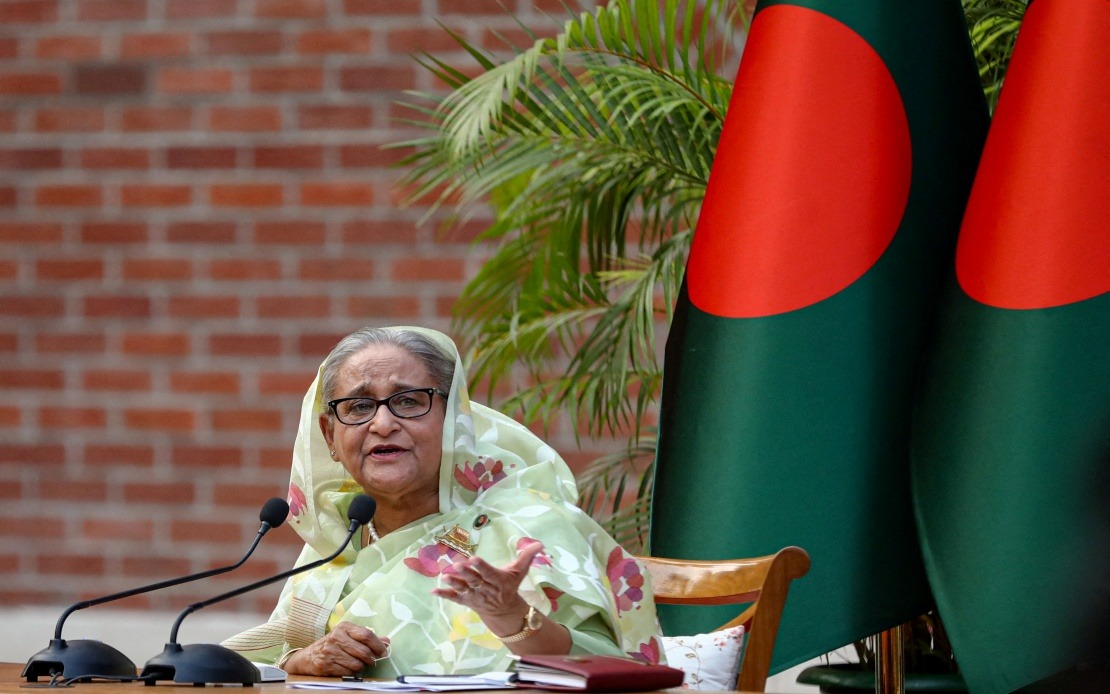
Sheikh Hasina, the 78-year-old former Prime Minister of Bangladesh, has publicly committed to returning to her country and submitting to judicial proceedings, even as she confronts the prospect of imprisonment or execution. Speaking through a written interview with Kyodo News, Hasina acknowledged the grave personal risks she faces while rejecting the legitimacy of her conviction on charges connected to a 2024 crackdown on student-led demonstrations. Her declaration represents a striking act of political defiance from exile in India, where she has sought refuge since fleeing Bangladesh in August 2024 as anti-government unrest intensified across the nation.
The circumstances that precipitated Hasina's departure stemmed from widespread student protests triggered by a High Court decision to reinstate a 30 percent civil service quota reserved for descendants of those who fought in Bangladesh's 1971 independence war. What began as a focused grievance over employment policy rapidly transformed into a comprehensive challenge to governmental authority, drawing participation from diverse segments of society. Security forces responded with force, resulting in an estimated 1,400 deaths according to United Nations assessments, predominantly among protesters struck by gunfire. Hasina categorically denied authorising these lethal responses, instead contending that opposition figures orchestrated and exploited the movement for political gain.
In November 2025, Bangladesh's war crimes tribunal found Hasina guilty of crimes against humanity in a trial conducted without her physical presence, sentencing her to death. This development escalated diplomatic tension between Dhaka and New Delhi, with Bangladesh formally requesting India's extradition of the former leader. India's Ministry of External Affairs acknowledged receipt of the request, indicating it was reviewing the matter through the prism of applicable legal and judicial frameworks. The extradition question has assumed particular significance within regional geopolitics, reflecting broader questions about asylum, judicial sovereignty, and cross-border accountability in South Asia.
Hasina's legal team and international observers have raised substantial questions regarding the trial's fairness and independence. Human Rights Watch has publicly expressed concern about proceedings conducted in absentia, while simultaneously acknowledging that accountability for governmental abuses remains a legitimate objective. The former Prime Minister herself has proposed an alternative investigative approach, suggesting that independent international forensic experts could objectively examine the circumstances surrounding each death during the unrest, potentially establishing factual truths that transcend current political divisions. This proposal implicitly challenges the tribunal's findings while maintaining her openness to genuine accountability mechanisms.
The political landscape in Bangladesh has shifted dramatically since Hasina's departure. Following her resignation, an interim administration was established under Muhammad Yunus, the Nobel Prize-winning economist whose development work has achieved global recognition. When general elections were held in February 2026, the opposition Bangladesh Nationalist Party achieved victory, bringing Tarique Rahman to the office of Prime Minister. In response to these political changes, authorities banned all activities associated with Hasina's Awami League party in May 2025, effectively removing it from the institutional landscape. Rahman's government has publicly stated its intention to prosecute Hasina, with the Prime Minister's information adviser emphasising commitment to providing legal due process.
Hasina's political trajectory has encompassed considerable complexity. The daughter of Bangladesh's founding father Sheikh Mujibur Rahman, she served as Prime Minister across five non-consecutive terms, governing the country from June 1996 to July 2001 and again from January 2009 until her August 2024 departure. Her tenure included periods of relative stability as well as confrontations with extremist violence. Notably, during her third term in July 2016, militants launched an attack on the Holey Artisan Bakery in Dhaka that claimed 20 lives, including nine Italian nationals, seven Japanese citizens, two Bangladeshis, one Indian, and one American of Bangladeshi heritage. Two police officers also died during the response operation. The assault demonstrated the security challenges confronting Bangladesh and the international dimensions of such crises, particularly given Japan's substantial investment in infrastructure projects there.
Hasina's broader framing of Bangladesh's situation emphasises the nation's regional and international significance. She has articulated an argument that Bangladesh's stability transcends parochial national concerns, asserting that the country's trajectory carries consequences for South Asia more broadly, the Bay of Bengal region, development partners, and nations including Japan that have committed substantial resources and diplomatic capital to Bangladeshi development initiatives. This positioning suggests Hasina views her potential return not merely as a personal matter but as bearing implications for regional stability and international relations. She has appealed for a period of national healing while maintaining that genuine reconciliation cannot entail allowing perpetrators of serious crimes to escape proper legal accountability.
The question of democratic restoration has emerged as central to Hasina's post-crisis vision. She has emphasised that Bangladesh's subsequent decade can constitute a period of recovery and renewal exclusively if democratic institutions are genuinely restored and citizens are granted authentic capacity to determine their nation's direction. This formulation implicitly critiques current governance arrangements while avoiding explicit condemnation of her successors. Her framing positions herself not as seeking personal vindication but as advocating for institutional and systemic reforms that would benefit the broader Bangladeshi population. Yet the incompatibility between this aspirational vision and her current status as a convicted fugitive presents an apparent contradiction within her public discourse.
For Malaysia and other Southeast Asian nations, the Bangladesh situation illustrates ongoing tensions between state sovereignty, judicial independence, and international law. Malaysia, which maintains substantial economic and strategic relationships throughout South Asia, faces questions about how transitional justice processes should function when political upheaval involves multiple actors claiming legitimacy. The case demonstrates how student-led movements can rapidly escalate into broader constitutional crises, a phenomenon with direct relevance across the region given comparable political dynamics in several neighbouring states. Furthermore, the extradition question between India and Bangladesh reflects the complex frameworks governing accountability in South Asia, where regional relationships often complicate pursuit of justice.
Hasina's insistence upon returning despite the death sentence reflects a calculated political gambit. By publicly committing to judicial processes while simultaneously questioning their legitimacy, she positions herself as willing to engage democratic and legal procedures while maintaining that current authorities lack moral authority to adjudicate the matters in question. This strategy appears designed to cultivate international sympathy, particularly among nations that have historically supported her government, while simultaneously maintaining her credibility among domestic supporters who might otherwise regard her as permanently abandoning Bangladesh. Her emphasis on forensic investigation and independent verification strategies attempts to elevate the discourse beyond what she characterises as purely political prosecution toward frameworks premised on objective evidentiary analysis.
The unresolved question of whether and when Hasina might actually return to Bangladesh remains contingent on multiple variables. India's extradition decision will prove decisive, as will any potential shifts in Bangladesh's government or international diplomatic calculations. Should she return, the trial would likely dominate Bangladeshi politics while potentially destabilising the region more broadly. Conversely, continued exile permits Hasina to maintain a leadership position within opposition circles while avoiding immediate physical jeopardy. The current stalemate therefore serves certain interests even as it leaves fundamental questions about accountability and justice unresolved. For observers across Southeast Asia, the unfolding situation demonstrates how constitutional crises in one country can generate complex cross-border implications affecting regional stability and the foundations of international law governing state relations.

