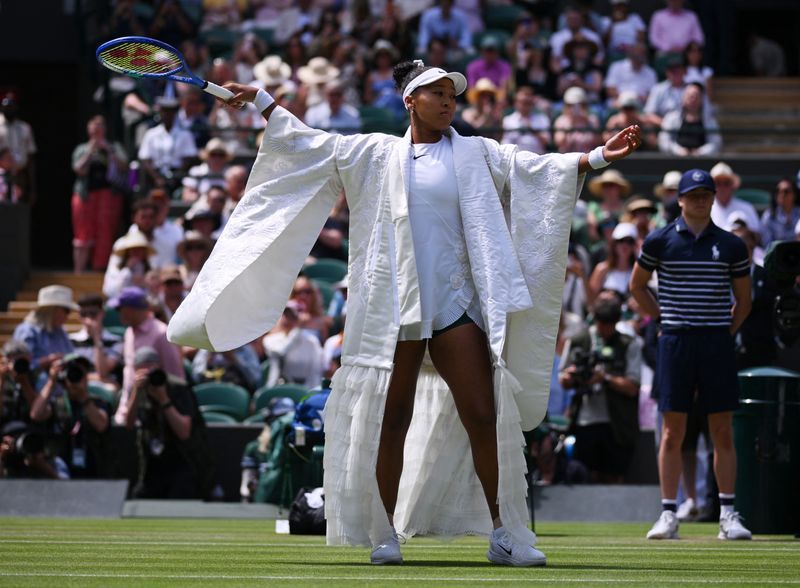
Naomi Osaka has arrived at Wimbledon with a statement that extends far beyond her distinctive courtside wardrobe. The four-times Grand Slam champion from Japan dismantled unseeded Australian Daria Kasatkina with a 6-1 6-3 victory on Friday, securing her maiden appearance in the tournament's second week and affirming that her tennis capabilities are every bit as compelling as her widely celebrated fashion credentials. Playing under the summer sun on Court One, the 14th seed demonstrated a blend of tactical acuity and controlled aggression that suggests she could pose a genuine threat in the latter stages of the competition.
Osaka's ascent through Wimbledon's first week has naturally captivated the crowd, though perhaps not always for the reasons traditionalists might prefer. The 28-year-old has courted significant media attention with a succession of eye-catching ensembles, each reflecting her status as one of the sport's leading style innovators. Her most recent creation, a flower-patterned kimono inspired by the "Kill Bill" motif, served as her walkout robe on Friday—a playful nod to cinema that epitomises how she has redefined what it means to be a contemporary professional athlete. Yet increasingly, the narrative around Osaka is shifting away from mere sartorial commentary towards genuine recognition of her competitive resurgence.
The match against Kasatkina unfolded as a clear demonstration of Osaka's superiority on grass. Breaking her Russian-born opponent in the opening exchanges with a crisp backhand winner, she rapidly established dominance by constructing a double break through a penetrating forehand that left Kasatkina struggling to mount an effective response. The opening set evaporated in less than forty minutes, a rout that underscored the gulf between the two competitors when Osaka finds her rhythm on the surface. For those tracking her progression following recent grass-court tournaments in Europe, this performance validated emerging optimism about her continued revival after injury setbacks.
The second set proved somewhat more competitive, though ultimately yielded the same destination. After squandering an early advantage that had briefly suggested a more spirited contest, Osaka fought back to construct two match points. Rather than allowing anxiety to intrude, she clinched proceedings with composure and precision, refusing the temptation to over-complicate matters. This composure under pressure represents precisely the kind of mental resilience that distinguishes champions from talented journeymen, and it was conspicuously evident throughout her time on Court One.
Osaka's recent trajectory warrants careful attention from Southeast Asian tennis enthusiasts and indeed the broader sports community. Following her achievement of reaching the Bad Homburg final on grass before suffering an injury that forced retirement, questions lingered about whether she could recover her form in the near term. Wimbledon provides the definitive early answer to those concerns. Her systematic dismantling of Kasatkina, achieved with the kind of controlled intensity rather than wild aggression that sometimes characterises her play, suggests a player who has integrated hard-won lessons about pacing herself across tournament schedules.
The immediate challenge ahead arrives in the form of a second-round clash against either world number one Aryna Sabalenka or former French Open champion Jelena Ostapenko, a matchup that will constitute the true test of whether Osaka's current form represents a sustained recovery or merely a strong showing against modest opposition. Sabalenka, in particular, represents the type of power-dominant opponent who can trouble even the most accomplished players on any surface. However, Osaka's demonstrated ability to combine precision with power, evident in her performance against Kasatkina, provides legitimate grounds for optimism about her quarter-final prospects.
In her courtside remarks, Osaka reflected that she had never previously recorded a victory on Court One, rendering Friday's result particularly meaningful in terms of her personal Wimbledon history. She emphasised her appreciation for the crowd's support and her own sense of confidence accumulated through intensive grass-court preparation over the preceding fortnight. These comments, while modest in tone, reveal a player who understands the psychological dimensions of tournament tennis and recognises that accumulated match play builds the kind of comfort necessary to compete effectively against the tour's elite practitioners.
For Malaysian observers and broader Southeast Asian sports audiences, Osaka's progression carries cultural significance beyond the immediate confines of professional tennis. As a player of global prominence who maintains strong connections to Japanese identity whilst competing on sport's largest stages, her success resonates across the region. The manner in which she has navigated the intersection between commercial visibility and competitive excellence—the fashion statements and the tennis prowess—offers a template for how contemporary athletes can build multifaceted careers without sacrificing competitive integrity.
Looking ahead, Osaka's ambitions for Wimbledon will be tested incrementally over the coming days. Her stated philosophy of approaching tennis one point and one day at a time reflects mature understanding that premature focus on distant objectives breeds complacency and distraction. Whether she ultimately adds a Wimbledon title to her Grand Slam collection remains uncertain, but her demonstrated capacity to compete with genuine intensity on grass surfaces in 2024 suggests that dismissing her prospects would be profoundly unwise. The combination of technical skill, mental fortitude, and stylistic panache that defines Osaka as a competitor suggests that her journey through Wimbledon may yet yield further surprises.

