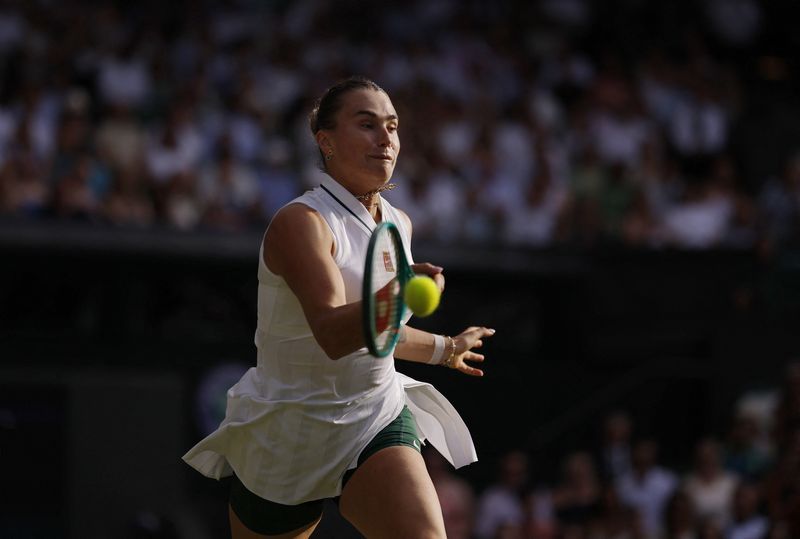
Naomi Osaka delivered a commanding fourth-round victory over world number one Aryna Sabalenka at Wimbledon on Sunday, dismantling the top seed with a 6-2 7-6(2) scoreline on Centre Court and fundamentally reshaping the trajectory of the women's championship. The upset triumph represents the Japanese star's most significant achievement since her comeback to professional tennis following the birth of her daughter Shai in 2024, and it comes at a moment when the tournament's title picture appeared to be tightening around an elite group of elite contenders.
The matchup between the two players carried considerable historical weight, featuring competitors with a combined eight Grand Slam titles between them. Yet despite expectations of a closely contested affair befitting their respective credentials, Osaka delivered a clinical performance that left little room for competitive friction. The opening set proved particularly lopsided, with Sabalenka's formidable baseline power game rendering ineffective throughout a mere 32-minute first set. The world number one's visible frustration mounted visibly as her typically dominant stroke-making pattern continued to misfire against an opponent who seemed to have mapped out an effective blueprint.
Sabalenka's struggles intensified the drama surrounding her tournament trajectory. Having reached three successive Wimbledon semi-finals without converting any into a championship appearance, the 28-year-old arrived at this match with considerable unfinished business on grass. The departure of defending champion Iga Swiatek and second seed Elena Rybakina in the previous round had appeared to offer a genuine pathway toward her maiden title at the All England Club. Instead, Sabalenka fell well short of the standard required to capitalize on these unexpected openings at the top of the draw.
The second set provided more of the competitive texture that the capacity Centre Court crowd had anticipated when the match began. Osaka maintained her composure throughout the tighter proceedings, while Sabalenka fought to regain some measure of control. The critical moment arrived during the tiebreak, where Osaka's excellence under pressure proved decisive. By claiming victory in the sudden-death decider, Osaka snapped Sabalenka's remarkable streak of 21 consecutive tiebreak victories across Grand Slam tournaments, a statistic that underscored just how thoroughly the top seed had been undermined by her opponent's superior execution in the moment that mattered most.
Osaka's emotional response to her triumph highlighted the significance of the occasion from her perspective. Speaking immediately after the match, she emphasized the psychological and emotional rewards of competing at such a level against an opponent of Sabalenka's stature. The 14th seed acknowledged the personal dimension of the victory, noting that she had suffered three consecutive defeats to Sabalenka previously. For a player navigating the complex process of returning to competitive tennis while managing motherhood, the magnitude of erasing that losing record represented a breakthrough moment that transcended mere ranking points.
The broader implications of Osaka's advancement extend beyond her own quarter-final meeting with Czech 10th seed Karolina Muchova. With the top three seeds now eliminated from the women's draw, the tournament has been genuinely opened up in a manner that seemed unlikely during the opening rounds. This development creates opportunities for unseeded or lower-seeded players to advance toward positions they might otherwise struggle to reach in a more predictable competitive environment. The women's championship now lacks a clear favorite, with multiple narratives and potential storylines remaining viable.
Osaka and Sabalenka represent an intriguing study in contrasting career trajectories despite their considerable similarities. Both emerged as hardcourt specialists, with each player holding four Grand Slam titles accumulated exclusively on that surface prior to this Wimbledon encounter. Born merely seven months apart, their career arcs have diverged sharply, with Osaka capturing all four of her major titles before Sabalenka claimed her maiden Grand Slam victory. Their earlier meeting eight years prior had occurred during Osaka's maiden Grand Slam victory at the U.S. Open, a moment when both players were ascending but Osaka had positioned herself first.
Beyond the on-court dynamics, Osaka has continued to generate considerable attention through her carefully curated approach to presentation and performance apparel, incorporating Japanese-inspired aesthetics into her walk-on outfits. However, the real narrative shifting attention toward Osaka involves the quality of her tennis itself. Her aggressive service return strategy thoroughly disrupted Sabalenka's rhythm throughout Sunday's encounter, with Osaka repeatedly positioning herself to catch her opponent off-balance through superior anticipation and execution.
Sabalenka's post-match demeanor reflected the emotional toll of unexpected defeat. Having arrived at the press conference minutes after departing the court, the world number one expressed her need to mentally distance herself from the disappointment, indicating her intention to consume alcohol and consciously set aside thoughts of tennis. This raw honesty about the psychological burden of losing at this level provided insight into the mental fortitude required to compete at professional tennis's highest echelon, where margins between success and elimination often hinge upon marginal differences in execution during crucial moments.
For Malaysian and Southeast Asian observers, Osaka's resurgence carries particular resonance given the region's growing interest in women's professional tennis and the broader narrative of elite athletes managing personal and professional responsibilities. Her successful return to competition demonstrates that extended absences from professional sport need not permanently diminish competitive capacity, particularly when underpinned by genuine motivation and comprehensive preparation.
Osaka's quarter-final assignment against Muchova presents a different strategic challenge than the Sabalenka encounter. The Czech player brings her own particular strengths to grass-court competition, though she lacks the raw power that characterizes Sabalenka's game. Osaka's victory has fundamentally altered expectations for the remainder of the women's championship, injecting genuine unpredictability into a tournament that had appeared destined for a predictable conclusion shaped by the traditional favorites.

