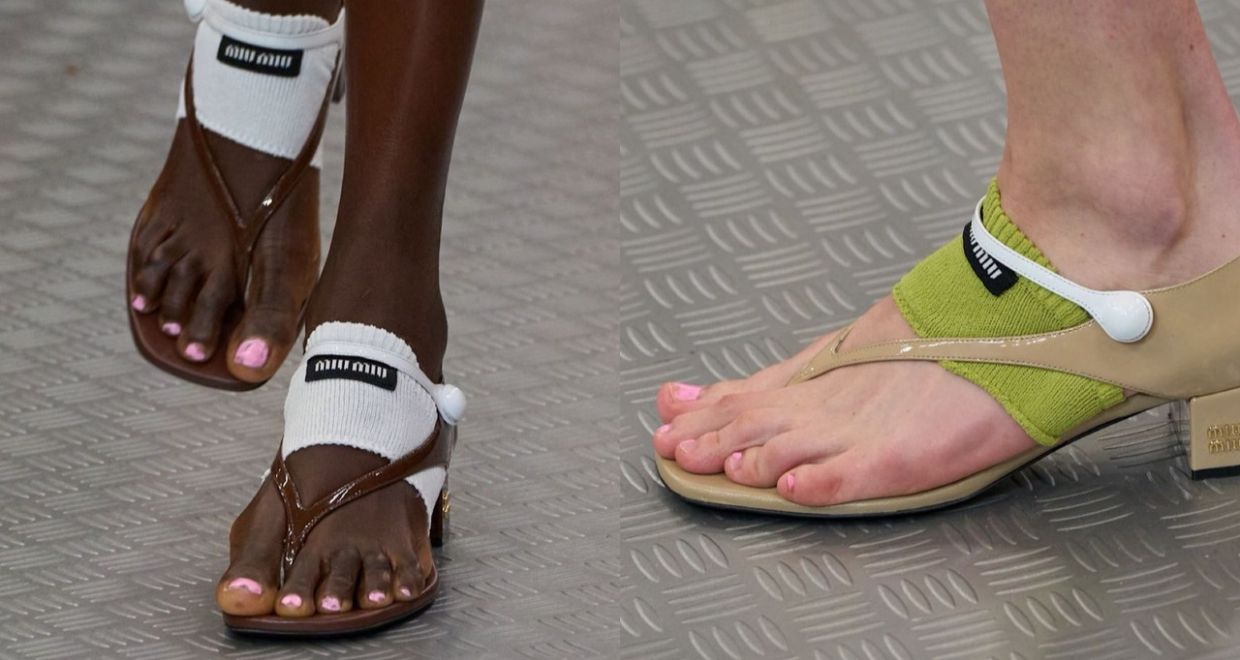
Fashion rarely settles on extremes, and this summer's footwear dilemma exemplifies the challenge: going barefoot seems too casual, yet traditional socks trap heat in tropical climates. South Korea's early heat wave has prompted a surprising solution that is rapidly gaining traction across Asia: open-toe socks. These cropped socks, engineered to cover only the arch and upper foot while leaving toes exposed, represent a cunning compromise that retailers and fashion platforms are actively promoting alongside complementary warm-weather accessories like flip-flop socks and sheer leg warmers.
The momentum behind this trend is considerable and measurable. Online fashion platform W Concept documented an 80 percent surge in summer shoe sales between May 31 and June 7 compared to the previous year, with mules, slides, and flip-flops leading the charge. More striking still, the commerce platform Ably tracked a remarkable 1,664 percent increase in transaction values for socks specifically designed to wear with flip-flops over a month-long period from mid-May to mid-June, accompanied by a staggering 3,227 percent climb in search queries. These figures underscore that open-toe socks have transcended novelty status and are crystallising into a genuine seasonal phenomenon.
The trend's origin story credits the Italian luxury label Miu Miu, whose 2025 Spring/Summer collection introduced an unconventional sock design that departed from traditional full-foot coverage. Rather than enveloping the entire foot, Miu Miu's interpretation featured a sock wrapping exclusively around the arch, creating an aesthetic that seemed deliberately impractical until influencers and celebrities began championing the look. South Korean actor Cha Jung-won subsequently popularised the style through social media by pairing sky-blue flip-flops with beige knit leg warmers, providing a visual reference that transformed the concept from designer eccentricity into accessible street style.
What distinguishes contemporary open-toe socks from their winter predecessors is a fundamental reimagining of purpose and material composition. Where winter versions prioritise thermal retention through thick wool or cotton blends, summer iterations employ sheer, mesh, and loosely knit fabrics that emphasise breathability and ventilation. This material revolution allows the accessory to function as a styling accent rather than a warmth source, introducing colour contrast and layering opportunities to otherwise monotonous flip-flop-and-bare-foot combinations. Fashion retailers have repositioned open-toe socks as a strategic tool for elevating pedestrian summer outfits without adding genuine discomfort.
The practical advantages extend beyond pure aesthetics. A representative from online retailer 29CM articulated the functional appeal, noting that open-toe socks substantially reduce friction and chafing caused by flip-flop straps against the skin. This mechanical benefit becomes particularly valuable during Southeast Asia's monsoon seasons, when the same socks can be worn with rain boots to mitigate skin irritation from waterlogged footwear. For consumers in tropical regions experiencing high humidity and frequent footwear transitions, the design addresses legitimate comfort concerns while simultaneously offering styling possibilities.
Navigating the open-toe sock aesthetic requires some consideration regarding colour coordination and overall composition. Fashion professionals suggest beginning conservatively with neutral shades like grey, black, or white, which provide visual grounding without overwhelming an outfit. Pairing grey socks with black flip-flops or ballerina flats creates a cohesive foundation compatible with denim, Bermuda shorts, and satin skirts. For those prepared to embrace bolder experimentation, vivid hues such as yellow, pink, or sky blue command attention, particularly when deliberately mismatched with shoe colours—a styling choice that paradoxically enhances sophistication through apparent casualness.
The strategic restraint in accompanying pieces distinguishes successful open-toe sock styling from misguided attempts at the trend. Because the socks and shoes already command visual attention, the remaining wardrobe elements should maintain simplicity and familiarity. A basic T-shirt paired with shorts or a straightforward shirt-and-skirt combination allows the footwear styling to serve as the outfit's focal point without creating visual chaos. Conversely, clothing featuring visible patterns such as polka dots or floral prints harmonises particularly well with open-toe socks, as pattern repetition across multiple garment layers creates intentional design coherence.
The cultural significance of this trend extends beyond mere fashion novelty, representing a broader shift in how Asian consumers approach seasonal dressing in warming climates. As temperatures rise and humidity intensifies across Southeast Asia, garments and accessories traditionally relegated to cooler seasons are being reimagined for tropical conditions. Open-toe socks exemplify this recalibration—taking a quintessentially winter item and reconstructing it for summer wear through material innovation and styling recontextualisation. This adaptability suggests growing consumer sophistication in layering and accessorising beyond binary choices of full coverage or complete exposure.
Fashion editor Je Hye-yoon encapsulated the philosophical transformation underlying this trend by asserting that socks need no longer function as hidden necessities but rather as visible design statements. The directive to bare toes, leave them openly exposed, or tuck them strategically between flip-flop straps positions socks as purposeful accessories commanding their own presence within an outfit. This conceptual elevation reflects broader fashion industry trends privileging intentionality and layering over traditional silhouette conventions. For Malaysian and Southeast Asian consumers navigating perpetual heat and humidity, open-toe socks offer a refreshingly pragmatic yet aesthetically credible option for footwear styling that acknowledges both comfort and contemporary design sensibilities.
%22%2F%3E%3C%2Fpattern%3E%3C%2Fdefs%3E%3Crect%20width%3D%22100%25%22%20height%3D%22100%25%22%20fill%3D%22url(%23ph20e1dg)%22%2F%3E%3Crect%20width%3D%22100%25%22%20height%3D%22100%25%22%20fill%3D%22url(%23ph20e1dp)%22%2F%3E%3Ctext%20x%3D%2250%25%22%20y%3D%2250%25%22%20text-anchor%3D%22middle%22%20dominant-baseline%3D%22central%22%20fill%3D%22rgba(255%2C255%2C255%2C0.95)%22%20font-family%3D%22Georgia%2C%20'Times%20New%20Roman'%2C%20serif%22%20font-weight%3D%22700%22%20font-size%3D%22272%22%20letter-spacing%3D%22-0.02em%22%3EMITRA%3C%2Ftext%3E%3C%2Fsvg%3E)
%22%2F%3E%3C%2Fpattern%3E%3C%2Fdefs%3E%3Crect%20width%3D%22100%25%22%20height%3D%22100%25%22%20fill%3D%22url(%23ph29qdrg)%22%2F%3E%3Crect%20width%3D%22100%25%22%20height%3D%22100%25%22%20fill%3D%22url(%23ph29qdrp)%22%2F%3E%3Ctext%20x%3D%2250%25%22%20y%3D%2250%25%22%20text-anchor%3D%22middle%22%20dominant-baseline%3D%22central%22%20fill%3D%22rgba(255%2C255%2C255%2C0.95)%22%20font-family%3D%22Georgia%2C%20'Times%20New%20Roman'%2C%20serif%22%20font-weight%3D%22700%22%20font-size%3D%22320%22%20letter-spacing%3D%22-0.02em%22%3ERim%3C%2Ftext%3E%3C%2Fsvg%3E)
%22%2F%3E%3C%2Fpattern%3E%3C%2Fdefs%3E%3Crect%20width%3D%22100%25%22%20height%3D%22100%25%22%20fill%3D%22url(%23phnm1xg)%22%2F%3E%3Crect%20width%3D%22100%25%22%20height%3D%22100%25%22%20fill%3D%22url(%23phnm1xp)%22%2F%3E%3Ctext%20x%3D%2250%25%22%20y%3D%2250%25%22%20text-anchor%3D%22middle%22%20dominant-baseline%3D%22central%22%20fill%3D%22rgba(255%2C255%2C255%2C0.95)%22%20font-family%3D%22Georgia%2C%20'Times%20New%20Roman'%2C%20serif%22%20font-weight%3D%22700%22%20font-size%3D%22320%22%20letter-spacing%3D%22-0.02em%22%3EPM%3C%2Ftext%3E%3C%2Fsvg%3E)