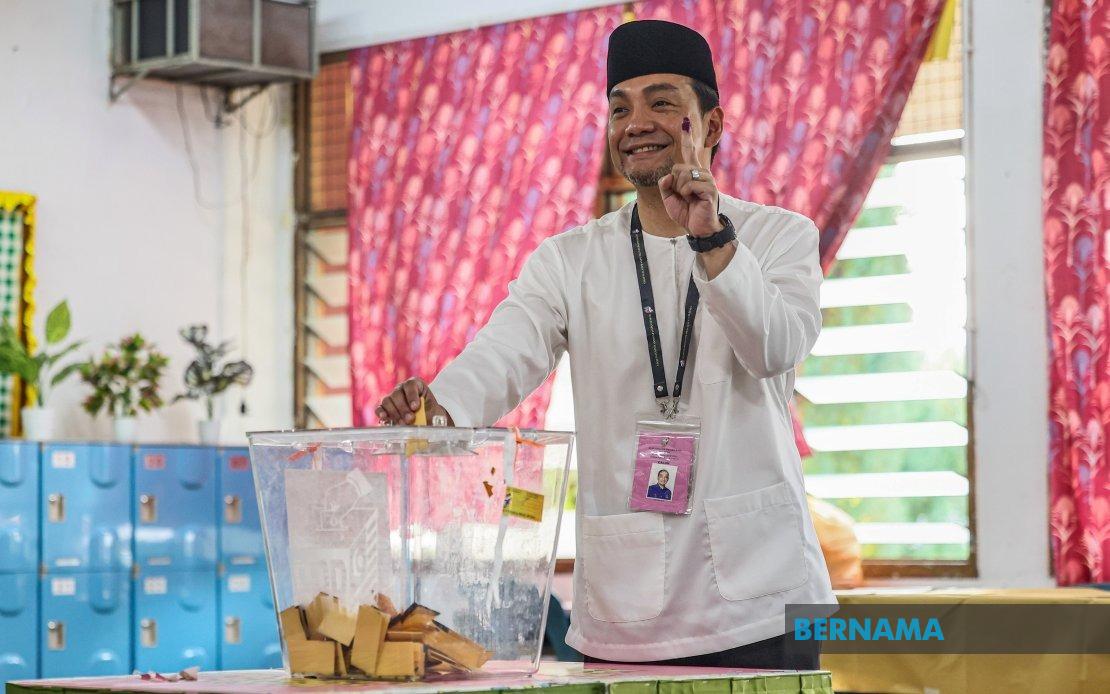
Johor Menteri Besar Datuk Onn Hafiz Ghazi exercised his democratic right on July 11 when he voted in the 16th Johor state election at Sekolah Kebangsaan Simpang Renggam, arriving at the polling station at 8.33 am. As chairman of the Johor Barisan Nasional chapter, Onn Hafiz represents the ruling coalition's bid to retain control of the state government, though his personal contest has narrowed to a two-way affair with his Pakatan Harapan opponent.
Before entering the polling booth designated as Stream 4, the Menteri Besar engaged in the customary pre-election ritual of conversing with fellow voters who were queuing to cast their ballots. Such interactions serve a dual purpose in Malaysian electoral culture—they project accessibility and political engagement while reinforcing the personal connection between candidates and constituents at the grassroots level. For an incumbent seeking validation for a second term, this visibility matters significantly in shaping the narrative of continuity and commitment.
Onn Hafiz faces a straight contest against Nur Hafiz Roslan, the Pakatan Harapan standard-bearer in his constituency. The bipolar nature of this particular race reflects the broader political consolidation that has characterised Malaysian elections since the 2018 general election, with the two major coalitions dominating most competitive seats. For Onn Hafiz, this configuration presents both opportunity and risk—opportunity because straight fights between established parties tend to favour incumbents with administrative resources, yet risk because any swing toward the opposition carries greater consequence when there is no split opposition vote.
Immediate upon completing his vote, Onn Hafiz spoke to the assembled press and articulated a public appeal for voter participation. He stressed the importance of early polling to discharge the civic obligation that comes with democratic citizenship, while also emphasising the practical consideration of ensuring orderly and efficient conduct throughout polling day. Such messaging reflects the election commission's ongoing concerns about voter turnout and the logistical challenges posed by concentrated voting during peak hours. For an incumbent administration, high turnout often correlates with stronger performance, particularly in well-organised constituencies.
Across the state, parallel voting activities underscored the contest's complexity and the multi-layered nature of electoral competition in Johor. The Puteri Wangsa constituency, situated in the same Simpang Renggam polling area where Onn Hafiz voted, presented a starkly different electoral landscape. Here, Dr Maszlee Malik, the Pakatan Harapan candidate and former federal education minister, arrived at SJK (C) Tuan Poon at 8.58 am to cast his ballot, entering a considerably more crowded field than the Menteri Besar faced.
The Puteri Wangsa five-cornered contest demonstrates the fragmentation that continues to characterise Malaysian electoral politics outside the direct BN-PH binary. Dr Maszlee competes not only against Teow Chia Ling of the governing Barisan Nasional coalition but also against Rashifa Aljunied of MUDA, Nicholas Paul Vincent representing Parti Bersama Malaysia, and an independent candidate, Wang Wee Siong. This multiplication of contestants introduces strategic complexity for voters and creates opportunities for unexpected outcomes when the opposition and independent vote fragments across multiple non-establishment options.
Dr Maszlee's presence as a PH candidate carries particular significance given his previous service as education minister in the Pakatan Harapan-led federal government of 2018 to 2020. His transition from federal ministerial office to state electoral politics reflects the recalibration that opposition parties have undertaken following their loss of federal power in March 2020. For many established PH figures, state-level elections have become the arena where credibility and electoral viability must be re-established, making contests like Puteri Wangsa consequential for the broader opposition narrative.
The presence of MUDA in the Puteri Wangsa race underscores the emergence of a third political force that has gained traction particularly among younger urban voters seeking alternatives to the traditional BN-PH dichotomy. Since its registration in 2021, MUDA has positioned itself as representing reform-minded politics unburdened by the baggage of either ruling or recently-defeated opposition establishments. The party's decision to contest multiple Johor seats signals confidence in its ability to convert youthful electoral enthusiasm into tangible political representation.
Pacoal Bersama Malaysia's participation in the Puteri Wangsa contest reflects another dimension of Malaysia's increasingly pluralistic electoral environment. The party, founded in 2022, represents an attempt to create political space for those who wish to challenge establishment orthodoxy without aligning with the more ideologically defined opposition coalition. Such parties face an uphill struggle in converting protest sentiment into durable political structures, yet their persistent appearance across multiple elections suggests they articulate genuine grievances within significant voter segments.
The Johor state election, encompassing contests across multiple constituencies with varying demographic profiles and political histories, serves as a crucial barometer for the post-pandemic recalibration of Malaysian politics. Unlike federal elections, state contests allow voters to make choices specifically calibrated to state-level governance without the complicating factor of determining which coalition controls national government. This distinction has become increasingly important as Malaysian federalism has evolved, with state governments claiming greater policy autonomy and electoral significance.
For Johor specifically, the election held particular weight as the second-most populous state and traditionally a bastion of Barisan Nasional support. The state's economic importance, tied to its proximity to Singapore and role as a manufacturing and logistics hub, means that governance performance directly impacts business confidence and investment patterns across Southeast Asia's second-largest economy. Performance in Johor therefore carries implications beyond state politics, influencing market perceptions of Malaysia's political stability and economic governance.
The polling day activities captured here—from the Menteri Besar's early morning participation to the parallel contests across multiple constituencies—reflected the quotidian reality of Malaysian democratic practice. While national elections dominate international attention and domestic media focus, state elections like Johor's involve intricate local dynamics, candidate quality, and constituency-specific issues that ultimately determine electoral outcomes. The straightforward nature of Onn Hafiz's contest contrasted sharply with the crowded fields in constituencies like Puteri Wangsa, illustrating how the electoral map fragments differently across geography and time.

