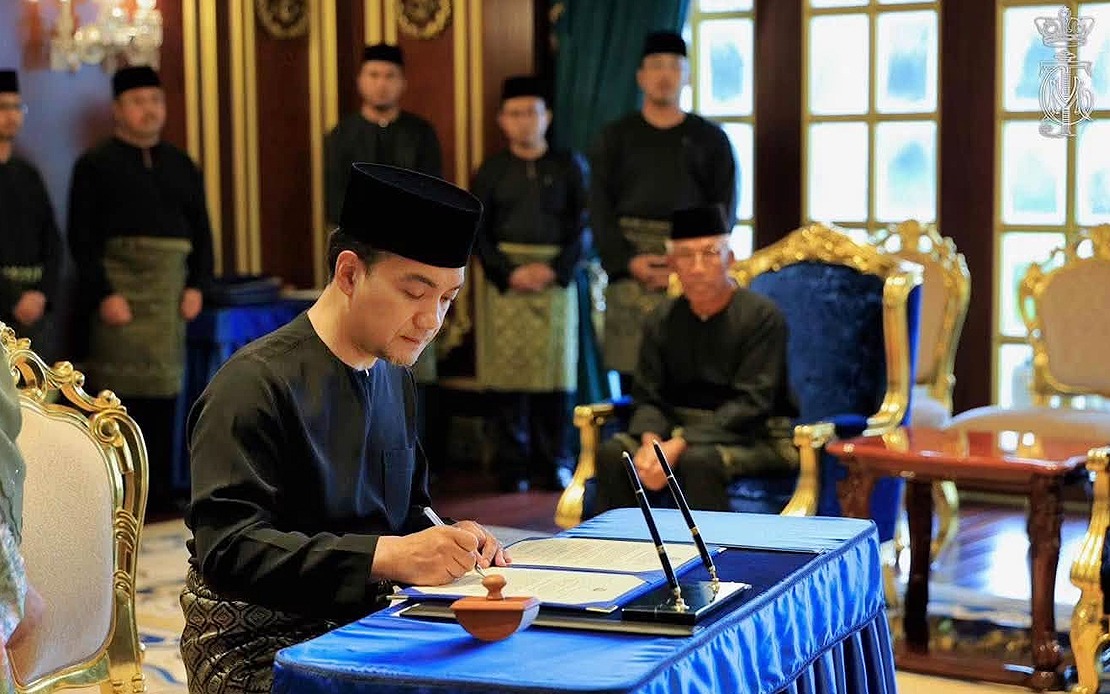
Datuk Onn Hafiz Ghazi has assumed office for a second term as Johor Menteri Besar, taking the oath before the Regent of Johor, Tunku Mahkota Ismail, at Istana Bukit Serene following Barisan Nasional's decisive victory in the state election. The 48-year-old's renewed mandate comes after the coalition captured 48 of the state's 56 seats, a substantial improvement over the 40 seats BN secured in 2022, providing him with considerably enhanced political capital to pursue his governance agenda over the next five years.
Onn Hafiz enters his second term as custodian of one of Malaysia's most storied political lineages. He is the great-grandson of Datuk Onn Jaafar, the late founder of UMNO and Johor's seventh Menteri Besar, and the grandson of Tun Hussein Onn, Malaysia's third Prime Minister. This genealogical connection to two towering figures in the nation's political and institutional history has shaped both his political identity and the expectations surrounding his leadership. The weight of this inheritance is particularly pronounced in Johor, where the family's influence has endured across generations and remains central to the state's power structures.
Born on March 2, 1978, Onn Hafiz's professional trajectory before entering electoral politics distinguishes him from previous generations of his family who came to power primarily through political networks. He completed his early education at the Royal Military College before obtaining a degree in accounting from the University of Hertfordshire in the United Kingdom. This international education and subsequent career in the corporate sector have positioned him as a technocrat within UMNO's leadership ranks, bringing management expertise and a results-oriented approach to state administration.
His professional background spans two decades of business experience prior to his 2022 appointment as Menteri Besar. He spent three years with the international audit and consulting firm PricewaterhouseCoopers between 2001 and 2004, gaining exposure to corporate governance and strategic planning at a multinational level. Thereafter, he transitioned into the private sector, holding several senior positions including directorships at Chin Well Holdings Berhad and serving as chief executive officer of KMB Sdn Bhd until 2013. This commercial and administrative experience has visibly influenced his governance philosophy, which emphasises operational efficiency, private sector partnerships, and measurable economic outcomes.
Onn Hafiz's entry into active politics occurred gradually rather than as an immediate family succession. Between 2012 and 2018, he served as a member of the UMNO Youth executive council and chief of the Sembrong UMNO Youth division, building grassroots credibility within the party's organisational structure. Simultaneously, from 2013 to 2018, he worked as political secretary to the defence minister, providing him with exposure to federal-level governance and policy formulation. This combination of party activism and ministerial experience created a balanced profile that distinguished him from purely political operators within UMNO.
His electoral debut came in 2018 when he successfully contested the Layang-Layang seat in the 14th General Election, securing a parliamentary mandate that served as his launching pad for state-level politics. Following this victory, he was appointed chairman of the Johor Tourism, Youth and Sports Committee, a portfolio through which he demonstrated capacity for administrative responsibility at the state level. When the 2022 Johor state election occurred, he shifted his electoral base to the Machap state seat, which he won decisively. This victory positioned him as a leading contender for the Menteri Besar position when BN formed government, and his appointment on March 15, 2022, followed organically from his legislative success and demonstrated competence.
Since assuming the position of Johor's 19th Menteri Besar nearly four years ago, Onn Hafiz has oriented state policy around the "Maju Johor 2030" development blueprint. This long-term strategic framework prioritises economic diversification, sectoral expansion, and the attraction of foreign and domestic investment to the state. Rather than pursuing politically populist quick-win initiatives, this agenda reflects his corporate background and suggests a preference for sustained structural development over short-term political advantage. The framework encompasses infrastructure expansion, investment in human capital, and positioning Johor as a regional economic hub competitive with neighbouring jurisdictions in the region.
Within UMNO's party structures, Onn Hafiz has progressively consolidated influence over the state organisation. Since 2023, he has served as chairman of the Johor UMNO Liaison Committee and chief of the Simpang Renggam UMNO division, representing both formal party authority and grassroots organisational control. Previously, from 2018 to 2023, he had served as deputy chief of the same division, indicating a methodical elevation of rank within party hierarchies. These positions ensure that his authority extends beyond the state administration into UMNO's electoral machinery, providing him with substantial control over candidate selection and party campaign strategies during future electoral cycles.
Onn Hafiz's position differs markedly from that of his grandfather, Tun Hussein Onn, who reached the Prime Ministerial office during an era when political advancement operated through very different mechanisms. Similarly, his great-grandfather Datuk Onn Jaafar, though a pioneering nationalist figure and UMNO founder, governed in an earlier constitutional and institutional context. By contrast, Onn Hafiz operates within a mature democracy with established competitive mechanisms, institutional constraints, and heightened expectations for technical competence in administration. His corporate background and emphasis on measurable development outcomes suggest an attempt to modernise the family's political brand while retaining its historical authority.
The BN's improved electoral performance in 2022 relative to 2022, gaining eight additional seats, indicates that Onn Hafiz's governance approach has achieved sufficient resonance with Johor voters to warrant expanded support. Whether this reflects satisfaction with "Maju Johor 2030" implementation, broader antipathy toward opposition parties, or simply the consolidation of BN's traditional base remains analytically ambiguous. However, the expanded majority provides Onn Hafiz with substantially greater legislative flexibility to implement policy initiatives without dependence on independent assemblymen or coalition partners, potentially enabling more decisive executive action during his second term.
The political implications of this victory extend beyond Johor itself. As a senior figure within UMNO and a member of the party's younger generation of leaders, Onn Hafiz's continued success at the state level may position him as a contender for higher national office as the party navigates leadership transitions in coming years. His combination of family pedigree, technical competence, and demonstrated electoral success represents a profile that UMNO's elite may increasingly value as the party seeks to rebuild its national position following electoral setbacks. The consolidation of his authority in Johor provides a geographic power base from which such ambitions might be launched.
Looking forward, Onn Hafiz faces the challenge of translating his expanded electoral mandate into tangible development outcomes that maintain public confidence through the second term. The "Maju Johor 2030" agenda requires sustained investment, effective implementation capacity, and resilience against economic downturns or unforeseen disruptions. His corporate experience provides him with frameworks for project management and performance measurement, yet translating private sector efficiency into democratic governance remains inherently complex. The state's economic performance over the next five years will substantially determine whether his second term consolidates the family's political legacy or whether the Onn-Hussein dynasty proves vulnerable to the competitive pressures of contemporary Malaysian politics.

