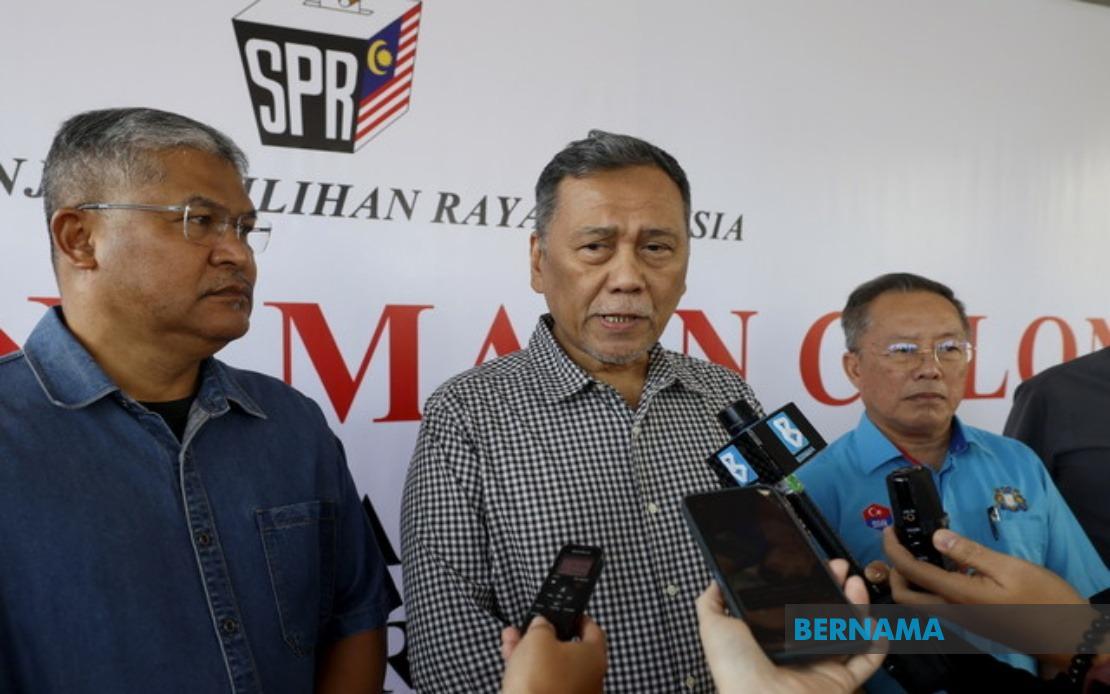
With the Johor state election entering its crucial nomination phase, the Election Commission has disclosed that 593 nomination forms have been distributed across the state, yet just 133 candidates have taken the decisive step of submitting their deposits. Election Commission chairman Datuk Seri Ramlan Harun indicated during a media briefing in Johor Bahru that these figures represented activity up to the morning of June 26, with the formal nomination process set to commence the following day. The relatively modest deposit conversion rate—roughly 22 percent of forms sold—suggests many interested parties were still evaluating their candidacy or managing last-minute logistical hurdles.
Ramlan projected that candidate numbers would climb substantially during the final hours before nomination opened, as prospective contenders rushed to complete administrative requirements. The tight timeline meant the Election Commission anticipated a surge in deposit payments throughout the nomination day itself, a pattern common in Malaysian state elections where candidates often submit documentation at the eleventh hour. He encouraged those intending to contest to arrive early, framing punctuality as essential for maintaining the smooth operation of the nomination centres scattered across Johor's 56 constituencies.
The Election Commission had undertaken meticulous preparation for the nomination process, conducting two consecutive days of dry runs across all 56 nomination centres to identify procedural bottlenecks and test security protocols. Ramlan provided assurance that physical infrastructure and staffing arrangements were in place, though such preparations often face real-world pressures when hundreds of candidates, supporters, and officials converge on nomination venues simultaneously. The scale of logistics required to manage nominations across such a geographically dispersed network underscores the complexity of administering state elections in Malaysia's second-largest state by population.
Security considerations loomed large in the Election Commission's planning. Ramlan pointedly reminded all political parties, their candidates, and grassroots supporters to adhere strictly to regulations and refrain from provocative behaviour that might spark confrontations at nomination centres. Such warnings reflect the charged atmosphere that typically surrounds Malaysian elections, where passionate supporters sometimes test the boundaries of acceptable conduct. The Maharani constituency returning officer, Zainal Eran, outlined specific measures designed to physically separate supporters of rival parties, permitting only each candidate, their official proposer, and a single designated supporter to enter the actual nomination centre, while other backers would occupy cordoned field areas facing partisan-specific barriers.
The multi-party competition expected in Johor reflects Malaysia's increasingly fragmented political landscape. Pakatan Harapan announced a comprehensive slate across all 56 seats, distributing candidates among its three components: PKR fielding 20 candidates, Amanah 19, and DAP 17. This coalition's presence across every constituency demonstrates its commitment to reclaiming ground in a state it governed until 2023, when Barisan Nasional and Perikatan Nasional secured a remarkable combined supermajority. Barisan Nasional's own decision to contest all 56 seats, with UMNO providing the bulk of candidates at 36, supplemented by 16 from MCA and four from MIC, signals its determination to consolidate power in a traditional stronghold.
Perikatan Nasional's candidate allocation reveals internal negotiations among its four component parties. PAS was assigned 11 seats, reflecting both its organisational footprint in Johor and ongoing power-sharing dynamics within the coalition. Bersatu received 16 seats, a substantial allocation for Muhyiddin Yassin's party that underscores its claimed status as a co-leader of the Perikatan bloc. The Malaysian Indian People's Party secured five nominations, while Pejuang, the newer vehicle for Mahathir Mohamad's political ambitions, received just one seat—a telling indication of the septuagenarian leader's diminished leverage within Perikatan despite his organisational efforts.
Smaller and emerging political entities demonstrated their desire to participate in Johor's electoral contest. The Malaysian United Democratic Alliance announced four-seat participation, while Parti Sosialis Malaysia targeted a single constituency, reflecting the fringe status of explicitly leftist politics in Malaysia. Most notably, Parti Bersama Malaysia declared its intention to field 15 candidates across Johor, marking its debut electoral contest at state level. The emergence of new parties contesting state elections underscores how Malaysia's political ecosystem continues evolving, with voters and organisers exploring alternatives beyond the established major coalitions.
The dissolution of the Johor State Legislative Assembly on June 1 set in motion a compressed but structured electoral calendar that gives candidates and voters relatively limited time for campaigning. The nomination process on June 27 would formally establish the field of competitors, followed by early voting on July 7 for military personnel and election workers, with the general polling day scheduled for July 11. This tight timeline means successful candidates would have only two weeks between nomination and election day to conduct their campaigns, intensifying the need for pre-existing campaign infrastructure and party machinery.
For Malaysian political observers and regional analysts, the Johor contest carries significance beyond state boundaries. Johor, as Malaysia's second-most populous state and historically a Barisan Nasional stronghold, serves as a crucial testing ground for broader coalitional dynamics and voter sentiment. The state's economic importance, its role as Malaysia's land bridge to Singapore, and its influence on national politics mean that results here often foreshadow national trends. The nomination figures and party distributions evident in this 2024 contest illustrate how Malaysia's political fragmentation has deepened since 2020, with voters and politicians no longer confined to binary choices between longstanding coalitions.
The diversity of candidates and parties participating in the Johor election also reflects how Malaysian electoral politics has localised in important ways. Candidates increasingly tailor their platforms to constituency-specific issues—whether those involve land development, infrastructure, or communal concerns—rather than purely national messaging. The nomination phase, despite its administrative appearance, fundamentally shapes which local voices gain platforms and which policy priorities receive formal hearing within the democratic process. As the 133 confirmed candidates and potentially hundreds more await nomination, Johor's political machinery prepares to process ambitions, calculations, and democratic participation.

