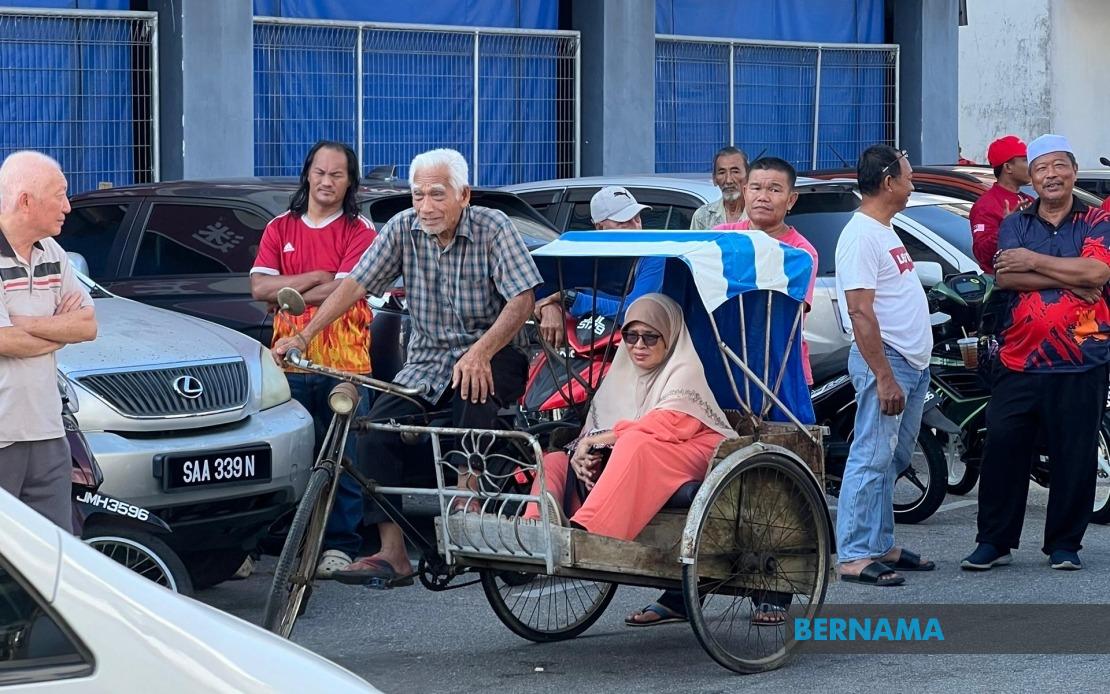
In the sweltering heat of a Johor afternoon, an 86-year-old religious leader chose the humblest form of transport to realise a cherished dream. Abdul Razak Pelangga, the imam of Masjid Raudhatul Jannah Parit Bugis, pedalled his trishaw nearly a kilometre from his home in Kampung Parit Bugis to a coffee shop in Senggarang, determined to grant his wife a long-held wish of seeing Prime Minister Datuk Seri Anwar Ibrahim in person.
The journey, undertaken in oppressive heat on July 5, reflected more than mere curiosity about a national leader. Abdul Razak carried with him a memory spanning decades—a previous encounter with Anwar years before his ascent to the premiership, when the latter had visited his mosque to lead congregational prayers. That brief interaction, remembered fondly as a moment of warmth and genuine connection, had lodged itself in Abdul Razak's mind as something worth preserving and sharing. When word reached him that the Prime Minister would be stopping at Kedai Kopi Hailam Sri Medan that morning as part of the PMX Meet-and-Greet Programme for the Senggarang state constituency, the opportunity seemed too significant to miss.
What makes Abdul Razak's choice of transport noteworthy is the deliberation behind it. Despite having access to more convenient alternatives—a car or motorcycle that would have been far less arduous in the oppressive weather—he selected the trishaw specifically to circumvent the practical complications of modern urban life. The quest for parking, a mundane frustration familiar to anyone navigating Malaysian towns, became the deciding factor. In an era increasingly dominated by motorised convenience, his decision reflected a preference for simplicity and purpose over efficiency. The trishaw, associated with traditional lifestyles and slower rhythms of community life, seemed the appropriate vessel for this intentional pilgrimage.
Abdul Razak's recollection of his earlier encounter with Anwar painted a picture of genuine affection rather than political partisan zeal. He described how Anwar had been notably approachable during that mosque visit, creating an impression of personable warmth that transcended the formalities usually associated with public figures. When he shared this memory with his wife, Jamilah Samsudin, it clearly resonated deeply enough to inspire her wish to see the Prime Minister herself. For many Malaysians, particularly those in smaller towns away from media epicentres, television broadcasts remain the primary window into the lives of national leaders, making live proximity to such figures feel like an extraordinary privilege.
The actual encounter, when it arrived, fell slightly short of direct personal interaction. The crowd that gathered at the coffee shop, drawn by the same magnetism that had inspired Abdul Razak's journey, was too large to permit intimate exchanges with every well-wisher. Yet the couple found satisfaction in proximity itself. Seeing the Prime Minister at close range, even without the hoped-for face-to-face conversation, delivered sufficient meaning to validate the effort and heat endured. This speaks to something often overlooked in political discourse—the human desire for connection with leaders, a sentiment that transcends rational political analysis and speaks to deeper needs for recognition and shared experience within the national community.
Anwar's visit to Batu Pahat, lasting approximately fifty minutes, served a calculated electoral purpose. The breakfast engagement formed part of campaign activities tied to the Johor state election, with Communications Minister and Pakatan Harapan Communications Director Datuk Fahmi Fadzil also in attendance. Such grassroots meet-and-greet programmes serve multiple functions in contemporary Malaysian politics—they generate local goodwill, provide opportunities for informal dialogue on community concerns, and create human-interest moments that resonate far beyond the immediate venue through media coverage.
The timing of Abdul Razak's civic participation adds another dimension to this narrative. He planned to cast his vote on July 11, a date coinciding with his eighty-seventh birthday, investing the act with personal significance beyond its electoral function. For him, voting represented a fundamental civic responsibility that became doubly meaningful when aligned with his life milestone. This perspective—viewing electoral participation as a privilege deserving respect and intentional engagement—reflects a generational attitude toward democratic processes that contrasts with the sometimes cynical or casual approach evident among younger voters.
The Johor state election schedule, with early voting beginning July 7 and primary polling set for July 11, created the compressed timeline within which these events unfolded. This relatively concentrated campaign period for a state election demonstrates how Malaysian electoral cycles at the subnational level maintain distinctive rhythms from federal elections, requiring different engagement strategies and often commanding less national media attention despite their local importance. Batu Pahat, as a smaller constituency within this framework, received a direct prime ministerial visit—an indicator of the competitive political landscape in Johor, where state-level contests carry significant implications for national coalition dynamics.
Abdul Razak's story illuminates the persistence of traditional community values and the continuing cultural resonance of personal encounters with authority figures, even in an increasingly digitalised society. His willingness to undertake discomfort in pursuit of a meaningful moment reflects values that remain prevalent throughout Malaysian society, particularly among older generations who came of age when such direct engagement with public figures was more feasible and expected. The trishaw journey itself—a deliberately chosen, labour-intensive mode of transport through harsh conditions—carries symbolic weight, representing a commitment to presence and participation that transcends the transactional nature of much contemporary political engagement.
Ultimately, the episode underscores how political significance operates at multiple levels simultaneously. While the morning served electoral purposes for Anwar and his coalition, for Abdul Razak and Jamilah it represented something more personal—a closing of a circle begun years earlier, a moment of validation for longstanding admiration, and an occasion to affirm their continued engagement with democratic processes. In the intersection of these narratives lies a fuller picture of how political leadership functions not merely as policy implementation but as a repository for human hopes, memories, and desires for connection that endure across decades and circumstance.

