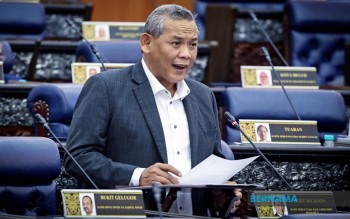
The debate over Tabung Haji's investment performance has taken on a more nuanced tone as Parliament examines findings from the Royal Commission of Inquiry, with Port Dickson Member of Parliament Datuk Seri Aminuddin Harun cautioning against attributing all losses to wrongdoing. Speaking during a special parliamentary sitting on the RCI report, the former Negeri Sembilan menteri besar stressed the need for measured discussion that acknowledges the inherent risks present in any investment portfolio, separating genuine market-driven declines from those rooted in poor judgment or institutional failure.
Aminuddin's intervention underscores a critical distinction often lost in public discourse surrounding the pilgrim fund manager. Every investment strategy, by its nature, carries exposure to market volatility and economic cycles. The challenge for stakeholders and policymakers lies in developing mechanisms capable of identifying which losses stem from unavoidable market fluctuations and which emerge from negligent decision-making, unresolved conflicts of interest, or breakdowns in governance frameworks. This analytical precision matters significantly for Tabung Haji's future credibility with the millions of Malaysian Muslims whose savings are held by the institution.
The RCI report itself, released publicly on July 29, provides a roadmap for distinguishing these categories. Spanning 211 pages and covering the period from 2014 to 2020, the inquiry identified systemic weaknesses in management and operations while recommending 25 separate improvements. Notably, 75 per cent of these recommendations had already been implemented by Tabung Haji as of late July, suggesting the institution has begun responding to the commission's findings. However, the narrow timeframe examined by the RCI has drawn criticism from parliamentarians, with some arguing that critical developments occurring after 2020 fell outside the investigation's scope.
Among the RCI's specific recommendations were forensic audits of 14 investments that experienced significant declines, a targeted approach designed to clarify the precise causes behind each loss. These forensic reviews carry particular weight because they potentially separate systemic issues from isolated incidents of poor stewardship. For Malaysian investors holding savings with Tabung Haji, such detailed analysis provides transparency about whether fund managers made decisions based on sound reasoning that subsequently encountered unfavourable market conditions, or whether governance lapses contributed materially to losses.
Aminuddin has directed particular attention toward the appointment processes that determine Tabung Haji's leadership and senior management ranks. He argues persuasively that the institution must be helmed by individuals whose credentials rest on genuine expertise and proven investment experience, rather than political patronage or personal connections to decision-makers. This observation resonates across Southeast Asia, where several major sovereign wealth funds and state-managed investment vehicles have encountered difficulties linked to leadership positions being filled as rewards for political loyalty rather than professional capability.
The former menteri besar's proposal extends beyond excluding active politicians from the board chair and membership roles. Instead, he advocates a comprehensive screening framework examining prospective board members across multiple dimensions: personal integrity, investment experience, Islamic finance knowledge, risk management competency, accounting and auditing expertise, legal understanding, corporate governance familiarity, and pilgrimage management background. Such multidisciplinary evaluation could substantially elevate the quality of board-level decision-making, particularly given Tabung Haji's unique position straddling commercial investment objectives with religious and social responsibilities toward Malaysian Muslims preparing for hajj.
Conflict of interest declarations would form an essential component of this enhanced appointment regime, creating formal mechanisms to identify and manage situations where board members or senior executives might derive personal benefit from institutional decisions. The absence of robust conflict management has plagued various Malaysian state-owned enterprises and government-linked companies over recent years, often resulting in suboptimal allocation of resources or misguided investments that damaged public confidence.
Yet Aminuddin's focus on future governance reforms contrasts with calls from some parliamentarians for more comprehensive historical scrutiny. Datuk Mohd Isam Mohd Isa, representing Tampin and sitting on the Public Accounts Committee, has proposed establishing a new RCI specifically covering 2021 to 2025, arguing that the existing commission's restriction to 2014-2020 left significant gaps. The period after 2020 witnessed important developments within Tabung Haji that warrant detailed examination alongside historical patterns, according to Mohd Isam's reasoning.
This tension between forward-looking reform and backward-looking investigation reflects genuine challenges in institutional accountability. The original RCI was established in 2021, with members appointed in January 2022, and submitted findings to the Yang di-Pertuan Agong in August 2022. The decision to limit its scope to 2014-2020 may have been deliberate, allowing the commission to examine a defined period without indefinitely extending proceedings. However, the Malaysian investment landscape shifted markedly following the pandemic's onset in 2020, affecting asset valuations, portfolio strategies, and market access worldwide.
Mohd Isam's proposal to refer Tabung Haji governance matters to the Public Accounts Committee provides an alternative accountability mechanism, potentially allowing deeper scrutiny of recent operational performance through a body with permanent oversight capacity rather than time-limited inquiry. This approach could address the temporal gaps raised by critics while operating within existing parliamentary structures and procedures.
For Malaysian citizens with Tabung Haji savings accounts, these parliamentary discussions carry direct relevance to their financial security and the institution's ability to support their hajj aspirations. The distinction between market-driven losses and governance-driven ones matters enormously when evaluating management competence and predicting future performance. Aminuddin's emphasis on distinguishing these categories, combined with structural reforms to board selection and strengthened conflict management, represents a substantive agenda for restoring confidence in an institution central to Malaysian Muslim financial life. The upcoming period will reveal whether parliamentary recommendations translate into durable institutional changes capable of preventing historical patterns from recurring.

