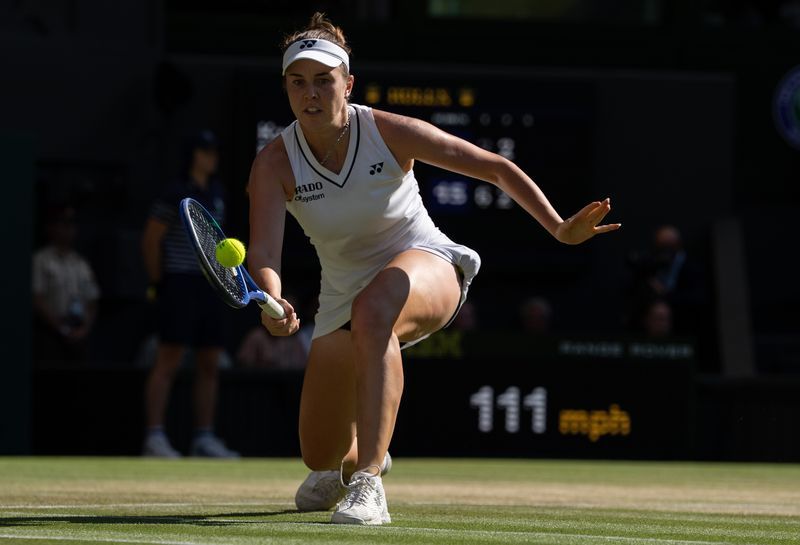
Linda Noskova's victory at Wimbledon represents one of tennis's most remarkable comebacks, a seventh-seeded performance that demonstrated the mental fortitude required to reach sport's highest levels. The 21-year-old Czech player claimed the Venus Rosewater Dish on Saturday, defeating compatriot Karolina Muchova in a final that saw her navigate one of the most challenging psychological moments in Grand Slam tennis. Few players at such a young age, competing in their maiden Grand Slam final, possess the emotional resilience to recover from the collapse that Noskova experienced.
Noskova's dominance in the opening stages suggested an inevitable procession towards the title. Leading 5-2 in the second set with the match apparently under complete control, she accumulated five separate match points across three service games of Muchova's. The ninth seed appeared destined to join the storied lineage of Czech women who have claimed the Wimbledon crown. However, Muchova's refusal to surrender, combined with mounting pressure that visibly affected Noskova's serving motion, triggered one of the most dramatic collapses in recent final history. Three points dissolved at 5-2, another evaporated when her opponent double-faulted at 5-3, and a fifth opportunity vanished in the ninth game as Muchova's fighting spirit gained momentum.
The psychological weight of the collapse became evident as Muchova reeled off five consecutive games to force a deciding set. Noskova's body language betrayed her inner turmoil; she returned to her chair covering her ears against the crowd's roars, her initial confidence replaced by the shock of having victory snatched from her grasp. The mental reset required at this juncture would have been beyond many players' capacity, yet something pivotal occurred during her court break. Walking towards the bathroom, Noskova caught sight of the championship trophies and experienced an epiphany that would alter the trajectory of the final.
Speaking afterwards, Noskova recalled the transformative moment with striking clarity. She explained how, during her bathroom break, she splashed cold water on her face and consciously reframed the match as beginning anew. Yet the genuine turning point came when she encountered the trophies themselves. Her subsequent reflection—that she would not accept the smaller runner-up trophy but was determined to claim the prestigious one—crystallized her resolve. This moment encapsulated more than tactical adjustment; it represented a fundamental psychological repositioning, where she confronted the magnitude of her loss head-on and converted despair into unwavering determination.
Upon returning to court, Noskova faced the crucial test of holding serve in the opening game of the third set. This single game became disproportionately significant in determining the final's outcome. Having lost five consecutive games and squandered multiple championship points, holding serve would provide psychological momentum that losing would have rendered potentially catastrophic. Noskova held that game, and with it came an unmistakable shift in her play. Her timing on groundstrokes sharpened, her footwork became more decisive, and her tactical execution improved noticeably. When she eventually reached match point again at 5-3 in the third set—more than an hour after her first opportunity—she converted it decisively.
Noskova's post-match reflection on the opening game of the third set demonstrated mature tennis understanding beyond her years. She acknowledged that losing that game would likely have altered the entire tenor of the deciding set, suggesting the match might have unfolded entirely differently. The consistency of Muchova's comeback in the second set, where she won five games in succession, had established a template that might have repeated itself. Breaking this momentum through a decisive hold gave Noskova the psychological leverage required to consolidate and ultimately seal victory.
The Czech champion's poise reflects dimensions of her character extending well beyond competitive tennis. At 21, Noskova has demonstrated a philosophical maturity and worldview that provides context for her mental resilience under pressure. She wears a nose ring as a subtle expression of individuality and has discussed extensively the influence of her mother Ivana, who died from cancer two years before this triumph. These personal experiences have clearly shaped her approach to adversity and her capacity to maintain equilibrium when circumstances become overwhelming.
Noskova's character becomes further evident through her broader life priorities and engagement beyond tennis. During her previous off-season, she spent significant time volunteering in Zanzibar at a school, an experience that fundamentally altered her perspective on what constitutes genuine hardship. Upon returning from that period, she reflected openly on heightened appreciation for her circumstances and opportunities. This exposure to different realities provides crucial context for understanding how she processed the near-catastrophic collapse of her match position; in the broader tapestry of her life and concerns, the match represented a challenge to overcome rather than an existential threat.
Environmental concerns and broader social consciousness occupy considerable space in Noskova's worldview. She has explicitly identified herself as a nature enthusiast and has articulated plans to engage in environmental volunteering in the coming months and years. Growing up in a Czech forest village shaped her connection to ecological issues, and she has demonstrated active involvement in various crises through her voluntary work. These commitments suggest someone with perspective and purpose extending far beyond trophies and rankings, yet paradoxically, this very perspective may strengthen her resilience in competition by preventing her from catastrophizing individual defeats.
Noskova's achievement at Wimbledon carries particular significance within the Czech tennis tradition. She becomes the third Czech woman to win the tournament's singles title within a four-year span, representing an extraordinary concentration of excellence from a relatively small nation. At 21, she is also the youngest women's champion since fellow Czech Petra Kvitova claimed the first of her two Wimbledon titles in 2011. This lineage connects Noskova to a distinguished legacy and underscores how Czech tennis has positioned itself among the sport's elite producing nations for women's competition.
The broader implications of Noskova's triumph extend beyond individual achievement or national pride. Her path through the final—particularly her extraordinary recovery from multiple match points and psychological crisis—offers important lessons about resilience, perspective, and the mental architecture required for elite performance. The image of a young player standing before the championship trophies during her moment of deepest doubt, making a quiet commitment to claim the larger one, encapsulates the determination that separates champions from talented players.
Noskova's post-victory reflections indicated someone already processing the magnitude of her achievement. She emphasized that the two-week tournament will remain permanently etched in her memory, stating simply that everything she endured proved worthwhile. Her journey from psychological disintegration to triumph, from squandering five match points to converting the decisive one, has secured her place among tennis's most remarkable comeback stories. For Malaysian and Southeast Asian observers, her victory reinforces how young players with proper mental frameworks and perspective on life can overcome seeming catastrophe through determination and clarity of purpose.

