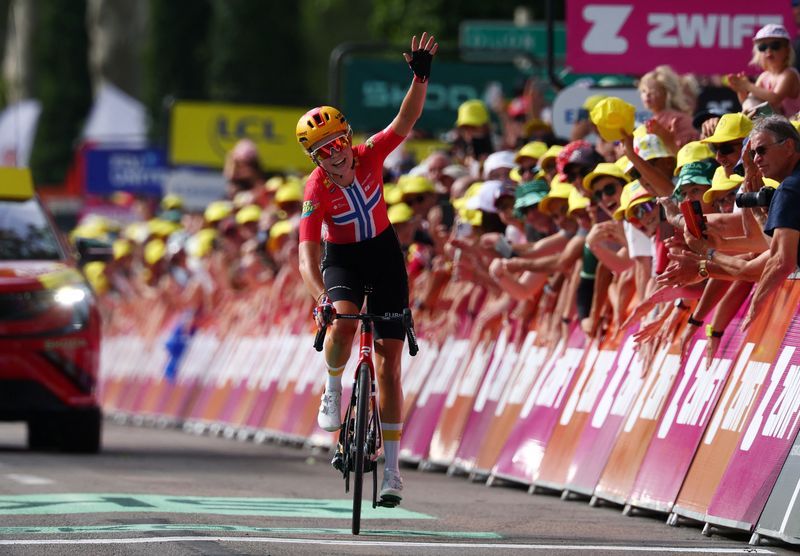
Sigrid Haugset of Norway delivered a landmark performance at the Tour de France Femmes, breaking through the tape in solitary glory to etch her name into cycling history as the first Norwegian ever to win a stage at the prestigious women's race. The 27-year-old Uno-X Mobility rider's dominant display across the 156.5-kilometre route also propelled her to the yellow jersey, making her the inaugural Norwegian woman to hold the coveted overall lead at the Tour de France Femmes.
Haugset's breakthrough moment came on a stage that moved the race into hillier terrain for the first time, setting the scene for the decisive moves that would reshape the general classification. After launching her attack during the climb to Col de la Savine, she gradually extended her advantage over the peloton, building the foundation for what would become an impressive margin of victory. The breakthrough attack succeeded where others faltered, as the race faced its first significant test of climbing prowess on what proved to be a challenging day for many of the field's top contenders.
Lotte Kopecky of Belgium emerged as Haugset's chief challenger, pursuing the Norwegian with characteristic determination in the second half of the stage. The Belgian's aggressive chase saw her narrow the gap to just 10 seconds with a mere 10 kilometres remaining, raising questions about whether Haugset could maintain her advantage through the gruelling final moments. Yet despite mounting physical exhaustion and the psychological pressure of having a formidable opponent breathing down her neck, the Norwegian found reserves of strength that allowed her to decisively pull away. Kopecky eventually crossed the line one minute and 24 seconds adrift, while Marianne Vos of the Netherlands completed the podium in third place at Poligny.
The victory came under circumstances that tested Haugset's mental fortitude as much as her physical capabilities. In a candid post-race reflection, she acknowledged the internal conflict that unfolded during the final kilometres, torn between the security of a prestigious second-place finish and the possibility of an even greater achievement. The cheers of her supporters back home in Norway ultimately galvanised her determination to push through the pain and exhaust, transforming that emotional connection into tangible competitive advantage when the outcome hung in the balance.
With her stage victory, Haugset assumed control of the general classification with an imposing lead of two minutes and 22 seconds over Kimberly Le Court of Mauritius. This substantial cushion positions the Norwegian as a serious contender for the final yellow jersey when the race concludes, though professional cycling's unpredictability means significant challenges certainly remain in the coming stages. The margin represents a commanding statement of intent, though equally reflects the narrow margins that typically separate success and failure at this level of elite competition.
The day's racing highlighted the physical and tactical demands that characterise the women's Tour de France at its most compelling. Early in the stage, a mass crash occurred during the category one climb to Col de la Faucille, bringing down several prominent riders including reigning world champion Magdeleine Vallieres and former Tour de France champion Demi Vollering. Both cyclists remounted and continued, though such incidents inevitably disrupt the rhythm of a race and compound the physical cumulative toll that builds through the three-week calendar. Notably, the peloton stabilised following the crash, with no breakaway attempts emerging during the remainder of the demanding 11.4-kilometre ascent.
The tactical situation entering the decisive closing kilometres favoured Haugset, as race leader Lorena Wiebes of the Netherlands found herself trailing by 13 minutes as the race entered its final 20 kilometres. This considerable deficit reflected how the day's attacks had fractured the field and shifted the balance of power within the peloton. With Wiebes struggling to keep pace and other general classification threats like Vollering sitting with the main group more than two minutes down, the race essentially revolved around Haugset and her pursuers, simplifying the tactical calculus considerably.
Haugset's performance carries particular significance for Norwegian cycling more broadly, breaking through a ceiling that had previously limited compatriots at the women's Tour de France. Her achievement opens a pathway for other Norwegian cyclists to aspire toward similar success at the sport's most prestigious event, potentially catalysing greater investment and interest in the sport within Norway. The symbolic importance of being the first Norwegian woman to don the yellow jersey transcends individual statistics, representing a generational milestone for the nation's cycling community.
The champion's understated reaction at the finish line, where exhaustion rendered her unable to celebrate with traditional flair, underscored the physical cost of her achievement. Despite her boyfriend's anticipated disappointment at her failure to acknowledge the moment with appropriate jubilation, Haugset simply lacked the physical reserves necessary for the customary celebration. This brutal honesty about the demands of elite cycling resonates with audiences who understand that such performances demand everything an athlete possesses, leaving nothing in reserve for the pageantry that normally accompanies victory.
Looking forward, the yellow jersey now rests on Norwegian shoulders as the Tour de France Femmes progresses through its remaining stages. Haugset's commanding lead and demonstrated mental resilience suggest she possesses the qualities necessary to defend her position, though the unpredictable nature of three-week stage racing ensures that dramatic shifts remain entirely possible. Her breakthrough performance has already altered the trajectory of the race, establishing new hierarchies and raising questions about which riders possess the form and tactical positioning to challenge her authority in the mountains and on the final time trial.

