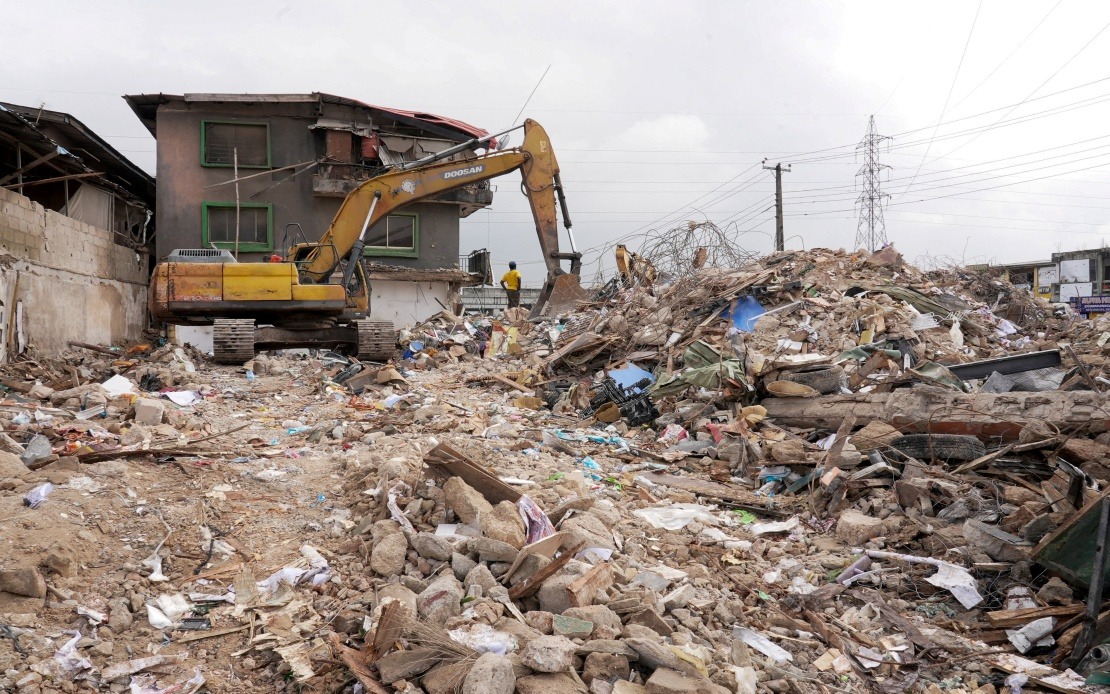
A devastating structural failure in Nigeria's commercial heartland has claimed nine lives and left dozens more injured following the collapse of a three-storey shopping complex in Lagos on Thursday morning. The incident, which occurred in Alakija, a rapidly developing satellite community situated along the congested Lagos-Badagry Expressway, prompted an immediate mobilization of emergency response teams that laboured continuously through the night to extract survivors trapped beneath tonnes of concrete and steel. By the conclusion of rescue operations on Friday, authorities had recovered the bodies of nine victims while successfully pulling 27 others to safety, many of whom sustained significant injuries requiring immediate hospitalization.
Olufemi Oke-Osanyintolu, permanent secretary of the Lagos State Emergency Management Agency, detailed the intensive rescue effort to news organizations, explaining how coordinated teams worked relentlessly to reach and evacuate those trapped in the debris field. The scale of the rescue operation underscored the challenging conditions responders faced, with emergency personnel excavating through multiple layers of collapsed building material to locate survivors. Those rescued were transported directly to medical facilities across Lagos for comprehensive treatment of their varied and sometimes critical injuries. The speed and coordination demonstrated by rescue teams highlighted the importance of established emergency protocols in densely populated urban areas where minutes can determine outcomes in structural disasters.
Investigators have launched formal inquiries to establish the underlying causes of the collapse, which remains officially undetermined at this juncture. Preliminary assessments suggest that the majority of those affected were commercial operators and their customers who were conducting regular business activities within the shopping complex when the structure failed catastrophically. Additionally, residents from adjacent neighbourhoods were among those trapped, indicating the building's central role in the community and the widespread impact of its failure.
The rescue effort drew participation from multiple organizations beyond traditional first-responders, including the China Civil Engineering Construction Corporation, which operates a substantial railway development project in the vicinity. This multi-agency collaboration demonstrated how major construction enterprises can rapidly contribute equipment and personnel to humanitarian emergencies, a model increasingly relevant as infrastructure projects expand across Nigeria and West Africa.
The incident represents the latest in a persistent pattern of structural failures across Nigeria that has drawn sustained criticism from urban planners, engineers, and safety advocates. Experts consistently identify three principal factors contributing to these recurring tragedies: the deteriorating condition of aging buildings that have not undergone proper maintenance or structural reinforcement; systematic non-compliance with established building codes and regulations that govern construction standards; and the widespread practice of using inferior or counterfeit construction materials that fail to meet engineering specifications.
Nigeria's rapid urbanization has created pressure for quick, affordable housing and commercial developments, often incentivizing cost-cutting measures that compromise structural integrity. The economic incentives favouring speed and reduced expenditure over safety compliance remain powerful, particularly in informal construction sectors where enforcement mechanisms are limited. Lagos, as the nation's largest city and primary economic centre, experiences this tension acutely, with constant demand for new commercial and residential spaces competing against the imperative for rigorous safety oversight.
For Malaysian observers, the Lagos collapse offers instructive parallels to urban development challenges in Southeast Asia. Malaysia has maintained relatively robust building codes and enforcement mechanisms compared to many developing nations, yet the region continues to grapple with informal construction, aging infrastructure requiring renewal, and pressure from rapid urbanization. The Lagos incident underscores why countries like Malaysia maintain stringent regulatory frameworks overseen by bodies such as the Malaysian Institute of Architects and local building authorities.
The tragedy also highlights the vulnerability of informal commercial sectors in developing cities, where shop owners and street-level traders often operate in structures that may not have undergone formal safety certification. Many victims in the Lagos collapse were individuals engaged in petty commerce, reflecting how building failures disproportionately affect lower-income populations who occupy less-regulated commercial spaces. This socioeconomic dimension of structural disasters receives insufficient policy attention in many developing nations.
Investigative authorities will likely examine construction permits, design documentation, and maintenance records to determine whether the collapse resulted from original design defects, inadequate construction execution, or accumulated structural degradation over time. Such inquiries typically reveal chains of negligence involving multiple parties: contractors who cut corners, developers who prioritize profit margins, inspectors who may have overlooked violations, and property owners who deferred maintenance investments. Understanding these causative chains remains essential for preventing recurrence.
The incident will likely prompt the Lagos State Government and Nigerian federal authorities to reinvigorate building safety campaigns and enforcement initiatives, though historical patterns suggest that such efforts often fade without sustained political commitment and adequate resource allocation. Structural disasters in major African cities frequently catalyze temporary attention before bureaucratic and financial constraints limit follow-through on reforms. Establishing permanent, well-funded building inspection regimes and strengthening penalties for violations represents the necessary but often elusive response required to genuinely reduce future incidents.
For regional observers in Malaysia and ASEAN, the Lagos collapse serves as a sobering reminder that even the most rapidly developing economies must prioritize building safety infrastructure and regulatory enforcement alongside commercial expansion. The distinction between disaster-prone cities and those with strong safety records ultimately hinges not on economic development level alone, but on the institutional capacity and political will to enforce standards consistently.

