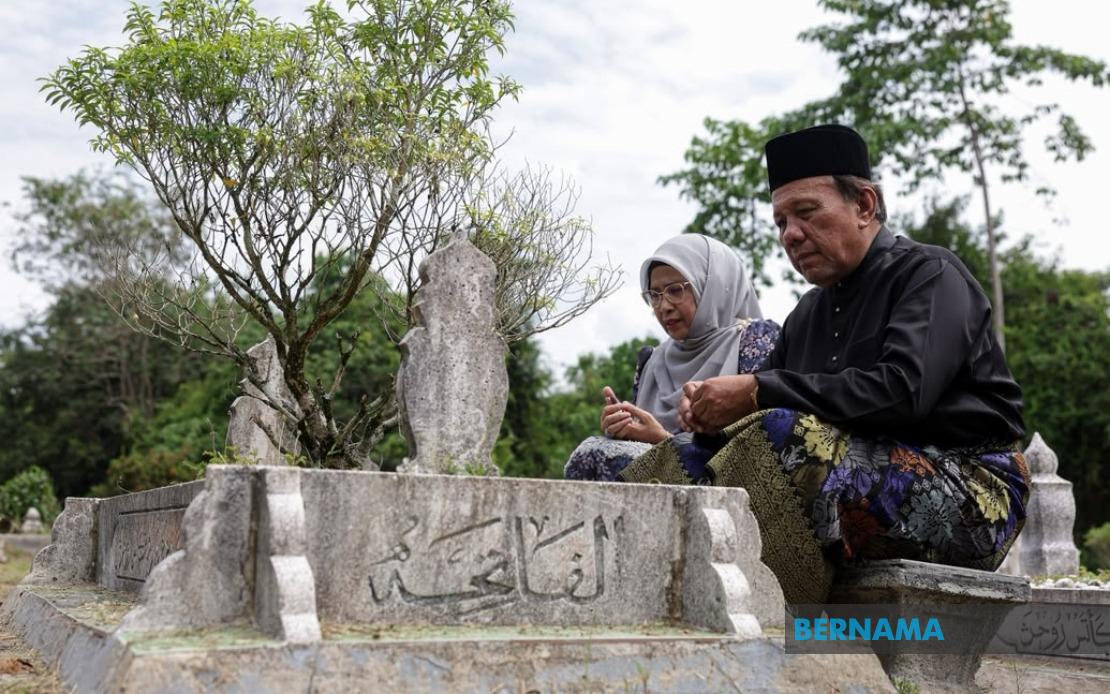
Datuk Ismail Lasim wasted no time in paying his respects to his ancestors after officially assuming the role of Menteri Besar of Negeri Sembilan. Accompanied by his wife Datin Noraishah Othman, the newly sworn-in chief minister journeyed to Tebing Tinggi Muslim cemetery in Kuala Pilah on the same day he took office, dressed in traditional formal Malay attire befitting the solemn occasion. The visit demonstrated a blend of personal devotion and cultural observance, reflecting the significance many Malaysian political leaders place on familial and spiritual obligations even as they step into demanding public positions.
Ismail's oath-taking ceremony took place before Tuanku Muhriz Tuanku Munawir, the Yang di-Pertuan Besar of Negeri Sembilan, at Istana Besar Seri Menanti. His elevation to the state's highest executive position came directly after his victory in the recent state election, where he secured the Juasseh state seat. The swift transition from electoral triumph to ceremonial office underscores the institutional efficiency of Malaysia's constitutional monarchy and state governance structures, allowing newly elected representatives to commence their duties promptly.
The cemetery visit carried particular emotional weight given the family history involved. Ismail's father, the late Lasim Yaman, had passed away nearly four years prior to this moment, in March 2020, at the remarkable age of 97. His mother, the late Bedah Othman, had preceded her husband in death, having departed in September 2014. By visiting their resting place so soon after taking office, Ismail signalled his respect for the generational legacy that shaped his values and trajectory, a common practice among Malaysian leaders who view such acts as grounding moments before embarking on significant responsibilities.
The timing of Negeri Sembilan's recent state election and the formation of its new government reflected broader political realignments across Malaysia's federal system. The 16th state election, held the day before Ismail's oath-taking, delivered a decisive outcome that would structure governance in the state for the ensuing term. The electoral results demonstrated continued support for established coalitional structures, with voter preferences coalescing around familiar political formations rather than fragmenting into numerous smaller entities.
Barisan Nasional's performance proved particularly commanding in this contest, securing 18 of the state assembly seats available. This substantial haul reflected the coalition's enduring appeal to Negeri Sembilan's electorate, reinforcing its position as a dominant force in Malaysian politics despite periodic challenges and criticism. The coalition's consistent ability to mobilise voter support across multiple states and federal territories continues to shape the country's political landscape, though observers note that margins and regional variations merit careful analysis.
Perikatan Nasional, the newer coalition that has gained prominence in Malaysian politics over recent years, captured seven state seats in the election. While this fell substantially short of Barisan Nasional's tally, it reflected the coalition's growing footprint in state-level politics and its capacity to attract voters in specific constituencies. The emergence and consolidation of Perikatan Nasional as a significant electoral force has introduced greater fluidity into Malaysian party politics compared to earlier decades when two-coalition dominance was less contested.
Crucially, the combined strength of Barisan Nasional and Perikatan Nasional in the state assembly translated into a commanding supermajority. With 25 seats secured between them in what appears to be a legislative chamber of 32 members, the two coalitions achieved the two-thirds majority threshold that grants extraordinary legislative and constitutional powers. This configuration enables the government to pass legislation and introduce state constitutional amendments without requiring opposition support, a significant advantage in executing policy agendas.
The formation of a collaborative government between Barisan Nasional and Perikatan Nasional in Negeri Sembilan represents a notable example of post-election coalition-building in Malaysian state politics. Rather than contesting power, the coalitions united to form the administration, a pattern increasingly observed in Malaysian governance following the 2018 federal election and its subsequent political upheavals. Such arrangements often reflect pragmatic calculations about stability, resource sharing, and the management of diverse interests within legislative chambers.
For Negeri Sembilan specifically, the new government structure headed by Ismail Lasim promises continuity in state administration while potentially incorporating policy perspectives from both coalitions. The state, traditionally an important component of Malaysian federalism, hosts significant agricultural, manufacturing, and services sectors that require careful policy attention. The supermajority enjoyed by the governing coalitions should facilitate relatively smooth passage of the state budget and development initiatives, though internal tensions between coalition partners occasionally emerge in Malaysian state governments.
Ismail's background as the representative for Juasseh and his elevation to the chief ministership reflects the importance placed on the Kuala Pilah area and its constituent constituencies within Negeri Sembilan's political geography. His connection to the district, evident through his family roots and now reinforced by his cemetery visit, may strengthen his political standing among constituents who appreciate leaders with deep community ties. This localism, balanced with state-level responsibilities, characterises much of Malaysian state politics.
The ceremonial and personal dimensions of Ismail's early actions as Menteri Besar highlight how Malaysian political life interweaves formal constitutional procedures with cultural and religious observances. His visit to his parents' graves, conducted with appropriate solemnity and family accompaniment, reflected values broadly shared across Malaysian society regarding filial piety and spiritual observance. Such moments, though sometimes overlooked in analyses focused on electoral mathematics and policy platforms, contribute to how political leaders establish their public identities and connect with citizens' expectations regarding moral character and cultural sensitivity.
Looking forward, Ismail's tenure will be tested by the state's development challenges, economic management, and the need to maintain cohesion within the two-coalition government structure. The supermajority provides substantial legislative flexibility, but effective governance requires more than numerical dominance. The new Menteri Besar must navigate state-federal relations, particularly given ongoing economic uncertainties affecting Malaysian states' revenue bases and development capacity. His early demonstration of cultural and spiritual grounding through the cemetery visit may serve as a foundation for building broader public confidence as he faces the practical demands of office.

