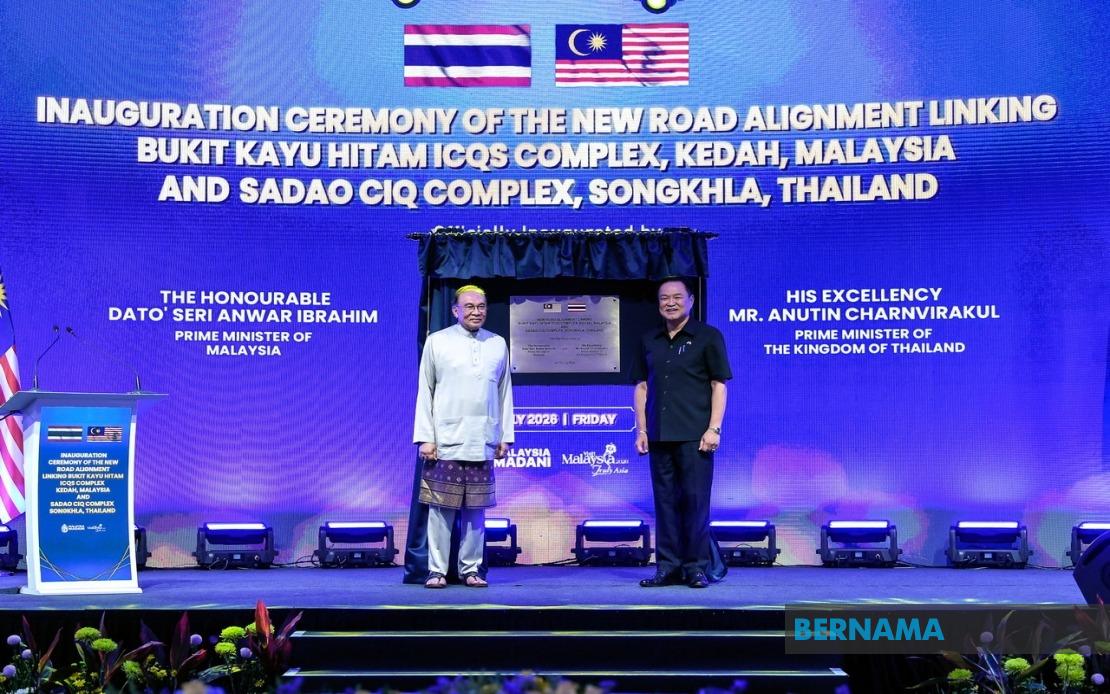
Prime Minister Datuk Seri Anwar Ibrahim has framed a newly launched road connection between Malaysia and Thailand as a transformative project that extends beyond routine infrastructure development to reshape the economic landscape of both nations' border regions. Speaking at Bukit Kayu Hitam in Kedah, Anwar described the new road alignment linking the Bukit Kayu Hitam Immigration, Customs, Quarantine and Security (ICQS) Complex and the Sadao Customs, Immigration and Quarantine (CIQ) Complex in Thailand as a historic milestone that will strengthen cross-border connectivity and facilitate deeper trade and economic cooperation.
The significance of this venture lies not merely in its physical infrastructure but in what it represents for bilateral relations and regional development strategy. Anwar characterised the project as a departure from conventional diplomatic engagement, positioning it instead as a concrete expression of political commitment to solving longstanding challenges that have historically complicated trade between the two countries. The roadway serves as the physical embodiment of efforts to break down barriers that have historically impeded the movement of goods and people across one of Southeast Asia's most important borders.
Central to Anwar's vision is the establishment of a special economic border zone spanning northern Peninsular Malaysia and southern Thailand. This framework would unlock development opportunities across five Malaysian states—Perlis, Kedah, Kelantan, Perak and Penang—by creating a deliberately designed corridor for commerce and investment. Such a zone represents a more structured approach than ad-hoc cross-border initiatives, offering businesses predictability and consistent policy frameworks. The Prime Minister acknowledged that constructing such an arrangement requires sustained effort and cannot be rushed, reflecting the complexity of coordinating economic policies across two sovereign nations with different legal and regulatory systems.
The launch ceremony, jointly officiated by Anwar and Thailand's Prime Minister Anutin Charnvirakul, signified high-level political commitment from both governments. Anutin's presence at the border—a symbolic gesture that underscores the importance of understanding communities beyond major metropolitan centres—demonstrated Thailand's seriousness in pursuing the initiative. The two leaders used the occasion to signal that their governments view border development not as peripheral to national interests but as central to prosperity for citizens in these regions.
Beyond infrastructure, both governments have outlined an ambitious agenda to resolve outstanding technical obstacles that currently frustrate traders and business operators. Malaysia and Thailand have committed to expediting the resolution of customs procedures, immigration protocols, fisheries regulations and trade-related disputes that have accumulated over years of negotiations. The speed with which both sides are approaching these issues suggests a genuine shift in diplomatic momentum. Anwar noted that some longstanding matters—issues that had consumed years or even decades of diplomatic engagement—were substantially addressed during recent high-level talks, demonstrating the effectiveness of direct political commitment to problem-solving.
Financially, the two countries are targeting a bilateral trade relationship worth USD30 billion by 2027, a significant increase that would require substantially improved cross-border infrastructure and smoother regulatory processes. The new road alignment directly supports this objective by reducing transit times and transaction costs for businesses moving goods between the two nations. Malaysian exporters seeking Thai markets and Thai businesses looking to access Malaysian distribution networks stand to benefit from reduced logistical friction. For regional supply chains integrated across the Malaysia-Thailand border, the improvements could yield measurable competitive advantages.
The initiative carries particular relevance for Malaysian readers given the direct benefits to northern states that have historically lagged other regions in economic development. Border communities in Perlis, Kedah and Kelantan have limited access to large regional markets and face geographic constraints that complicate economic diversification. A functioning special economic zone with Thailand could fundamentally alter growth trajectories for these areas by creating new employment opportunities and attracting regional investors seeking lower-cost production bases with access to both Malaysian and Thai markets. The zones could potentially become manufacturing and logistics hubs serving the broader Southeast Asian region.
From a Southeast Asian perspective, this development reflects broader trends toward deepening intraregional integration. ASEAN members have increasingly recognised that border regions, traditionally viewed as peripheral or problematic, can become engines of growth when properly managed and connected. Malaysia and Thailand's approach offers a template that other ASEAN nations may consider for their own cross-border initiatives, potentially strengthening the region's internal connectivity and economic resilience.
The timing of this initiative also reflects practical recognition of regional realities. With global supply chains increasingly fragmented across multiple countries, having efficient border crossing infrastructure and harmonised regulatory frameworks provides competitive advantages in attracting foreign direct investment. Companies considering manufacturing or distribution operations in Southeast Asia evaluate not only labour costs and political stability but also the ease with which they can move goods across borders and into neighbouring markets. Thailand and Malaysia's efforts to reduce friction at their shared border make their region more attractive to international investors.
Anwar's emphasis on political will as the key ingredient for progress highlights how technical and legal obstacles to cross-border cooperation are ultimately questions of priority and commitment. Many trade disputes and regulatory complications that plague Malaysia-Thailand relations have endured not because they are inherently unsolvable but because they were not priority issues for political leadership. By elevating border development and cross-border commerce to the level of prime ministerial attention, both governments signal that resolving these obstacles will receive the resources and political capital necessary for success.
Looking forward, the success of this initiative will depend on sustained implementation beyond the launch ceremony. The vision of a special economic border zone and the target of USD30 billion in bilateral trade require consistent follow-through from bureaucrats and officials on both sides of the border. Customs officials, immigration personnel and trade regulators must operationalise the agreements reached at leadership level. Private sector participation will also prove crucial, as businesses must actively shift trade patterns and investment to take advantage of the improved border infrastructure and regulatory environment.
The project also demonstrates how infrastructure investment and economic cooperation can advance diplomatic objectives. Rather than pursuing bilateral relations primarily through high-level state visits or formal diplomatic channels, Malaysia and Thailand are anchoring their relationship in concrete economic interests and tangible improvements to citizens' lives. Border communities in both countries—traders, small business operators and workers—stand to benefit most directly from smoother customs procedures and better transportation links, creating grassroots support for the bilateral relationship that complements official diplomatic engagement.

