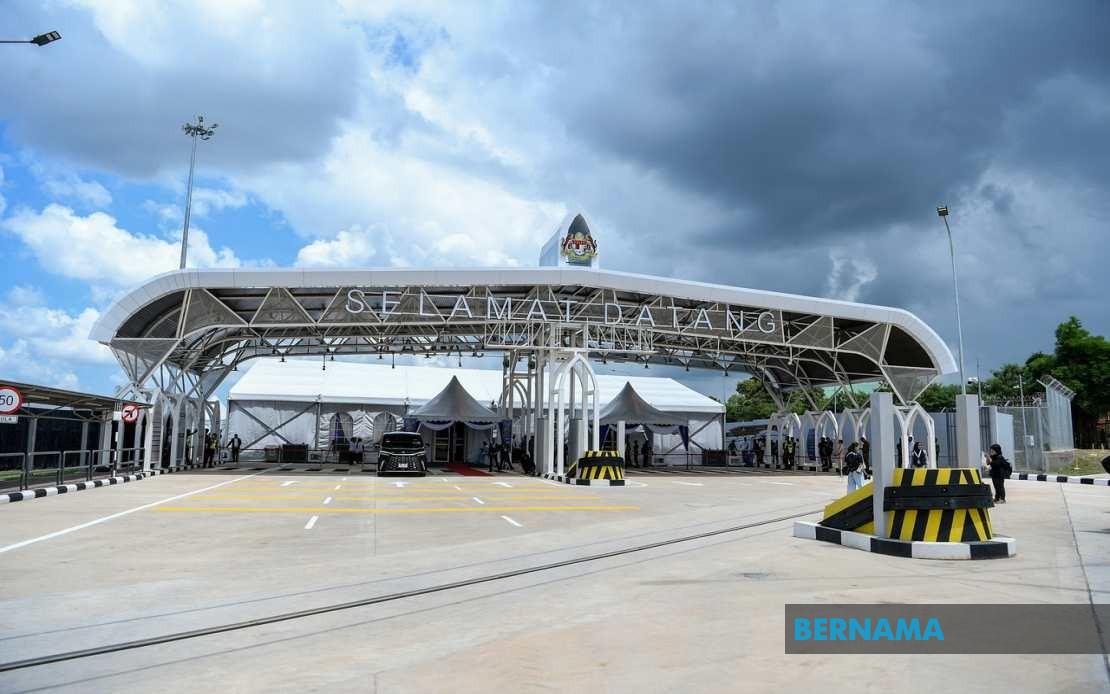
The newly opened border crossing at Bukit Kayu Hitam-Sadao is delivering tangible results for regional trade just weeks after its official launch, fundamentally reshaping how goods and people move between Malaysia and Thailand. The 900-metre corridor, which physically connects Kedah's Bukit Kayu Hitam Immigration, Customs, Quarantine and Security Complex with Thailand's Sadao Customs, Immigration and Quarantine facility, has achieved near-total adoption among commercial transporters in its opening month—a rare success story for infrastructure projects in Southeast Asia where implementation often lags behind intentions.
The transformation represents a significant operational breakthrough. Sadao Customs director Buntoon Oucharoen reported that nearly all commercial vehicles—lorries, buses, and vans—have migrated to the new route, virtually emptying the antiquated parallel pathway that previously bottlenecked traffic. What distinguishes this crossing is not merely wider lanes but genuinely modernised inspection capabilities. The introduction of advanced Fast Scan X-ray technology has compressed container scanning duration from five minutes to under sixty seconds, an tenfold acceleration that cascades through the entire supply chain. This technological upgrade, combined with direct computer-based cargo verification systems, eliminates the cumbersome queueing procedures that historically characterised this border point.
The volume metrics underline the crossing's strategic importance to both nations. Daily throughput now exceeds one thousand logistics vehicles, a staggering number that reflects not just increased capacity but genuine demand suppression previously caused by congestion. For Malaysian exporters, manufacturers, and trading companies, this efficiency gain translates directly into reduced transit times and lower operational costs—factors that determine competitiveness in time-sensitive sectors like agriculture, automotive parts, and perishables.
Bilateral trade figures validate the infrastructure investment's immediate economic impact. During July's final three weeks, Thai import volumes reached 19 billion baht (RM2.35 billion) against 12 billion baht (RM1.48 billion) for the equivalent 2023 period, representing a 58 percent year-on-year increase. Export performance proved even more dramatic, with July 2024 shipments totalling more than 24 billion baht (RM2.97 billion) compared to 13 billion baht (RM1.61 billion) previously—an 85 percent surge. These figures suggest that efficiency improvements directly unlock previously constrained trade volumes, indicating the old crossing had been suppressing natural demand.
The corridor's inauguration on July 10 by Thai Prime Minister Anutin Charnvirakul and Malaysian Prime Minister Datuk Seri Anwar Ibrahim symbolised shared commitment to regional integration, but the subsequent operational data proves substance behind the ceremony. Within days of commencing operations on July 11, the crossing demonstrated that modern border infrastructure, properly designed and staffed, becomes a genuine economic catalyst rather than a bureaucratic chokepoint.
Beyond freight, the crossing accommodates parallel tourism flows. The newly configured eleven inbound and eleven outbound lanes serve not only commerce but also leisure travellers, with particular benefit during weekends and public holidays when cross-border tourist movement typically peaks. Hat Yai's hospitality sector, represented by Sittipong Sitthiphataraprabha of the Hatyai-Songkhla Hotel Association, explicitly welcomed this infrastructure upgrade, recognizing that border efficiency directly affects tourist arrivals from Malaysia and regional visitors.
The broader Malaysia-Thailand trade relationship remains strongly positioned for expansion. First-quarter 2026 bilateral trade reached RM31.33 billion (US$7.90 billion), compared with RM27.35 billion (US$6.15 billion) during the same 2025 period, reflecting steady growth trajectory. Both governments have established an ambitious target of US$30 billion (RM122.6 billion) in annual bilateral trade by 2027, a goal rendered more credible given the infrastructure improvements now supporting cross-border transactions.
Looking forward, this crossing carries particular significance as Malaysia and Thailand prepare to commemorate the seventieth anniversary of diplomatic relations next year. The infrastructure investment demonstrates concrete commitment to deepening economic interdependence beyond ceremonial engagements. For Malaysian policymakers, the Bukit Kayu Hitam-Sadao success provides a replicable model for border modernisation—one where technology integration and coordinated bilateral planning generate immediate, measurable economic returns.
The crossing also reflects evolving Southeast Asian approaches to regional economic integration. Rather than relying solely on preferential trade agreements, both nations invested in physical infrastructure that removes friction from legitimate commerce. This pragmatic approach addresses the gap between theoretical trade openness and practical logistics reality that has historically constrained intra-regional commerce.
For Malaysian manufacturers and traders, particularly those operating in the northern regions, the new corridor represents competitive advantage. Companies previously disadvantaged by border delays can now compete more effectively in Thai markets, while Thai exporters gain improved access to Malaysian distribution networks. The 85 percent export surge in July 2024 suggests Malaysian sellers are actively exploiting this newfound efficiency.
The technological dimension merits emphasis for regional observers. The deployment of Fast Scan equipment and digital cargo tracking systems positions this crossing as an exemplar of modern border management, potentially influencing infrastructure decisions at other Southeast Asian crossing points. As supply chain digitalisation accelerates globally, border facilities that seamlessly integrate with electronic tracking systems become increasingly valuable.
Stability in bilateral relations undergirds this infrastructure success. Unlike some cross-border corridors hampered by geopolitical tensions or administrative discord, Malaysia-Thailand cooperation on this project remained consistent despite political transitions. Continuity across multiple governments on both sides reflected mutual recognition that cross-border trade infrastructure generates tangible benefits for ordinary citizens and businesses, transcending partisan considerations.
Moving forward, the crossing's success establishes foundation for potential expansion. Should demand continue growing at recent rates, both nations may need to contemplate additional capacity—whether through further lanes, extended operating hours, or enhanced processing technologies. The current month of operation suggests strong appetite for such investment.

